







Email: sales3@zhefanjewelry.com
Mastering Quality Assurance: How to Test 925 Silver Rings Quality at Scale for Manufacturers
This comprehensive guide for custom jewelry manufacturers explores advanced techniques for testing 925 silver rings quality at scale. From verifying the S925 stamp and gold plating as seen on elegant designs like the marquise-cut ring, to employing sophisticated methods like XRF analysis and durability assessments, we delve into ensuring every piece meets the highest standards. Understand crucial quality control steps for material composition, plating integrity, and secure stone settings, solidifying your brand's reputation for excellence.
- The Foundation of Fine Jewelry: Understanding 925 Sterling Silver
- Why Large-Scale Quality Testing is Crucial for 925 Silver Rings
- Method 1: Verifying the S925 Stamp and Beyond
- Method 2: Non-Destructive X-ray Fluorescence (XRF) Analysis
- Method 3: Assessing Plating Thickness and Adhesion
- Method 4: Evaluating Stone Setting Integrity and Durability
- Method 5: Comprehensive Visual Inspection and Finish Quality
- Partner with Zhefan Jewelry: Your Expert Custom Jewelry Manufacturer
- FAQ
The Foundation of Fine Jewelry: Understanding 925 Sterling Silver
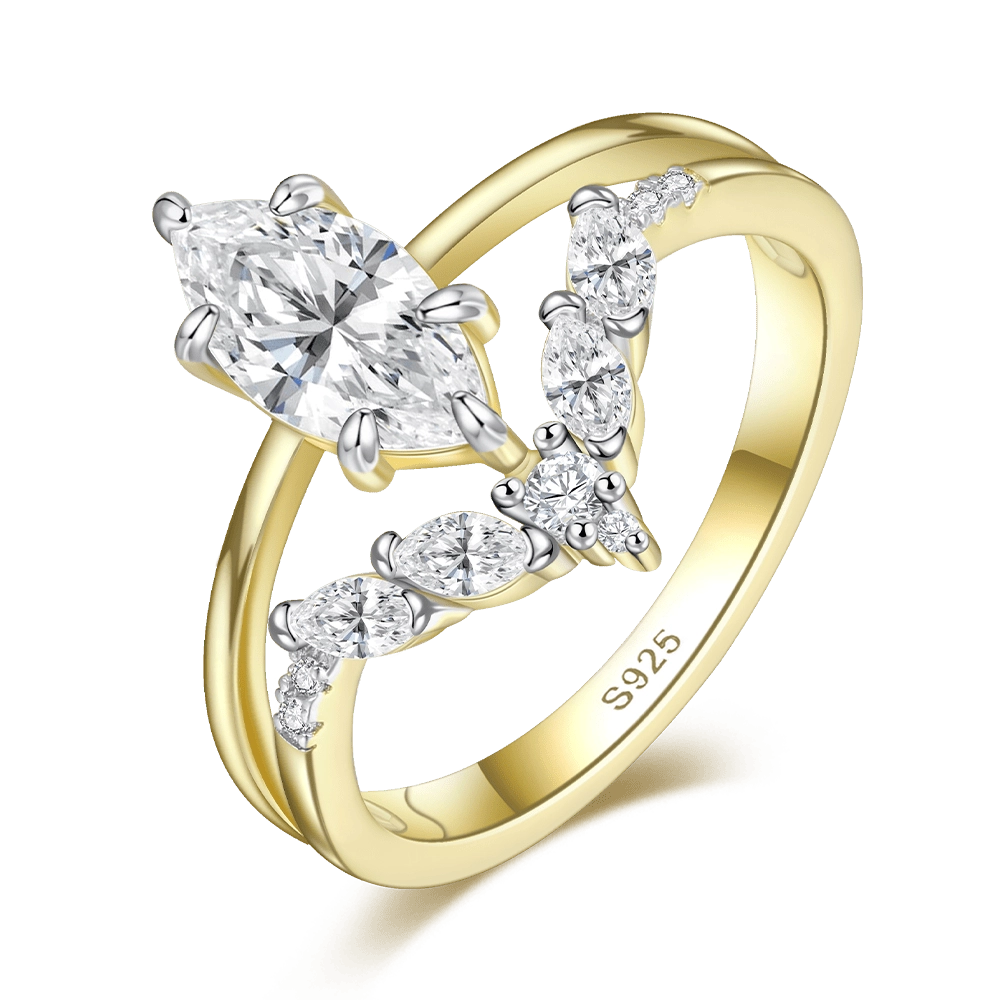
In the world of custom jewelry manufacturing, the integrity of materials is paramount. At Zhefan Jewelry, we understand that true quality begins with the base metal. 925 sterling silver, often marked with an 'S925' stamp as visibly etched into the beautiful gold-plated ring featured in our collection, represents an alloy of 92.5% pure silver and 7.5% other metals, typically copper. This specific composition provides enhanced strength and durability compared to pure silver, which is too soft for everyday wear. The ring pictured, with its intricate marquise-cut center stone and smaller accent stones, perfectly showcases how a high-quality S925 base can be transformed into a stunning piece, even when finished with a luxurious gold plating.
Why Large-Scale Quality Testing is Crucial for 925 Silver Rings
For any serious custom jewelry manufacturer, knowing
How to test 925 silver rings quality at scale?
is not just an advantage; it's a necessity. Producing hundreds or thousands of rings means that individual inspection isn't always feasible, yet consistent quality is non-negotiable for brand reputation and customer trust. Large-scale testing ensures that every piece, from its precious metal content to its stone settings, meets exacting standards before it reaches your inventory or your customers. This systematic approach is vital for maintaining product excellence and minimizing costly returns, making it a cornerstone for any reputable Custom Jewelry Manufacturer like Zhefan Jewelry.Method 1: Verifying the S925 Stamp and Beyond
The first indicator of a 925 sterling silver ring is often the 'S925' stamp, clearly visible on the inner band of the showcased ring. While this stamp is a standard marking for sterling silver, it's crucial to understand that stamps alone can be misleading. To truly verify authenticity, especially when performing a comprehensive process for
how to test 925 silver rings quality at scale?
, further testing is required. This initial visual check serves as a preliminary step before deploying more advanced analytical methods.Method 2: Non-Destructive X-ray Fluorescence (XRF) Analysis
For accurate and efficient material verification at scale, X-ray Fluorescence (XRF) technology is indispensable. This non-destructive testing method allows manufacturers to quickly and precisely determine the elemental composition of the silver alloy. XRF machines can confirm the 92.5% silver content, ensuring that the rings meet the sterling silver standard without damaging the finished product, including those with gold plating like the ring shown. This is a primary technique for confirming the true metal content when assessing
how to test 925 silver rings quality at scale?
.Method 3: Assessing Plating Thickness and Adhesion
For gold-plated 925 silver rings, the quality of the plating is as important as the silver itself. The stunning gold finish on the ring in the image highlights the aesthetic value of good plating. At scale, this involves testing for both plating thickness and adhesion. XRF can again be utilized to measure the thickness of the gold layer, ensuring it meets specified microns for durability and longevity. Adhesion tests, such as careful scratch or tape tests, verify that the plating will not easily chip or flake off, maintaining the ring's visual appeal and preventing premature tarnishing.
Method 4: Evaluating Stone Setting Integrity and Durability
The intricate arrangement of marquise and round brilliant-cut stones on the featured ring demands meticulous attention to setting integrity. For large-scale production, this involves systematic checks on prong security, bezel tightness, and overall stone alignment. Manufacturers employ vibration tests or controlled impact tests to simulate wear and ensure that all stones are securely fastened and will not loosen or fall out during normal use. This aspect of testing is critical for maintaining the high-end appearance and value of the jewelry, especially when dealing with varied stone cuts and sizes.
Method 5: Comprehensive Visual Inspection and Finish Quality
Despite advanced technological tests, a thorough visual inspection remains a cornerstone of quality control. At Zhefan Jewelry, this includes scrutinizing each ring for surface imperfections, scratches, uneven polishing, and proper alignment of all design elements. For rings like the one pictured, the brilliance of the stones, the smoothness of the gold plating, and the precise curves of the band are all meticulously checked. This final inspection step confirms that the aesthetic appeal and craftsmanship are flawless, reinforcing the brand's commitment to delivering superior products to custom jewelry manufacturers globally.
Partner with Zhefan Jewelry: Your Expert Custom Jewelry Manufacturer
Ensuring the consistent quality of 925 silver rings at scale requires not only sophisticated equipment but also deep expertise and a rigorous quality control framework. At Zhefan Jewelry, we pride ourselves on our comprehensive testing protocols that cover every aspect of production, from raw material verification to the final polished product. When you partner with us, you're not just choosing a Custom Jewelry Manufacturer; you're choosing a partner dedicated to delivering unparalleled quality and reliability in every single piece, whether it's an elegant marquise-cut gold-plated ring or a large-volume order of classic sterling silver bands. Trust Zhefan Jewelry to help you maintain your reputation for excellence.
FAQ
What does 'S925' on a ring mean?
The 'S925' stamp on a ring, as seen on the inner band of our featured ring, indicates that the item is made of 925 sterling silver. This means the metal composition is 92.5% pure silver and 7.5% other metals, typically copper, added to enhance its strength and durability for jewelry use.
Is gold-plated 925 silver considered real silver?
Yes, gold-plated 925 silver is considered real silver in its core material. The 'S925' stamp refers to the sterling silver base. The gold plating is a layer of gold applied over the sterling silver to give it a gold appearance, adding aesthetic value without changing the authenticity of the underlying silver.
What is the most reliable way to test 925 silver rings quality at scale?
The most reliable way to test 925 silver rings quality at scale for composition is through X-ray Fluorescence (XRF) analysis. This non-destructive method accurately determines the elemental percentages of the alloy, verifying the 92.5% silver content. Combined with plating thickness tests, stone setting integrity checks, and visual inspections, it forms a robust quality assurance strategy.
How does Zhefan Jewelry ensure the quality of gemstone settings in its rings?
At Zhefan Jewelry, we ensure the quality of gemstone settings through systematic checks on prong security, bezel tightness, and overall stone alignment, especially for intricate designs like the marquise and round brilliant-cut stones featured in our rings. We also employ controlled vibration or impact tests to simulate wear and ensure all stones remain securely fastened for lasting durability.
What common quality issues should a buyer look for in 925 silver rings?
Buyers of 925 silver rings should look for a clear 'S925' stamp (though not solely rely on it), even plating without bubbles or discoloration, securely set stones (no wobbling or gaps), smooth finish without scratches or sharp edges, and consistent design aesthetics. For gold-plated items, ensure the plating color is uniform and robust.
How often should a Custom Jewelry Manufacturer perform quality checks during production?
A reputable Custom Jewelry Manufacturer like Zhefan Jewelry should perform quality checks at multiple stages of production, not just at the end. This includes initial raw material inspection, checks after casting and polishing, during stone setting, and a final comprehensive inspection before packaging. This multi-stage approach is crucial for maintaining consistent quality at scale.
Tags
large order urn pendant necklaces
large order urn pendant necklaces
women's brass rings
women's brass rings
brass jewelry exporters
brass jewelry exporters
vintage style nickel free brass earrings
vintage style nickel free brass earrings
925 silver star hoop earrings
925 silver star hoop earrings
brass four leaf clover earrings
brass four leaf clover earrings
Recommended for you
CAD & 3D Printing in Custom Jewelry Production Explained
Seasonal Campaigns Featuring cubic zirconia brass jewelry
Sustainable Practices for Producing Gold Plated Earrings
Packaging ideas for 925 sterling silver nickel free jewelry
Product Categories
You may also like

925 Silver Jewelry
Customizable High-Quality Fashion 925 Sterling Silver AAA Cubic Zirconia Heart-Shaped Open Tennis Bracelet.
Read More

Brass Jewelry
Customizable OEM ODM High-Quality Fashion Brass AAA Cubic Zirconia Classic Tennis Bracelet for Women Wholesale.
Read More
Get a Quote for Private Label Jewelry
We provide personalized jewelry customization services for clients worldwide.
Rest assured that your privacy is important to us, and all information provided will be handled with the utmost confidentiality.
By clicking 'Send Inquiry Now' I agree to ZHEFAN JEWELRY processing my personal data.
To see how to withdraw your consent, how to control your personal data and how we process it, please see our Privacy Policy and Terms of use.
From design to production, ZHEFAN JEWELRY offers a one-stop solution to help you enhance your brand value and market competitiveness.
Get A Quote
Contact
Tel: (+86) 188 1927 7817
© 2026 Zhefan Jewelry. All Rights Reserved.
Facebook
Instagram
YouTube
Whatsapp: +8618819277817