







Email: service@holycome.com
Hypoallergenic brass earrings: materials and finishes to use
Hypoallergenic brass earrings require more than a copper-zinc base: buyers must control nickel, lead, cadmium, surface porosity, plating adhesion, polishing quality, and wear testing. The most reliable specification combines compliant brass, nickel-free barrier layers, premium gold or silver finishes, sealed surfaces, and documented inspections. This guide explains suitable materials, finish systems, quality checks, and OEM/ODM procurement considerations for brands sourcing safe, durable, and commercially scalable fashion earrings.
- How to Specify Skin-Friendly Brass Earring Materials
- Start with a controlled copper-zinc alloy
- Use nickel-free construction where consumer sensitivity matters
- Define the component architecture, not only the base metal
- Finishing Systems That Improve Comfort and Durability
- Choose a suitable plating stack
- Compare finish options by use case
- Polish, seal, and test the finished surface
- Procurement Controls for a Sensitive-Skin Earring Collection
- Build compliance into the purchase order
- Use a staged approval process
- Measure commercial performance alongside technical quality
- Why HOLYCOME Supports Scalable Custom Earring Programs
- Integrated manufacturing and finishing capability
- Documented quality controls and material responsibility
- Design velocity and international supply support
- Frequently Asked Questions
Hypoallergenic brass earrings are best developed through a controlled material-and-finish system rather than a marketing claim alone. For commercial jewelry programs, buyers should specify the brass alloy, restrict nickel, lead, and cadmium, define the plating stack, require smooth polishing, and validate finished components through supplier documentation and wear testing. Brass remains attractive for fashion collections because it supports detailed casting, efficient production, and accessible pricing, while finishes such as 14K or 18K gold plating, rhodium, silver, PVD, and protective e-coating can improve appearance and skin-contact performance. However, no metal is universally allergy-proof: individual sensitivity, coating damage, sweat, friction, and prolonged wear all affect consumer experience. A qualified custom jewelry manufacturer should therefore provide traceability, compliance evidence, sample approval, and process controls before bulk production.
How to Specify Skin-Friendly Brass Earring Materials
Start with a controlled copper-zinc alloy
Brass is primarily an alloy of copper and zinc, but commercial grades can differ substantially in composition, machinability, color, hardness, and corrosion behavior. For earrings, the selected grade should be consistent from batch to batch and suitable for stamping, casting, CNC work, or wire forming. A stable alloy helps reduce surface defects and makes polishing and plating more predictable.
Material selection should also address restricted substances. Buyers should request a material declaration and, where appropriate, laboratory test reports covering nickel, lead, cadmium, and other regulated elements. The European Union’s REACH Regulation includes restrictions relevant to substances in articles, including nickel release from products intended for direct and prolonged skin contact. Compliance should be evaluated against the destination market, because legal limits and documentation expectations vary by jurisdiction.
Use nickel-free construction where consumer sensitivity matters
Nickel is a common cause of allergic contact dermatitis, so it should not be treated as an invisible default in earring components. A nickel-free specification can apply to the brass substrate, plating layer, posts, backs, jump rings, and decorative findings. This detail is important because an earring may contain several metals, and a compliant visible surface does not compensate for a nickel-containing post that remains in direct contact with a piercing.
Gold-filled, sterling silver, and 925 silver components may be appropriate upgrades for posts or hooks when a brand targets sensitive-skin consumers, although the exact alloy and solder composition still require verification. For High Quality collections, solid 925 silver jewelry and gold vermeil jewelry can provide a stronger material story than plated brass, while brass remains useful for larger fashion silhouettes and cost-sensitive programs.
Define the component architecture, not only the base metal
A buyer’s technical specification should identify every skin-contact part: post, lever-back, French hook, clutch, connector, solder, coating, and decorative element. Pearl jewelry, enamel details, synthetic stones, and adhesives also require process control because residues or rough edges can create discomfort even when the metal itself is compliant.
For pierced earrings, the post diameter, tip geometry, burr removal, and back tension affect usability. A smooth, rounded post with a properly fitted clutch reduces snagging and mechanical irritation. The design team should also avoid narrow crevices that trap moisture or polishing compound, particularly in high-relief custom designs.
Finishing Systems That Improve Comfort and Durability
Choose a suitable plating stack
Gold plating is widely used on brass because it delivers a High Quality visual effect at a lower material cost than solid gold. A dependable stack commonly includes surface preparation, polishing, cleaning, an adhesion layer, a barrier layer, and the final decorative deposit. The barrier layer helps reduce migration from the brass substrate and supports more consistent color, but its chemistry must be disclosed and tested rather than assumed.
Rhodium and palladium-colored finishes can create a bright, cool appearance, while silver plating offers a softer white tone. Black, antique, and two-tone finishes require additional control because patinas and darkening agents may remain in recessed areas. Buyers should approve a physical sample under normal lighting and inspect both the face and the skin-contact side.
Compare finish options by use case
| Finish or material approach | Typical commercial advantage | Key risk to control | Recommended buyer verification |
|---|---|---|---|
| Gold-plated brass | Accessible High Quality appearance and broad color flexibility | Wear-through, color variation, and substrate exposure | Plating thickness specification, adhesion test, and nickel-release documentation |
| Rhodium-plated brass | Bright white appearance and strong visual contrast | Scratching or loss of brightness at friction points | Surface inspection, abrasion evaluation, and coating declaration |
| Silver-plated brass | Soft white appearance and cost efficiency | Tarnish and exposure of underlying brass | Tarnish assessment, protective topcoat review, and color approval |
| PVD-coated component | Hard decorative surface and strong color consistency when controlled | Edge chipping or incomplete coverage on complex geometry | Adhesion, edge coverage, and production sample inspection |
| 925 silver post or hook | Stronger High Quality and sensitive-skin positioning | Alloy variation, tarnish, or solder-related issues | Material certificate, hallmark policy, and solder composition review |
| E-coating or clear protective coating | Additional barrier against moisture and oxidation | Cloudiness, cracking, and inconsistent coverage | Coverage inspection, cure verification, and wear simulation |
The table compares practical sourcing choices rather than promising that one finish is universally hypoallergenic. Performance depends on thickness, preparation, geometry, handling, and the wearer’s biology. A useful reference for quality planning is ISO 10993-1, which provides a framework for biological evaluation of medical-device materials; it is not automatically a jewelry certification, but its risk-based logic illustrates why skin-contact materials should be assessed systematically rather than described with unsupported claims.
Polish, seal, and test the finished surface
Polishing is a functional operation, not only a visual step. Fine polishing removes casting texture, tool marks, sharp edges, and micro-burrs that can increase friction or create weak points in a coating. Cleaning must then remove oils, compound residue, dust, and processing contaminants before plating or sealing.
Durability checks should reflect the product’s expected use. Depending on the sales channel, a quality plan may include visual inspection, coating adhesion, abrasion, perspiration or artificial sweat exposure, tarnish observation, clasp operation, and dimensional checks. The ISO 3160-2 framework is associated with corrosion and resistance testing for gold alloy surfaces and can help buyers understand the importance of defined test conditions, although jewelry programs should select methods appropriate to their specific construction.
Procurement Controls for a Sensitive-Skin Earring Collection
Build compliance into the purchase order
A purchase order should state the approved base alloy, prohibited substances, plating color, minimum finish requirements, component materials, packaging conditions, and acceptable defect limits. Terms such as “hypoallergenic,” “nickel-free,” or “eco-friendly” should be linked to measurable criteria and supporting records. The World Health Organization’s chemical-safety resources reinforce the broader principle that chemical risk depends on exposure, hazard, and control measures.
Buyers should also distinguish between a supplier declaration and an independent laboratory report. A declaration explains the manufacturer’s material position; laboratory testing provides evidence for a defined sample and test method. Neither document should be treated as permanent proof for every future batch. Changes in alloy source, plating chemistry, subcontracting, or polishing materials can alter performance.
Use a staged approval process
An efficient sourcing workflow begins with a technical brief, followed by a prototype, a pre-production sample, and a sealed production standard. The sealed sample should show the approved color, texture, logo placement, post length, backing fit, and packaging. For repeat orders, retain a reference sample and require notification before any process or material change.
For private-label jewelry brands, this approach reduces the risk of receiving attractive samples that cannot be reproduced at scale. It also supports marketplace compliance, customer-service responses, and product liability management. Product descriptions should avoid absolute claims such as “safe for everyone.” A more defensible statement can identify the tested material and finish while advising consumers with known metal allergies to review the composition.
Measure commercial performance alongside technical quality
Low unit cost does not necessarily create the best margin. Returns, negative reviews, replating requests, inconsistent color, and delayed corrective production can exceed the initial savings from an uncontrolled finish. Buyers should evaluate total landed cost, first-pass yield, defect rate, reorder consistency, lead time, packaging protection, and supplier communication.
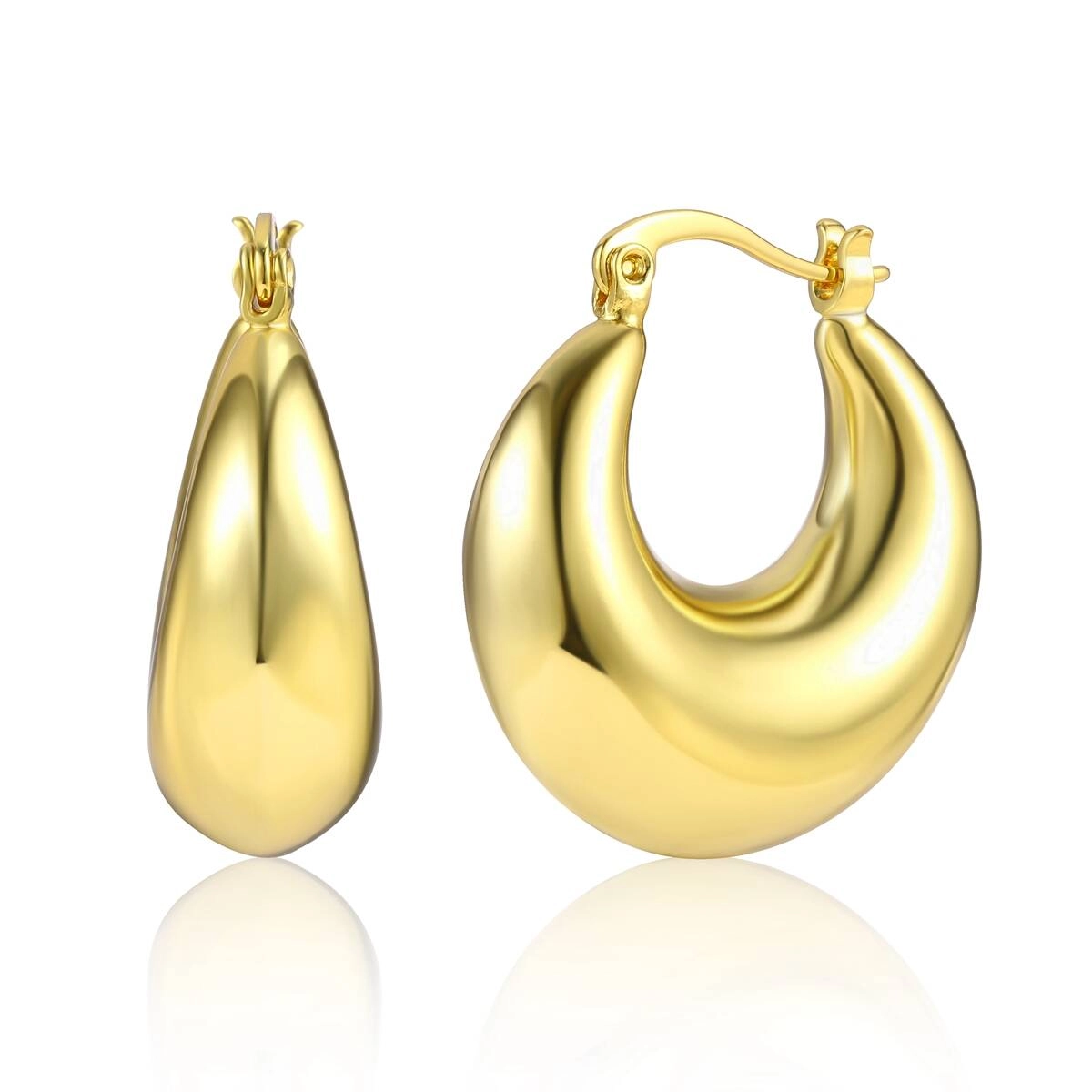
Design flexibility is another procurement variable. A supplier capable of producing textured hoops, sculptural drops, miniature charms, enamel accents, and mixed-material pieces can help a brand build a coordinated range. Brass jewelry can anchor accessible collections, while Sterling Silver Jewelry, gold vermeil jewelry, pearl jewelry, and mixed-metal designs support tiered pricing and visual merchandising.
Why HOLYCOME Supports Scalable Custom Earring Programs
Integrated manufacturing and finishing capability
Our team at HOLYCOME treats material selection, mold development, polishing, plating, assembly, and inspection as connected stages. Guangzhou HOLYCOME was established in 2002, with a manufacturing legacy dating back to 2016. Founded by a master mold craftsman, our operating culture is built around long-term refinement of tooling, surface preparation, and production consistency.
We operate two factories in Guangzhou and Meizhou across 800 square meters, supported by more than 80 skilled artisans and 20 sales professionals. Monthly capacity reaches approximately 600,000 pieces, allowing our partners to move from approved prototypes to commercial volumes without relying solely on fragmented outsourcing. This structure is valuable for brands that need synchronized production of earrings, necklaces, rings, bracelets, and coordinated accessories.
Documented quality controls and material responsibility
Our manufacturing process includes six rounds of precision polishing and six strict quality inspections. These checkpoints are designed to identify burrs, uneven plating, color inconsistency, loose components, surface contamination, and packaging defects before shipment. For sensitive-skin product lines, buyers can align the inspection plan with the agreed component specification and request relevant compliance documentation for the target market.
We use RoHS- and REACH-compliant eco-friendly materials according to the applicable product specification and destination requirements. Our capabilities cover brass jewelry, 925 silver jewelry, sterling silver designs, gold vermeil jewelry, pearl jewelry, and related OEM/ODM collections. This range enables brands to create good-better-best assortments without changing their entire supply structure.
Design velocity and international supply support
Our professional design team launches more than 500 original styles monthly, helping global partners respond to fashion cycles while reducing dependence on generic catalog products. Custom development can include mold creation, logo detailing, color matching, component substitution, packaging, and private-label presentation.
Our production experience includes service for leading Amazon sellers and global retail organizations such as Macy’s. The commercial objective is not simply to ship a finished accessory; it is to help brand owners achieve repeatable quality, faster market launches, and stronger product differentiation. Buyers evaluating a brass earring production partner can review our capabilities at HOLYCOME and request a project discussion through service@holycome.com.
For a new hypoallergenic-focused collection, the recommended brief should include the target consumer, destination markets, base alloy, nickel policy, post material, plating system, protective coating, color reference, test requirements, packaging, order quantity, and delivery schedule. With those parameters defined early, our engineering and production teams can recommend a practical construction that balances comfort, appearance, durability, compliance, and retail cost.
Frequently Asked Questions
Can brass earrings be hypoallergenic?
Brass earrings can be developed for sensitive-skin positioning when the alloy, posts, backs, solder, plating, and protective finish are controlled and tested. No metal is universally allergy-proof, so product claims should be based on documented composition and applicable testing.
Is nickel-free brass suitable for pierced earrings?
Nickel-free brass may be suitable when every skin-contact component is included in the specification and the finished item meets the destination market’s requirements. Buyers should verify the post, clutch, solder, connectors, and surface coating rather than checking only the visible decorative area.
Which finish is best for sensitive-skin fashion earrings?
There is no single best finish for every collection. Gold plating, rhodium, silver, PVD, and clear protective coatings can improve appearance and barrier performance when properly applied, while 925 silver posts or hooks may support a stronger premium material specification.
What documents should a jewelry buyer request from a supplier?
A buyer should request material declarations, relevant nickel, lead, and cadmium test reports, plating specifications, production inspection records, and confirmation of the applicable destination-market requirements. Independent laboratory reports should be tied to representative samples and defined test methods.
How can a brand reduce plating wear on brass earrings?
The brand should specify thorough polishing and cleaning, an appropriate adhesion or barrier layer, adequate decorative plating, edge coverage, and a compatible protective coating. Sample approval, abrasion or wear evaluation, and batch inspections help confirm that the finish can withstand expected handling and use.
Does a REACH-compliant product automatically meet every market requirement?
No. REACH compliance addresses applicable European Union chemical restrictions, while other countries and marketplaces may have different rules, limits, labeling requirements, or documentation expectations. The supplier and buyer should define compliance against the intended sales destinations.
Tags
engraved brass chunky hoop earrings
engraved brass chunky hoop earrings
custom gold plated earrings
custom gold plated earrings
plated brass tennis bracelet bulk importer
plated brass tennis bracelet bulk importer
sterling silver butterfly charm bracelet
sterling silver butterfly charm bracelet
gold plated brass chunky hoops
gold plated brass chunky hoops
oem brass chunky hoop supplier
oem brass chunky hoop supplier
Recommended for you
Supply Chain Risk Management for custom brass jewelry
Gold-Plated Pearl Jewelry: Manufacturing Standards and Durability Factors
Durability & Care: Ensuring Longevity of Custom Brass Necklaces
Comparing 925 Silver Necklace Suppliers: China vs India vs Italy
Product Categories
Get a Quote for Private Label Jewelry
We provide personalized jewelry customization services for clients worldwide.
Rest assured that your privacy is important to us, and all information provided will be handled with the utmost confidentiality.
By clicking 'Send Inquiry Now' I agree to HOLYCOME processing my personal data.
To see how to withdraw your consent, how to control your personal data and how we process it, please see our Privacy Policy and Terms of use.
From design to production, HOLYCOME offers a one-stop solution to help you enhance your brand value and market competitiveness.
Get A Quote
Contact
Tel: (+86) 188 1927 7817
© 2026 HOLYCOME. All Rights Reserved.
Facebook
Instagram
YouTube
Whatsapp: +8618078079070