







Email: service@holycome.com
Private Label Jewelry Manufacturer Guide to Custom Jewelry Collections for Different Markets
A practical guide for brand owners, retailers, distributors, and e-commerce operators planning market-specific jewelry collections. It explains how to select materials, translate regional preferences into product specifications, manage OEM and ODM development, validate compliance, compare production models, and evaluate a manufacturing partner’s capacity, quality system, customization range, and commercial reliability.
- How to Build Market-Specific Jewelry Collections
- Start with customer, channel, and price-position analysis
- Translate regional preferences into measurable specifications
- Build a balanced assortment instead of a catalog of isolated products
- Materials, Compliance, and Production Controls
- Select the metal according to value proposition and wear conditions
- Make chemical and product compliance part of sourcing
- Control quality from mold development through final inspection
- How to Evaluate an OEM and ODM Jewelry Partner
- Assess capacity, flexibility, and development speed together
- Compare commercial terms beyond the unit price
- Use a supplier scorecard for objective selection
- Why HOLYCOME Supports Scalable Custom Collections
- Integrated craftsmanship and manufacturing capacity
- Design agility for rapidly changing market demand
- Documented finishing and inspection discipline
- Frequently Asked Questions
A private label jewelry manufacturer helps brands convert market insights into differentiated collections through material selection, design development, branded packaging, controlled production, and scalable quality management. A successful program must account for regional style preferences, price architecture, skin-contact requirements, regulatory expectations, minimum order quantities, replenishment speed, and channel-specific merchandising. For buyers sourcing brass jewelry, 925 silver jewelry, sterling silver jewelry, gold vermeil jewelry, or pearl jewelry, the most reliable approach is to define the target customer and commercial objective first, then select a manufacturing partner capable of delivering consistent specifications across sampling, mass production, inspection, and repeat orders.
How to Build Market-Specific Jewelry Collections
Start with customer, channel, and price-position analysis
Collection planning should begin with the intended customer rather than with a factory catalog. A contemporary fashion retailer may need high-volume, trend-responsive pieces at accessible price points, while a High Quality online label may prioritize sterling silver, gold vermeil, gemstone detailing, and presentation-ready packaging. Department-store programs generally require stronger documentation, repeatability, and packaging consistency. Marketplace sellers may need rapid testing of multiple designs, compact shipping formats, and replenishment flexibility.
Market segmentation should include age profile, climate, cultural styling, purchase occasion, average order value, and return sensitivity. Lightweight earrings and adjustable necklaces may perform well in mobile-first fashion channels, whereas gift-focused collections can benefit from symbolic motifs, pearl accents, coordinated sets, and High Quality boxes. A buyer should translate these observations into a written product brief covering target retail price, expected wholesale cost, finish, dimensions, plating color, packaging, forecast volume, and launch date.
Translate regional preferences into measurable specifications
“Minimalist,” “luxury,” and “statement” are useful creative directions but are not sufficient manufacturing instructions. A technical brief should define pendant size, chain length, post and clasp construction, base metal, plating thickness where applicable, surface finish, stone or pearl grade, logo placement, and tolerance limits. It should also identify whether the collection is intended for daily wear, occasional use, gifting, resort styling, bridal accessories, or fast-fashion rotation.
Regional preference often influences proportions and color decisions. North American and European fashion programs may favor stackable layers, clean geometric forms, and mixed-metal styling. Gulf and South Asian markets can show stronger demand for ornate surfaces, larger silhouettes, and gifting-oriented presentation, although each segment requires local validation rather than assumptions. East Asian urban collections may emphasize refined proportions, symbolic details, and coordinated sets. These are starting hypotheses; sell-through data, competitor audits, customer testing, and retailer feedback should determine final assortment decisions.
Build a balanced assortment instead of a catalog of isolated products
A commercially effective collection usually contains entry products, core sellers, and higher-value statement pieces. Entry products attract first-time buyers and support promotional campaigns. Core designs provide dependable replenishment and establish the visual identity of the label. Statement products create editorial interest, raise average order value, and give wholesale buyers a reason to expand their assortment.
Collection architecture should also consider matching items. A coordinated necklace, bracelet, ring, and earring family creates cross-selling opportunities while reducing design-development costs. Colorways can extend a proven mold, but excessive variation creates inventory risk. Buyers should request a style-level forecast and identify which components can be reused across multiple designs without making the range appear repetitive.
Materials, Compliance, and Production Controls
Select the metal according to value proposition and wear conditions
Brass jewelry is often suitable for trend-led collections because it supports flexible forms, efficient development, and accessible pricing. Its performance depends on alloy selection, surface preparation, plating or coating system, and protection from moisture and chemicals. Brass programs should include clear requirements for color consistency, tarnish expectations, plating adhesion, and care instructions.
925 silver jewelry, also called sterling silver jewelry, contains 92.5% silver by mass under the conventional sterling standard. It is appropriate for brands seeking a precious-metal proposition with broad design flexibility. Buyers should confirm alloy documentation, polishing quality, plating or anti-tarnish treatment, solder integrity, and the handling of recycled or newly refined material. Gold vermeil jewelry generally combines a sterling silver base with a substantial layer of gold, so the specification must state gold karat, plating method, minimum thickness where contractually required, and testing procedure.
Pearl jewelry introduces additional variables, including pearl type, origin description, surface quality, luster, size range, matching tolerance, drilling quality, and attachment method. Product copy must describe cultured pearls accurately and avoid implying natural origin when that is not the case. The Gemological Institute of America’s pearl education provides useful terminology for buyers establishing consistent descriptions.
Make chemical and product compliance part of sourcing
Compliance cannot be added after production. The product brief should identify destination markets and applicable restrictions before the first sample is approved. For European sales, buyers should review the European Union REACH Regulation, particularly requirements relevant to restricted substances and articles that come into skin contact. Nickel release, lead, cadmium, coating chemicals, and packaging materials may require testing or supplier declarations depending on the market and product construction.
RoHS is primarily associated with electrical and electronic equipment rather than ordinary fashion jewelry, so buyers should avoid treating a RoHS statement as a universal substitute for jewelry-specific compliance. A responsible supplier should explain which tests apply to the product, which laboratory performed them, the sample identification, test date, and destination-market scope. The ISO 9001 quality management principles also provide a useful framework for evaluating documented processes, corrective action, and continual improvement, even when certification is not mandatory for the jewelry category.
Control quality from mold development through final inspection
Quality risk is created at several stages: 3D modeling, mold making, casting or stamping, deburring, soldering, polishing, plating, stone or pearl setting, assembly, packing, and shipment. Buyers should request approval samples at critical gates rather than relying only on a final visual check. A golden sample, approved color standard, measurement sheet, and packaging mock-up create a reference set for production control.
Inspection plans should define cosmetic defects, dimensional tolerances, clasp function, earring post alignment, plating appearance, sharp edges, missing components, logo accuracy, and carton labeling. Sampling levels should be agreed in writing, with nonconformity categories distinguishing critical, major, and minor defects. The ISO 2859-1 sampling standard is commonly referenced for attribute-based inspection systems, but the chosen acceptance criteria must fit the product’s risk and commercial requirements.
| Decision area | Trend-led brass program | 925 silver or gold vermeil program | Pearl-focused High Quality program |
|---|---|---|---|
| Primary commercial role | Fast assortment testing and accessible pricing | Elevated everyday wear and stronger material story | Gifting, occasion wear, and High Quality differentiation |
| Key specifications | Base alloy, coating, color, tarnish care, lightweight construction | 925 alloy, gold karat, plating or anti-tarnish treatment, hallmark policy | Pearl type, size, luster, surface, matching, drilling, and setting |
| Main quality risks | Color variation, coating wear, rough edges, clasp failure | Plating inconsistency, scratches, solder marks, tarnish, stone security | Surface blemishes, mismatch, weak drilling, detachment, inaccurate descriptions |
| Best replenishment model | Frequent small launches with proven-style repeats | Planned core-stock replenishment with controlled colorways | Smaller curated drops with stronger inspection and presentation |
How to Evaluate an OEM and ODM Jewelry Partner
Assess capacity, flexibility, and development speed together
Production capacity should be evaluated against the buyer’s actual launch pattern, not only a headline monthly output. Ask how capacity is allocated during peak seasons, whether sampling uses the same processes as bulk production, how quickly approved revisions are implemented, and whether repeat orders receive the same material and finish specifications. A supplier with scale but weak development communication can create delays, while a small workshop with excellent craftsmanship may struggle with replenishment or multi-market packaging.
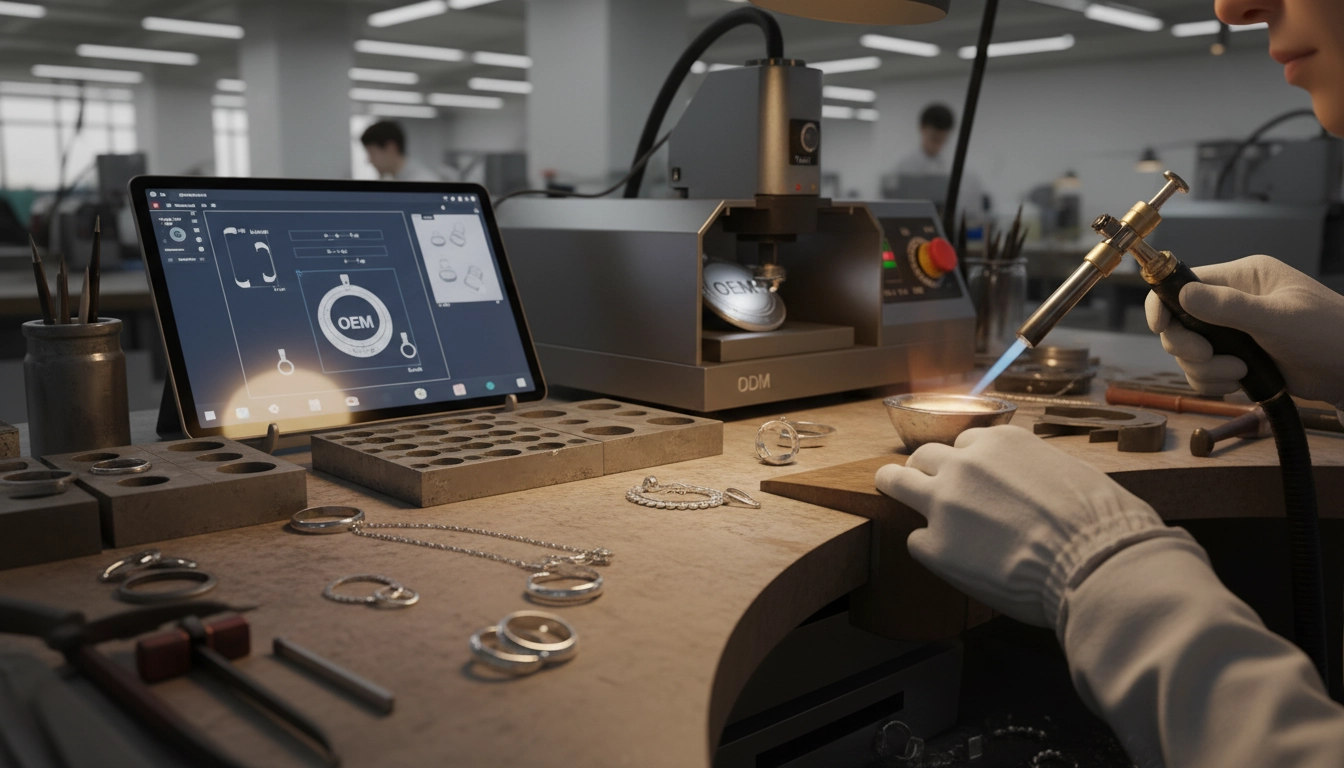
OEM capability is valuable when a brand owns the design and requires controlled execution. ODM capability is useful when a buyer wants access to original concepts, trend-responsive development, and adaptable existing models. In both cases, ownership of CAD files, molds, samples, artwork, and exclusive designs should be documented before commercial production begins.
Compare commercial terms beyond the unit price
Unit cost is only one part of landed cost. Buyers should compare mold charges, sampling fees, plating upgrades, stone or pearl substitutions, packaging, labeling, testing, freight preparation, payment terms, defect handling, and rework policy. A lower quote can become expensive when minimum order quantities are inflexible, revision rounds are charged unexpectedly, or defects cause missed launch windows.
Lead time should be divided into design confirmation, sampling, approval, raw-material procurement, production, inspection, packing, and dispatch. This structure makes bottlenecks visible and allows brand owners to build realistic launch calendars. Written change-control procedures are equally important: once a sample is approved, any modification to alloy, plating, component supplier, dimensions, or packaging should require documented buyer approval.
Use a supplier scorecard for objective selection
A sourcing scorecard can assign weighted scores to design capability, material range, compliance documentation, quality controls, monthly capacity, communication, minimum order quantities, delivery performance, packaging, sustainability evidence, and after-sales support. Reference checks should focus on repeat-order consistency, response to defects, ability to maintain color matching, and performance during seasonal volume peaks.
Claims about responsible production should be supported by evidence. Buyers can request material declarations, laboratory reports, factory audit records, environmental controls, worker-safety procedures, and corrective-action examples. Marketing language should not replace verifiable documentation. The U.S. Federal Trade Commission Jewelry Guides are also relevant when reviewing product descriptions, precious-metal claims, gemstone terminology, and representations made to consumers.
Why HOLYCOME Supports Scalable Custom Collections
Integrated craftsmanship and manufacturing capacity
HOLYCOME is a Guangzhou-based fashion jewelry manufacturer established in 2002, with a company legacy dating back to 2016. Founded by a master mold craftsman, our manufacturing DNA is built around long-term refinement of molds, finishing, assembly, and production consistency. We operate two factories in Guangzhou and Meizhou across 800 square meters, with more than 80 skilled artisans and 20 sales professionals supporting a monthly output of approximately 600,000 pieces.
Our production scope includes brass jewelry, 925 silver jewelry, sterling silver jewelry, gold vermeil jewelry, and pearl jewelry. This material breadth allows brand owners to build tiered collections for different markets while maintaining a coordinated design language. Brass can support accessible trend collections, while silver and vermeil can anchor elevated ranges. Pearl designs can add gifting, bridal, and occasion-focused depth.
Design agility for rapidly changing market demand
Our professional design team launches more than 500 original styles monthly, giving global partners a broad development base for seasonal edits, capsule collections, and channel-specific assortments. This capability supports both ODM selection and OEM customization. Buyers can request modifications to proportions, finishes, colorways, components, packaging, and branding while using a structured approval process to reduce ambiguity before bulk production.
Design volume is valuable only when supported by manufacturing discipline. Our team links creative development with mold engineering, sample review, production planning, and quality checkpoints. This helps project owners move from trend observation to commercially viable products without sacrificing repeatability or delivery planning.
Documented finishing and inspection discipline
Our process includes six rounds of precision polishing and six strict quality inspections designed to improve surface consistency and identify defects before shipment. Inspection attention covers appearance, assembly, finishing, dimensions, and overall workmanship. We also use RoHS- and REACH-compliant eco-friendly materials according to applicable product and market requirements, with buyers encouraged to confirm the precise documentation needed for each destination.
HOLYCOME provides comprehensive OEM and ODM solutions and has served leading Amazon sellers as well as global retail clients such as Macy’s. That customer profile reflects the need for dependable production, commercial communication, and scalable fulfillment. Our objective is not simply to manufacture individual pieces, but to help brands strengthen market influence through superior craftsmanship, responsive development, rapid delivery, and dedicated service. Buyers can review our capabilities at HOLYCOME or contact our sales team at service@holycome.com.
Frequently Asked Questions
Tags
custom bridal brass earrings
custom bridal brass earrings
holiday charm jewelry wholesale
holiday charm jewelry wholesale
925 silver bracelets manufacturer
925 silver bracelets manufacturer
handcrafted 925 silver earrings
handcrafted 925 silver earrings
wholesale custom brass necklaces
wholesale custom brass necklaces
sustainable custom brass earrings
sustainable custom brass earrings
Recommended for you
Design trends in 925 sterling silver nickel free jewelry 2026
What Makes a Reliable Brass Jewelry Factory? Key Features to Look For
How to Source an Ethical brass jewelry manufacturer
7 Costly Mistakes to Avoid When Partnering with a Silver Jewelry OEM/ODM Manufacturer in 2026
Product Categories
You may also like

925 Silver Jewelry
Customizable High-Quality Fashion 925 Sterling Silver AAA Cubic Zirconia Heart-Shaped Open Tennis Bracelet.
Read More

Brass Jewelry
Customizable OEM ODM High-Quality Fashion Brass AAA Cubic Zirconia Classic Tennis Bracelet for Women Wholesale.
Read More
Get a Quote for Private Label Jewelry
We provide personalized jewelry customization services for clients worldwide.
Rest assured that your privacy is important to us, and all information provided will be handled with the utmost confidentiality.
By clicking 'Send Inquiry Now' I agree to HOLYCOME processing my personal data.
To see how to withdraw your consent, how to control your personal data and how we process it, please see our Privacy Policy and Terms of use.
From design to production, HOLYCOME offers a one-stop solution to help you enhance your brand value and market competitiveness.
Get A Quote
Contact
Tel: (+86) 188 1927 7817
© 2026 HOLYCOME. All Rights Reserved.
Facebook
Instagram
YouTube
Whatsapp: +8618078079070