







Email: sales3@zhefanjewelry.com
What is the Production Capacity for Brass Rings Wholesale? Navigating Jewelry Manufacturing
Discover what truly defines the production capacity for brass rings wholesale. This post delves into critical factors like material selection, design complexity, manufacturing technologies, and supply chain management. Understand how choosing the right partner impacts your ability to scale, ensuring consistent quality and timely delivery for your jewelry brand's demands.
- Understanding Wholesale Jewelry Production Capacity
- Factors Influencing Ring Manufacturing Output
- Material Choices: Brass, Sterling Silver, and Beyond
- Design Complexity and Craftsmanship
- Manufacturing Technology and Workforce
- Optimizing Your Brass Ring Wholesale Orders
- Ensuring Quality and Scale for Your Brand
- Frequently Asked Questions
- What factors primarily determine the production capacity for wholesale brass rings?
- How does the intricate design of a ring, like the gold-plated S925 example, affect wholesale manufacturing timelines?
- Is there a significant difference in production capacity when manufacturing brass rings versus sterling silver (S925) rings for wholesale?
- How can a business verify a manufacturer's claims regarding their brass ring wholesale production capacity?
- What are typical lead times for large wholesale orders of custom-designed brass rings?
- FAQ
Understanding Wholesale Jewelry Production Capacity
For businesses seeking to procure jewelry in bulk, understanding a manufacturer's production capacity is paramount. When asking "What is the production capacity for brass rings wholesale?" you're not just inquiring about raw numbers; you're delving into a complex interplay of materials, technology, labor, and operational efficiency. A robust production capacity ensures that your brand can meet market demand, maintain consistent quality, and scale operations effectively without compromising on design integrity or delivery timelines.
Factors Influencing Ring Manufacturing Output
The ability of a manufacturer to produce rings in significant wholesale quantities is shaped by several key elements. These factors collectively determine the speed, volume, and quality of output.
Material Choices: Brass, Sterling Silver, and Beyond
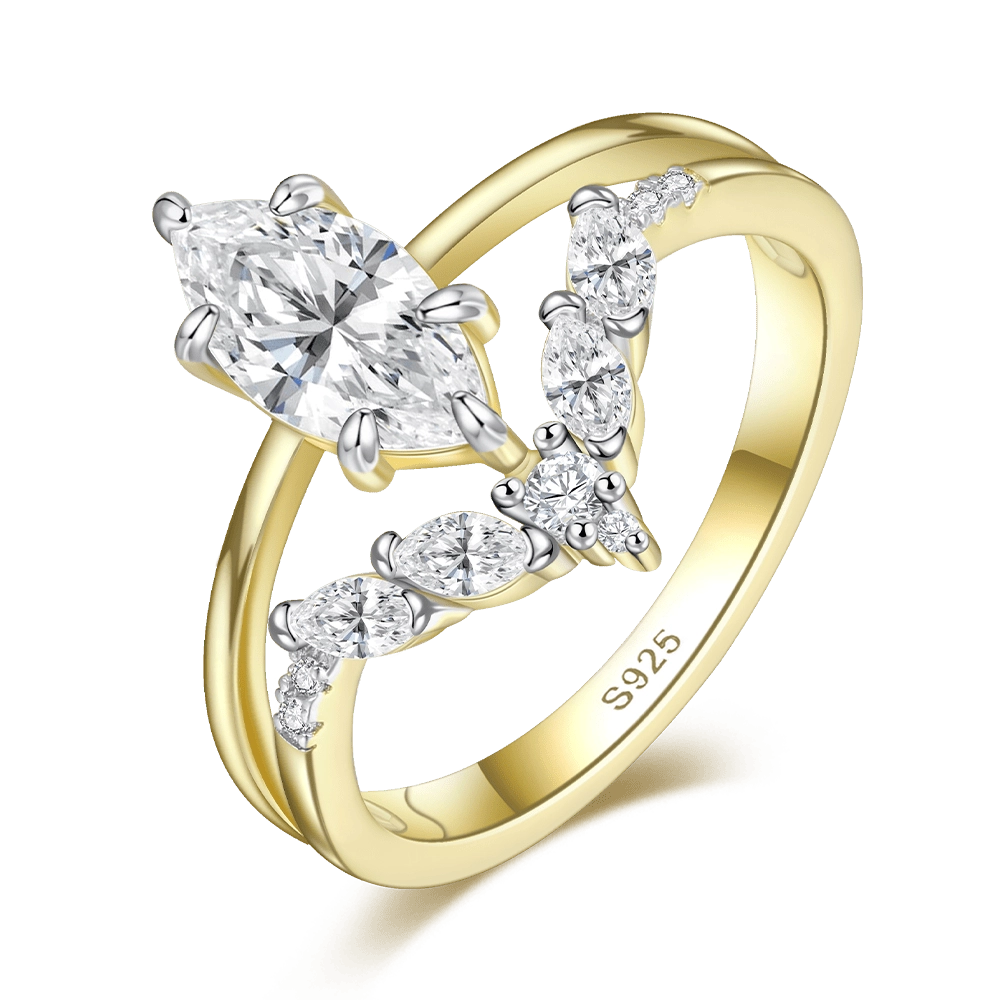
While brass is a highly popular choice for wholesale rings due to its versatility, cost-effectiveness, and excellent plating capabilities, other materials like sterling silver (S925) also play a significant role in the market. The ring pictured, with its elegant gold-colored band and clear 'S925' stamp, is an excellent example of a sterling silver piece, often gold-plated to achieve a luxurious finish. Manufacturers often specialize in certain metals or possess the capability to work with a range of materials, including both brass and S925. The specific properties of each metal influence the tooling, machinery, and finishing processes, which in turn affect overall production capacity.
Design Complexity and Craftsmanship
The intricacy of a ring's design directly impacts the time and resources required for its production. The exquisite ring shown features a prominent marquise-cut center stone, flanked by smaller round and marquise-shaped accent stones set within a delicate, split-shank band. Such detailed craftsmanship, involving precise stone setting, intricate metalwork, and careful polishing, demands specialized skills and potentially longer manufacturing cycles compared to simpler designs. A manufacturer's capacity isn't just about raw volume but also their ability to handle such nuanced designs at scale.
Manufacturing Technology and Workforce
Modern jewelry manufacturing relies heavily on advanced technology, including Computer-Aided Design (CAD), Computer-Aided Manufacturing (CAM), rapid prototyping, and sophisticated casting and polishing equipment. The level of automation and the efficiency of these technologies significantly boost production capacity. Equally crucial is a skilled workforce—artisans trained in specific crafting techniques, quality control specialists, and efficient assembly teams. The synergy between cutting-edge machinery and expert hands is vital for maintaining high output and superior quality when producing brass rings wholesale.
Optimizing Your Brass Ring Wholesale Orders
To maximize the benefits of a manufacturer's production capacity, strategic planning is essential. Clearly communicating your design specifications, material preferences, and desired quantities upfront can streamline the entire process. Reliable wholesale brass ring suppliers will work with you to understand your market needs and provide transparent timelines, helping you forecast inventory and manage your supply chain effectively. Consider placing trial orders to assess a manufacturer's quality and delivery consistency before committing to larger production runs.
Ensuring Quality and Scale for Your Brand
Ultimately, a manufacturer's production capacity is a testament to their ability to deliver consistent quality at scale. For brands looking to purchase brass rings wholesale, choosing a partner with proven capabilities ensures that each piece, whether a simple band or an intricate, stone-set design like the one featured, meets your brand's standards. This robust support allows your business to grow confidently, knowing that your demand for high-quality, fashionable rings can always be met.
Frequently Asked Questions
What factors primarily determine the production capacity for wholesale brass rings?
The production capacity for wholesale brass rings is primarily determined by several factors, including the type and quantity of manufacturing equipment (e.g., casting machines, polishing tools), the size and skill level of the workforce, the complexity of the ring designs, the efficiency of the supply chain for raw materials, and the overall operational setup of the manufacturing facility.
How does the intricate design of a ring, like the gold-plated S925 example, affect wholesale manufacturing timelines?
An intricate design, such as the gold-plated S925 ring with multiple marquise and round stones, significantly affects wholesale manufacturing timelines. Such designs require more precise CAD modeling, specialized molds, careful stone setting, detailed hand-finishing, and stricter quality control checks, all of which extend the production time compared to simpler, less embellished rings.
Is there a significant difference in production capacity when manufacturing brass rings versus sterling silver (S925) rings for wholesale?
While the core manufacturing processes (casting, polishing, plating) are similar, there can be differences in production capacity between brass and sterling silver (S925) rings. Brass is generally more cost-effective and sometimes quicker to cast and process in very high volumes. Sterling silver, being a precious metal, often requires more stringent quality control, specialized handling during plating (e.g., rhodium or gold plating), and may involve higher material costs and slightly longer finishing times, potentially affecting overall capacity for identical designs.
How can a business verify a manufacturer's claims regarding their brass ring wholesale production capacity?
To verify a manufacturer's production capacity for brass rings wholesale, businesses can request factory tours, review certifications (like ISO standards), ask for client testimonials or references, examine their production logs, and start with a smaller trial order to assess their ability to meet deadlines and quality standards before committing to larger volumes.
What are typical lead times for large wholesale orders of custom-designed brass rings?
Typical lead times for large wholesale orders of custom-designed brass rings can vary significantly based on design complexity, order quantity, and the manufacturer's current workload. Generally, lead times can range from 4 to 8 weeks from design approval to delivery. However, highly intricate designs, exceptionally large orders, or peak seasonal demands might extend this to 10-12 weeks or more.
FAQ
What factors primarily determine the production capacity for wholesale brass rings?
The production capacity for wholesale brass rings is primarily determined by several factors, including the type and quantity of manufacturing equipment (e.g., casting machines, polishing tools), the size and skill level of the workforce, the complexity of the ring designs, the efficiency of the supply chain for raw materials, and the overall operational setup of the manufacturing facility.
How does the intricate design of a ring, like the gold-plated S925 example, affect wholesale manufacturing timelines?
An intricate design, such as the gold-plated S925 ring with multiple marquise and round stones, significantly affects wholesale manufacturing timelines. Such designs require more precise CAD modeling, specialized molds, careful stone setting, detailed hand-finishing, and stricter quality control checks, all of which extend the production time compared to simpler, less embellished rings.
Is there a significant difference in production capacity when manufacturing brass rings versus sterling silver (S925) rings for wholesale?
While the core manufacturing processes (casting, polishing, plating) are similar, there can be differences in production capacity between brass and sterling silver (S925) rings. Brass is generally more cost-effective and sometimes quicker to cast and process in very high volumes. Sterling silver, being a precious metal, often requires more stringent quality control, specialized handling during plating (e.g., rhodium or gold plating), and may involve higher material costs and slightly longer finishing times, potentially affecting overall capacity for identical designs.
How can a business verify a manufacturer's claims regarding their brass ring wholesale production capacity?
To verify a manufacturer's production capacity for brass rings wholesale, businesses can request factory tours, review certifications (like ISO standards), ask for client testimonials or references, examine their production logs, and start with a smaller trial order to assess their ability to meet deadlines and quality standards before committing to larger volumes.
What are typical lead times for large wholesale orders of custom-designed brass rings?
Typical lead times for large wholesale orders of custom-designed brass rings can vary significantly based on design complexity, order quantity, and the manufacturer's current workload. Generally, lead times can range from 4 to 8 weeks from design approval to delivery. However, highly intricate designs, exceptionally large orders, or peak seasonal demands might extend this to 10-12 weeks or more.
Tags
cz brass jewelry export hub
cz brass jewelry export hub
wholesale silver bracelet manufacturer
wholesale silver bracelet manufacturer
cz brass earrings supplier
cz brass earrings supplier
custom brass layered necklace
custom brass layered necklace
rose gold brass chunky hoop earrings
rose gold brass chunky hoop earrings
mother of pearl heart necklace sterling chain
mother of pearl heart necklace sterling chain
Recommended for you
OEM Manufacturing Options for 925 Silver Necklace Orders
7 Viral Silver Jewelry Trends for 2026: From Bio-Organic Shapes to Recycled Luxury
Quality Control Checklist for Custom Gold Plated Earrings
Bulk Pricing Strategies for Mother of Pearl Stud Earrings
Product Categories
You may also like

925 Silver Jewelry
Customizable High-Quality Fashion 925 Sterling Silver AAA Cubic Zirconia Heart-Shaped Open Tennis Bracelet.
Read More

Brass Jewelry
Customizable OEM ODM High-Quality Fashion Brass AAA Cubic Zirconia Classic Tennis Bracelet for Women Wholesale.
Read More
Get a Quote for Private Label Jewelry
We provide personalized jewelry customization services for clients worldwide.
Rest assured that your privacy is important to us, and all information provided will be handled with the utmost confidentiality.
By clicking 'Send Inquiry Now' I agree to ZHEFAN JEWELRY processing my personal data.
To see how to withdraw your consent, how to control your personal data and how we process it, please see our Privacy Policy and Terms of use.
From design to production, ZHEFAN JEWELRY offers a one-stop solution to help you enhance your brand value and market competitiveness.
Get A Quote
Contact
Tel: (+86) 188 1927 7817
© 2026 Zhefan Jewelry. All Rights Reserved.
Facebook
Instagram
YouTube
Whatsapp: +8618819277817