






Email: sales3@zhefanjewelry.com
Does PVD Jewelry Tarnish or Fade? A B2B Durability Guide
PVD jewelry can offer strong resistance to wear and color change, but no decorative coating is permanent. This guide explains why PVD-coated jewelry may appear tarnished, faded, or worn or expose the underlying base metal—and how B2B buyers should evaluate these changes before bulk production.
- TL;DR for Jewelry Buyers
- Why PVD Durability Is Often Misunderstood
- Does PVD Jewelry Tarnish or Fade?
- Tarnish, Fading, Wear, and Discoloration Are Not the Same
- Why Quality PVD Jewelry Can Offer Strong Color Retention
- What Causes PVD Jewelry to Change Color?
- Poor Surface Preparation
- An Unsuitable Intermediate-Layer System
- Friction and Product Geometry
- Chemical and Environmental Exposure
- Damage That Exposes the Base Metal
- How Does the Base Metal Affect PVD Tarnish Risk?
- How Should B2B Buyers Evaluate PVD Jewelry Durability?
- Define the Complete PVD Specification
- Approve a Physical Master Sample
- Select Project-Relevant Tests
- Define the Acceptance Criteria Before Production
- How Zhefan Jewelry Controls PVD Project Risks
- Project-Specific PVD Assessment
- Surface Preparation Under the Zhefan 6-Polishing & 6-Inspection Quality Process
- Sample Approval and Bulk Inspection
- Conclusion
- References
- FAQ
TL;DR for Jewelry Buyers
- Quality PVD jewelry is generally resistant to visible tarnishing and fading, but it can still show wear, discoloration, or exposed base metal over time.
- Wear resistance and corrosion resistance are different properties — a hard PVD surface does not by itself guarantee corrosion protection for the metal underneath.
- Durability depends on the base metal, polishing quality, intermediate layers, coating system, product structure, friction, and chemical exposure.
- Buyers should approve the actual sample, define testing conditions, and document color, surface, adhesion, and wear requirements before bulk production.
Why PVD Durability Is Often Misunderstood
PVD jewelry is often promoted as tarnish-resistant, waterproof, scratch-resistant, or long-lasting. These descriptions can be useful, but they do not mean that every PVD-coated product will retain the same appearance indefinitely.
A properly developed PVD finish can provide strong resistance to wear and color change. However, the result still depends on the base metal, surface preparation, intermediate layers, coating chemistry, product geometry, wearing conditions, and quality-control standards applied during production.
For jewelry brands and wholesale buyers, the important question is not only whether PVD jewelry can tarnish or fade. Buyers also need to understand what type of color change has occurred, why it happened, and how the risk can be controlled before bulk production.
This guide focuses on tarnishing, fading, coating wear, exposed base metal, and B2B durability evaluation. Material suitability and the differences between PVD and electroplating are introduced only where they directly affect color retention. Full explanations are provided in the related guides linked throughout the article.
Does PVD Jewelry Tarnish or Fade?
Yes, PVD-coated jewelry can eventually appear faded, dull, scratched, or discolored or show exposed base metal. However, a properly engineered PVD coating is generally more resistant to surface wear and visible color change than many very thin decorative finishes.
Visible discoloration may come from the substrate rather than from the PVD film itself. Visible tarnishing often develops when the base metal becomes exposed, or when pores, incomplete coverage, edge damage, or another localized coating failure allows the underlying metal to react with the environment. A harder coating does not make the complete jewelry product permanent—the substrate and intermediate layers remain just as important as the PVD layer itself, and high-friction areas usually change before protected ones.
For buyers, "tarnish-resistant" is a more accurate specification than "tarnish-proof." PVD performance should be evaluated as a complete coating system rather than as a single surface layer. The same PVD color may perform differently on two products when the base metal, polishing quality, product structure, or intermediate-layer system is different.
PVD-coated jewelry can change appearance, but the cause should be diagnosed before the defect is classified—the failure is usually linked to wear, damage, adhesion, or substrate exposure rather than spontaneous coating tarnish.
Intact coating vs. edge wear
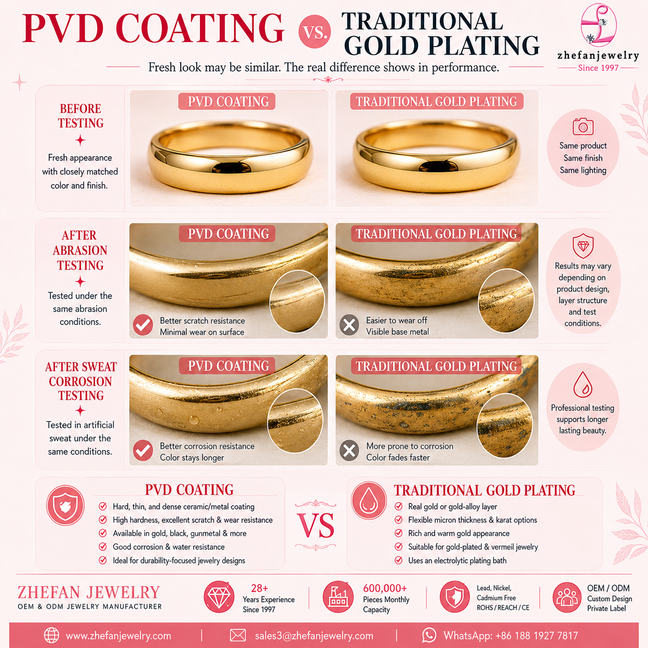
PVD jewelry coating wear and exposed base metal comparison
PVD wear often begins at edges, contact points, and damaged areas rather than across the entire surface at once.
Tarnish, Fading, Wear, and Discoloration Are Not the Same
Tarnish, fading, abrasion, peeling, staining, and exposed base metal describe different failure mechanisms. They should not be treated as interchangeable terms in a quality claim or inspection report.
|
Visible Condition |
Likely Cause |
B2B Interpretation |
|
Darkening near edges or scratches |
Exposed silver or brass reacting with the environment |
Coating wear, porosity, or damaged barrier layer |
|
Greenish marks |
Exposed copper-containing brass or surface contamination |
Base-metal exposure should be investigated |
|
Dull areas on ring bands or clasps |
Repeated friction and abrasion |
High-contact areas may require stronger testing |
|
Uneven color between production batches |
Process variation or color-control inconsistency |
The approved sample and color tolerance may be insufficient |
|
Peeling or flaking |
Adhesion failure, contamination, or substrate deformation |
Surface preparation or layer compatibility may be inadequate |
|
Temporary haze or residue |
Cosmetics, oil, dust, cleaning agents, or packaging contamination |
May be removable and not a coating failure |
|
Silver or brass color visible through the finish |
Coating and intermediate layers have been worn or scratched through |
The base material is exposed |
A buyer should first identify where the change appears, whether the surface is damaged, and whether the color can be cleaned away. Residue on an intact surface requires a different corrective action from peeling, abrasion, or corrosion beneath a damaged coating.
Correct failure diagnosis is essential because contamination, coating wear, adhesion failure, and base-metal corrosion require different production and quality-control solutions.
Why Quality PVD Jewelry Can Offer Strong Color Retention
Depending on the coating system, PVD can provide a hard, thin decorative surface with good resistance to abrasion, scratching, perspiration, and selected chemical exposure. Its performance comes from the complete coating structure rather than from the term "PVD" alone.
The process is carried out in a controlled vacuum environment, but the deposited film follows the existing surface rather than reshaping it. It does not fill pinholes, pitting, polishing lines, casting defects, deep scratches, or poor soldering marks. Deep recesses, hidden areas, moving components, and complex structures may also be more difficult to coat consistently than flat, open surfaces.
Wear resistance and corrosion resistance should not be treated as the same property. A hard PVD surface may improve resistance to abrasion and scratching, but the corrosion performance of the finished jewelry still depends on the substrate, intermediate layers, surface condition, coating continuity, and exposure environment. This distinction is especially important for brass and 925 sterling silver projects, because damage, pores, incomplete coverage, or exposed edges may allow the underlying metal to react even when the surrounding PVD surface remains visually intact.
PVD coating and conventional electroplating are both used to create decorative jewelry finishes, but they rely on different deposition methods and produce different surface properties. PVD is often selected when buyers require a harder decorative surface, while electroplating offers broader options for precious-metal finishes, plating thicknesses, and applications such as gold vermeil. Neither process is automatically better for every product. Buyers should compare the base metal, design structure, target color, retail positioning, and durability requirements before selecting a finish. Read our full guide to PVD Coating vs. Electroplating for Jewelry for a detailed B2B comparison.
A durable PVD finish requires suitable surface preparation, compatible layers, controlled deposition, and inspection of the finished product.
What Causes PVD Jewelry to Change Color?
Poor Surface Preparation
PVD cannot correct a poorly prepared jewelry surface. Any pinholes, pitting, scratches, black spots, polishing marks, or soldering defects may remain visible after coating and can contribute to localized failure.
PVD follows the existing surface texture, so residue, polishing compound, oil, dust, or oxidation left on the metal can affect adhesion. Rough casting areas may create an uneven appearance, and sharp edges may receive different effective coverage than broad, smooth surfaces. Buyers should approve the surface quality—documented through close-up images, approved samples, and written defect criteria—before coating begins, not only after.
An Unsuitable Intermediate-Layer System
The decorative PVD layer is only one part of the complete finish. Intermediate layers may support adhesion, surface leveling, color development, or separation from the base metal.
Silver and brass do not behave identically. Layer compatibility depends on the substrate, target color, product structure, material restrictions, expected wear, and project budget.
The same layer structure should not be transferred automatically to every product. Direct application without suitable preparation may increase the risk of discoloration, uneven coverage, or weak adhesion.
Buyers should ask the supplier to define the complete coating system, not only the final PVD color.
Friction and Product Geometry
Most visible PVD wear begins at high-contact areas rather than across the entire product at the same time. Common high-risk areas include the bottom of rings, bracelet links, chain contact points, clasps, hinges, sliding components, sharp edges, raised decorative areas, and any surface that repeatedly touches skin or other jewelry.
|
Product Type |
Typical Friction Level |
Main Areas to Inspect |
|
Rings |
High |
Bottom of band, edges, raised surfaces |
|
Bracelets |
High to medium |
Links, clasps, sliding parts |
|
Necklaces |
Medium |
Chain contact points, clasps, pendant edges |
|
Earrings |
Low to medium |
Posts, hinges, closures, edges |
|
Pendants |
Low to medium |
Bail, back surface, raised details |
Durability testing should reflect the actual product structure. A coating test performed on a flat metal coupon may not fully represent a ring, clasp, chain, or hinged earring.
Chemical and Environmental Exposure
Sweat, salt, chlorine, cleaning agents, perfume, cosmetics, humidity, and other chemicals may affect the coating system. The risk may increase after the surface has been scratched, worn, or locally damaged.
For B2B buyers, this should be treated as a specification issue rather than only as a consumer-care issue. The project should define expected wear conditions, likely contact with sweat or water, required chemical resistance, the relevant test method, and the acceptance criteria.
These requirements should be agreed upon before production rather than investigated only after customer complaints occur.
Damage That Exposes the Base Metal
An intact coating can reduce direct environmental contact with the base metal, but once it is worn through or deeply scratched, the behavior of the exposed silver or brass becomes more important. Exposed 925 silver may darken; exposed brass may darken or develop greenish discoloration. Localized change does not necessarily mean the entire PVD surface has failed — edge wear and point damage should be distinguished from widespread adhesion failure.
PVD color change usually results from a combination of surface condition, layer compatibility, mechanical wear, chemical exposure, and exposed base metal.
How Does the Base Metal Affect PVD Tarnish Risk?
Both 925 sterling silver and brass can be used as base metals for PVD-coated jewelry, but they should not be treated as identical substrates.
A metal being technically suitable for PVD does not mean that every design, stone-setting structure, or surface condition can use the same coating system. Silver and brass may require different polishing standards, barrier layers, cleaning procedures, and product evaluations before coating. Buyers who need a complete explanation of material suitability can review Can Silver or Brass Be PVD Coated?, which examines the feasibility, limitations, and production considerations for both materials.
|
Factor |
925 Sterling Silver Under PVD |
Brass Under PVD |
|
Main underlying risk |
Tarnishing after substrate exposure and possible deformation in thin or flexible structures |
Copper-alloy oxidation, surface porosity, and dependence on the barrier-layer system |
|
Appearance after coating damage |
Exposed silver may darken |
Exposed brass may darken or develop greenish discoloration |
|
Surface requirement |
Fine polishing, controlled cleaning, and product-specific preparation |
Surface leveling, porosity control, and suitable barrier preparation |
|
Mechanical concern |
Thin, hollow, or flexible structures may move beneath the hard surface layer |
Porous cast areas, sharp edges, and soldered sections require attention |
|
Layer consideration |
The intermediate structure must be compatible with silver and the target finish |
Barrier and intermediate layers may be needed depending on the design and finish |
|
Buyer requirement |
Approve the coating system on the actual silver product |
Do not evaluate brass PVD durability from color appearance alone |
The finished result depends on the relationship between the substrate, surface preparation, intermediate layers, and PVD finish. A successful result on one brass casting does not confirm performance on a different design, production batch, soldered structure, or surface condition. Similarly, approval of one sterling silver sample does not validate every silver thickness, component, or moving structure. The coating system should be reviewed on the actual SKU rather than transferred automatically from another project.
PVD-coated silver and brass samples.
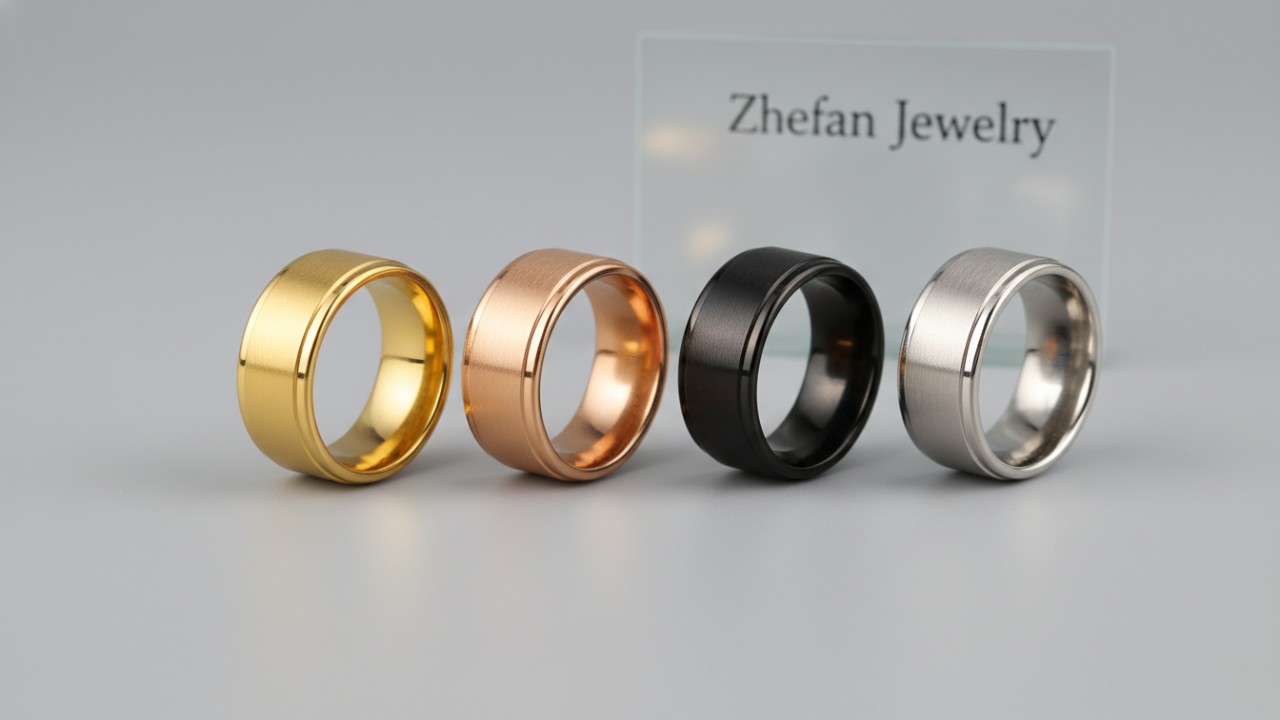
PVD coating on 925 sterling silver and brass jewelry samples.
Silver and brass can both be evaluated for PVD, but their surface preparation and intermediate-layer requirements may differ.
How Should B2B Buyers Evaluate PVD Jewelry Durability?
PVD durability should be evaluated through a written product specification, an approved physical sample, project-relevant testing, and documented acceptance criteria.
Define the Complete PVD Specification
|
Specification Field |
What the Buyer Should Confirm |
|
Base metal |
925 sterling silver or specified brass material |
|
Product structure |
Solid, hollow, cast, stamped, chain, hinged, or moving components |
|
Surface finish |
Mirror polish, high polish, brushed, matte, or textured |
|
Intermediate layers |
Purpose, sequence, and material restrictions |
|
PVD finish |
Color, coating type, gloss level, and whether precious metal is involved |
|
Sensitive components |
Stones, pearls, resin, enamel, glue, solder joints, or springs |
|
High-friction areas |
Ring bottoms, clasps, links, hinges, edges, and sliding parts |
|
Approved sample |
Physical color, surface, structure, and workmanship reference |
|
Testing requirements |
Method, duration, cycles, test location, and pass criteria |
|
Repeat-order control |
Color tolerance, master sample, and batch approval method |
Terms such as "gold PVD," "black PVD," or "long-lasting PVD" are not complete production specifications. They do not define the base metal, preparation method, layer structure, color standard, or testing requirement.
Approve a Physical Master Sample
Buyers should approve the actual base metal; inspect the real surface; confirm color under agreed lighting; check moving parts and friction points; and define which sample becomes the bulk-production reference—a digital image can support color communication, but the approved physical sample should remain the main reference for bulk appearance and workmanship.
Select Project-Relevant Tests
Possible test categories include visual and surface inspection, adhesion evaluation, scratch evaluation, wear or abrasion testing, artificial perspiration testing, corrosion or salt-spray testing, color comparison, coating-layer verification, and functional inspection after coating. ISO 16253:2017 provides requirements and test methods for vapor-phase-deposited hard coatings within the specific scope of watch cases and accessories, so any use as a benchmark for jewelry must be confirmed against the actual product and project requirements. Likewise, ISO 9227 defines salt-spray test procedures but does not prescribe product-specific exposure periods or the interpretation of results, and it is not intended to predict long-term service life. Test duration, abrasion cycles, or coating thickness should therefore not be converted directly into a guaranteed number of wearing years.
Define the Acceptance Criteria Before Production
Buyers should specify the acceptable color range, permitted surface defects, scratch and edge-wear standards, adhesion requirements, test conditions, inspection quantity, rework responsibility, and repeat-order color-control method.
A test name alone is not a quality standard. The method, sample preparation, test duration, location, and acceptance criteria must be documented.
How Zhefan Jewelry Controls PVD Project Risks
Zhefan Jewelry reviews the base metal, product structure, surface condition, stone-setting method, target color, expected wear, market requirements, and requested testing standard before confirming a PVD recommendation.
Project-Specific PVD Assessment
The review also covers high-friction areas, moving parts, stones, pearls, resin, enamel, glued components, finish gloss, material restrictions, order quantity, and required testing. The purpose is to identify structural and surface risks before the coating specification is finalized.
One PVD system should not be presented as a universal solution for every material, component, and jewelry structure.
Surface Preparation Under the Zhefan 6-Polishing & 6-Inspection Quality Process
Zhefan Jewelry's Proprietary 6-Polishing & 6-Inspection Process, also referred to as the Zhefan 6P6Q Quality Process, combines six polishing stages with six inspection checkpoints across production.
The stages most relevant to PVD durability include initial linen-wheel hand polishing; secondary linen-wheel polishing for pinholes, black spots, and pitting; detail polishing after stone setting where applicable; and final linen-wheel polishing before coating—supported by inspection after machine polishing, after hand polishing, and a final inspection after coating that checks surface smoothness, pinholes, pitting, black spots, scratches, rough edges, stone-setting areas, color consistency, and final appearance.
Because PVD follows the existing surface, pre-coating polishing and defect inspection are directly related to the final appearance. Coating should not be used to hide surface defects that should have been corrected earlier in production.
Zhefan 6P6Q process snapshot
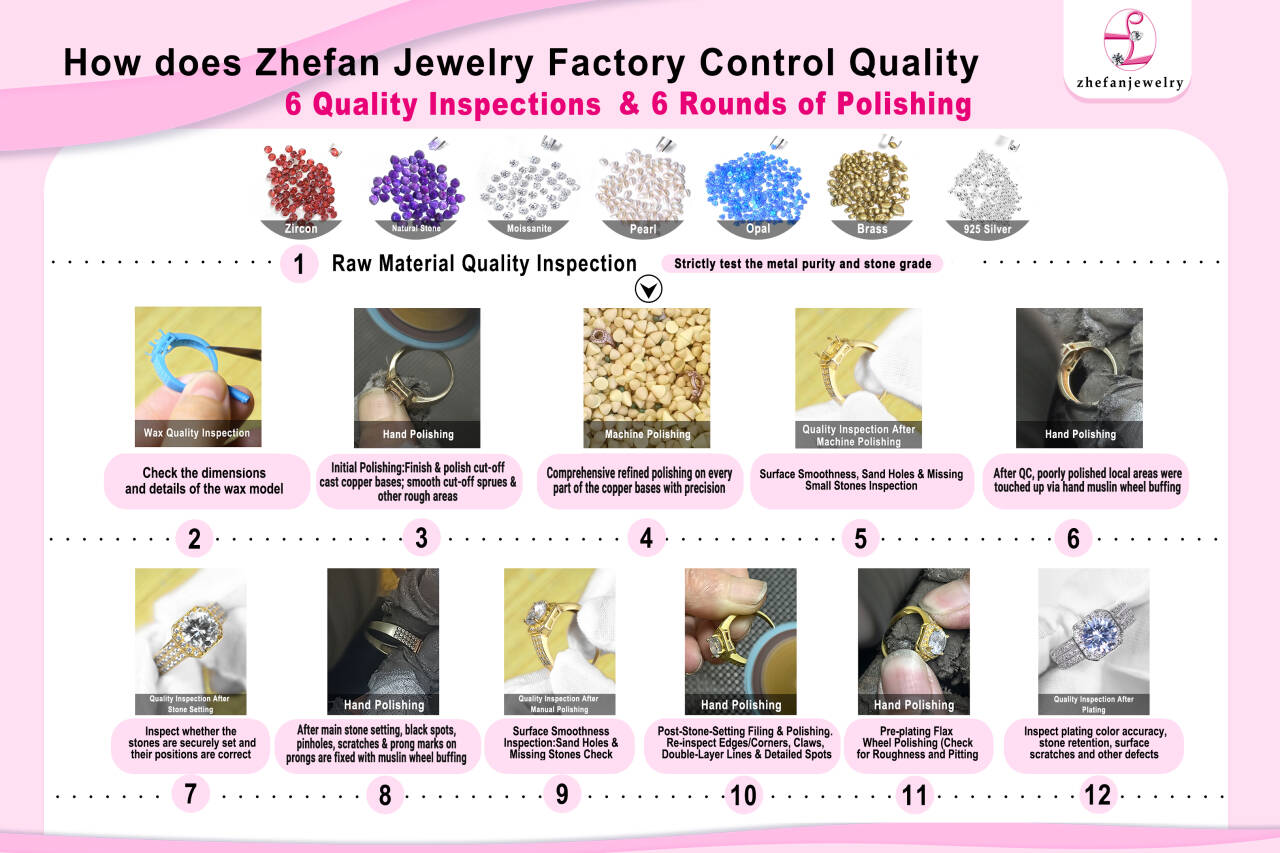
Zhefan 6P6Q quality process for PVD jewelry production
Relevant Zhefan 6P6Q stages focus on polishing quality, defect correction, pre-coating inspection, and final appearance review.
Sample Approval and Bulk Inspection
Zhefan Jewelry can support written specifications, CAD confirmation where required, sample development, physical color approval, surface approval, an approved-sample reference, post-coating inspection, project-specific test discussion, and bulk-production review.
Sample development typically takes approximately 7–10 days. Bulk production typically takes approximately 2–4 weeks. The final schedule depends on the design, quantity, surface preparation, stone setting, coating process, testing, packaging, and revision requirements.
International shipping is confirmed separately.
The objective is not to promise that PVD never changes. It is to identify the relevant risks, define the coating and quality requirements, and establish an approved production reference before bulk manufacturing.
Conclusion
PVD jewelry is better described as tarnish-resistant and wear-resistant than permanently tarnish-free. When a product changes appearance, buyers should determine whether the cause is surface residue, abrasion, coating damage, adhesion failure, uneven deposition, or corrosion of the exposed base metal.
A reliable PVD jewelry project requires more than choosing a color. The buyer and manufacturer should confirm the base metal, product structure, surface standard, intermediate layers, approved sample, testing method, and acceptance criteria before bulk production.
When these requirements are properly documented and inspected, PVD can be a suitable decorative finishing option for selected 925 sterling silver and brass jewelry projects.
|
Discuss Your PVD Jewelry Requirements Planning a PVD jewelry project in 925 sterling silver or brass? Send Zhefan Jewelry your design, base metal, target color, order quantity, expected wear conditions, and required testing criteria. Our team will review the product structure and discuss a project-specific coating and quality-control plan. Request a PVD Project Assessment
|
References
1. Oerlikon Balzers — BALTONE™ Decorative Coatings. Official product information on decorative PVD coatings and wear-resistant finishes. Accessed July 21, 2026.
2. Ionbond — Decobond™ Stainless Steel. Official technical information on decorative PVD coatings, improved wear resistance, and replication of the underlying surface texture. Accessed July 21, 2026.
3. Ionbond — PVD Coating Services. Official guidance explaining that cleaning and removal of foreign matter are essential to coating adhesion and performance. Accessed July 21, 2026.
4. ISO 16253:2017 — Watchcases and accessories — Vapor-phase deposited coatings. General requirements and test methods for vapor-phase-deposited hard coatings; scope limited to watch cases and accessories.
5. ISO 9227:2022 — Corrosion tests in artificial atmospheres — Salt spray tests. Defines salt-spray test apparatus and procedures but does not prescribe product-specific exposure periods or predict long-term service life.
6. Zhefan Jewelry — Can Silver or Brass Be PVD Coated?. First-party production guidance on substrate preparation, layer compatibility, product geometry, and project-specific validation.
7. Zhefan Jewelry — PVD Coating vs. Electroplating for Jewelry. Related B2B guide comparing deposition methods, finish options, and sourcing considerations.
FAQ
How Long Does PVD Jewelry Retain Its Color?
There is no universal wear period for every PVD jewelry product. Color retention depends on the product type, friction level, base metal, surface preparation, intermediate layers, coating system, chemical exposure, and acceptance standard. A supplier should not convert a PVD description, coating thickness, or laboratory test result directly into a guaranteed number of wearing years without evidence from the actual product and test conditions.
Can PVD Jewelry Appear Tarnished While the Coating Still Looks Intact?
If the coating is truly continuous and undamaged, visible discoloration may come from surface residue, cosmetics, cleaning agents, packaging contamination, or environmental deposits rather than tarnishing of the base metal. If corrosion appears beneath the finish, the coating system may contain pores, incomplete coverage, edge damage, or another localized failure that is not immediately visible without closer inspection. The product should therefore be cleaned and examined before the issue is classified as tarnish, coating failure, or substrate corrosion.
Is Gold-Colored PVD the Same as Gold-Plated Jewelry?
Not necessarily. A gold-colored PVD finish may use a decorative coating system that does not contain the same precious-metal layer as conventional gold electroplating. Buyers should confirm the coating composition, deposition process, base metal, intermediate layers, and permitted product description before using terms such as "gold plated" or "gold vermeil. "See PVD Coating vs. Electroplating for Jewelry for a full comparison.
Can Both 925 Sterling Silver and Brass Receive PVD Coating?
Yes, both materials can be considered for PVD coating, but they may require different polishing standards, cleaning methods, barrier layers, fixtures, and product evaluations. Stones, soldered sections, glued components, flexible structures, and moving parts should also be reviewed before the process is approved. See Can Silver or Brass Be PVD Coated? for the complete feasibility discussion.
When Should a PVD Sample Be Retested or Reapproved?
A PVD sample should be reviewed again when a change may affect appearance, adhesion, wear, or corrosion performance. Relevant changes include a new base-metal supplier, different casting quality, revised solder, modified polishing, a new intermediate-layer system, a changed PVD formula, a different coating facility, altered product geometry, new stones or adhesives, or a revised color target. The buyer should decide whether the existing master sample remains valid before repeat production begins.
Recommended for you

What Is Gold Vermeil Jewelry? A Complete Guide for Brands and Retailers

Thick Gold Plated Jewelry Manufacturer for 925 Silver & Brass Jewelry

How to Choose a Gold Vermeil Jewelry Manufacturer

Gold Vermeil vs. Gold-Plated Jewelry: Which Fits Your Luxury Jewelry Brand?

Can Silver or Brass Be PVD Coated? A Professional Guide for Jewelry Brands
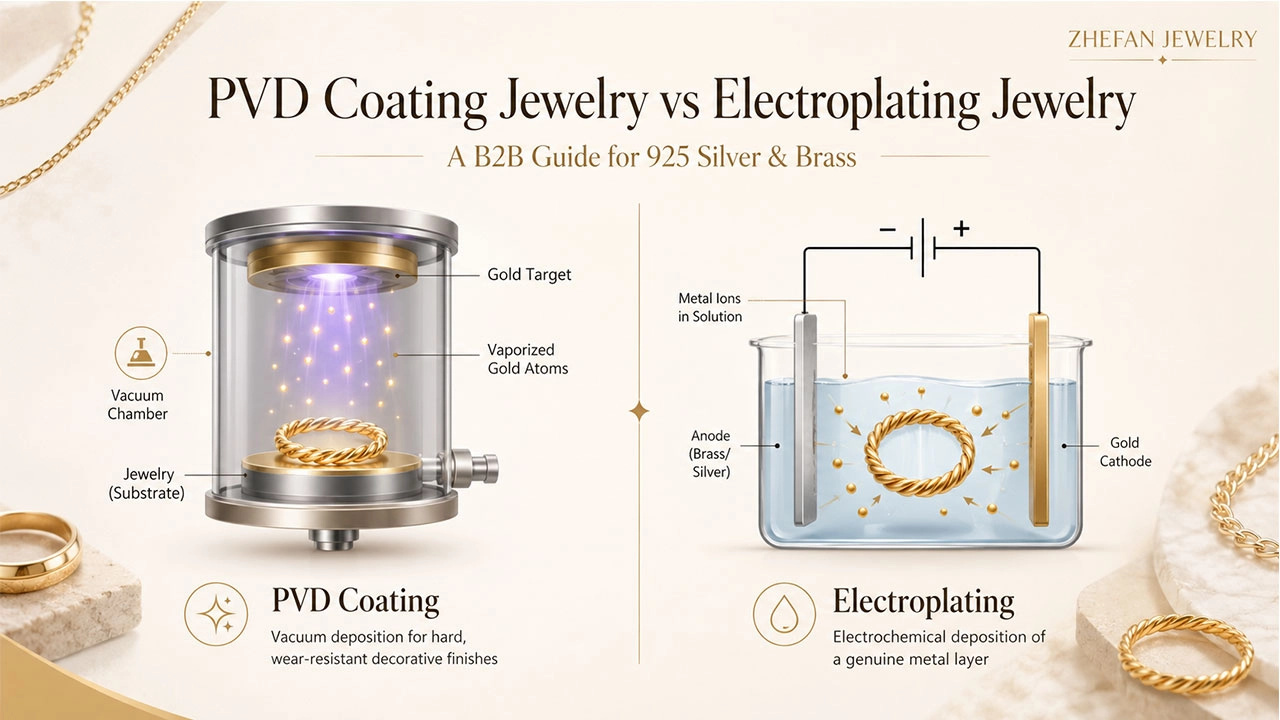
PVD Coating vs Electroplating for Jewelry: A B2B Buying Guide for 925 Silver and Brass
Product Categories
Discuss Your Ideas with a Professional Custom Jewelry Manufacturer
We provide personalized jewelry customization services for clients worldwide.
Rest assured that your privacy is important to us, and all information provided will be handled with the utmost confidentiality.
By clicking 'Send Inquiry Now' I agree to ZHEFAN JEWELRY processing my personal data.
To see how to withdraw your consent, how to control your personal data and how we process it, please see our Privacy Policy and Terms of use.
From design to production, ZHEFAN JEWELRY offers a one-stop solution to help you enhance your brand value and market competitiveness.
Get A Quote
Contact
Tel: (+86) 188 1927 7817
© 2026 Zhefan Jewelry. All Rights Reserved.
Facebook
Instagram
YouTube
Whatsapp: +8618819277817