






Email: sales3@zhefanjewelry.com
How Can a Jewelry Brand Change Manufacturers Without Losing Quality?
Changing jewelry manufacturers does not have to mean inconsistent plating, stones, finishing, or product feel. Learn how established jewelry brands transfer specifications, master samples, testing standards, and production controls to a new factory without sacrificing quality.
Changing manufacturers is very different from sourcing a manufacturer for a new jewelry collection.
When a brand develops a new product, there is room to adjust dimensions, finishes, materials, and manufacturing methods during sampling. When an established jewelry brand moves an existing product to a different manufacturer, however, customers already know what that product should look, feel, and perform like.
The challenge is therefore not simply finding another factory capable of making jewelry.
The real challenge is transferring an established quality standard from one manufacturing system to another without allowing the product itself to change.
A pendant that becomes slightly lighter, a tennis bracelet with different stone spacing, a gold finish that shifts from warm to pale, a clasp with different tension, or a logo engraving that becomes shallower may all technically remain “within specification.” To the customer, however, they can feel like a different product.
For established jewelry brands, a successful manufacturer transition depends on controlling these small differences before volume production begins.
- Quick Answer: How Can a Jewelry Brand Switch Manufacturers Without Losing Quality?
- Why Jewelry Quality Can Change Even When the Design Does Not
- Start With a Quality Transfer File, Not a New RFQ
- Identify the Product Characteristics the Customer Will Notice First
- Use the Existing Product as a Physical Reference Standard
- Do Not Transfer Old Manufacturing Problems Along With the Product
- Reconstruct the Hidden Manufacturing Specification
- Treat Plating Color and Thickness as Separate Quality Requirements
- Compare the Old and New Products Side by Side
- Separate Prototype Approval From Production Approval
- Measure the New Manufacturer Against the Product, Not Against the Previous Factory
- Transition Production in Stages Instead of Moving Every SKU at Once
- Keep Quality Standards Stable During the Transition
- Create a Formal Change-Control Process for Future Orders
- Protect Brand Quality With Documentation That Can Move With You
- What Should an Established Jewelry Brand Expect From a New Manufacturer?
- How Zhefan Jewelry Supports Manufacturer Transition Projects
- FAQ
Quick Answer: How Can a Jewelry Brand Switch Manufacturers Without Losing Quality?
A jewelry brand can change manufacturers without losing quality by transferring a controlled manufacturing standard, rather than simply sending the new factory a CAD file or product photograph.
The transfer should include the approved physical product, technical drawings, bill of materials, dimensions and tolerances, stone specifications, plating color and thickness requirements, surface finish, functional requirements, branding details, packaging instructions, and agreed quality limits.
The new jewelry manufacturer should then reproduce the product through controlled sampling, side-by-side comparison, pre-production approval, and a pilot production run before receiving full production volume.
For established brands, the safest transition is therefore not a supplier replacement. It is a quality-transfer project.

Why Jewelry Quality Can Change Even When the Design Does Not

One of the most common assumptions during a manufacturer transition is that the same CAD file should produce the same jewelry.
In practice, CAD represents only part of the finished product.
Two factories can work from identical dimensions and still produce jewelry that looks noticeably different because the finished result depends on many process variables that may never appear in the original design file.
Polishing intensity affects edge definition and surface reflection. Casting conditions influence porosity and dimensional stability. Stone-setting technique changes how stones sit and reflect light. Electroplating preparation affects both color and durability. Soldering methods can influence joint appearance and strength. Different chains, clasps, or finding suppliers can change the weight and tactile feel of the product.
This is why brands should not ask a new manufacturer merely to “copy the design.”
They should ask the manufacturer to reproduce an approved product standard.
That distinction is critical.
Start With a Quality Transfer File, Not a New RFQ
Before requesting quotations from a replacement manufacturer, an established jewelry brand should first consolidate everything that defines the current product.
This becomes the brand's Quality Transfer File.
For a mature SKU, the file should describe not only what the jewelry is made from but also what the customer is expected to experience when receiving it.
A practical quality transfer file can be structured around the following areas:
|
Quality Dimension |
What Should Be Controlled |
|
Product geometry |
Dimensions, proportions, wall thickness, chain length, stone spacing |
|
Metal |
Brass, 925 sterling silver, gold vermeil, or other confirmed substrate |
|
Stones |
Material, size, cut, shape, color, and setting style |
|
Surface |
Mirror polish, satin, brushed, matte, or other defined finish |
|
Plating |
Color, karat tone, layer structure, and required thickness |
|
Assembly |
Soldering, jump rings, hinges, links, clasps, and connectors |
|
Branding |
Logo size, engraving depth, hallmark, and placement |
|
Function |
Clasp tension, flexibility, movement, and wearable comfort |
|
Appearance |
Approved color, symmetry, stone alignment, and visible workmanship |
|
Packaging |
Bags, cards, boxes, labels, SKU identification, and packing method |
This document becomes much more valuable than a quotation sheet because it gives the new manufacturer a measurable definition of what the brand considers acceptable.
Without it, every supplier interprets words such as “premium,” “high quality,” “smooth polishing," and “long-lasting plating” differently.
Discuss Your Jewelry Quality Transfer
Identify the Product Characteristics the Customer Will Notice First
Not every specification carries the same commercial importance.
For each established SKU, the brand should identify its critical-to-quality characteristics.
These are the product features that should not change when manufacturing moves from one factory to another.
For a tennis bracelet, the critical characteristics might include stone alignment, link movement, stone setting security, clasp operation, finished width, and plating color.
For a pair of earrings, they might include overall weight, symmetry, post position, stone orientation, and closure resistance.
For a gold-plated brass necklace, customers may be particularly sensitive to gold tone, chain feel, pendant weight, polish level, and plating durability.
The objective is not to create an unnecessarily complicated inspection system. It is to identify which differences would make an existing customer believe that the product had changed.
Once these characteristics are defined, the new factory can focus engineering, sampling, and inspection resources around them.
Use the Existing Product as a Physical Reference Standard
Photographs are useful for communicating design intent, but they are not sufficient for transferring production quality.
Lighting, camera settings, screen calibration, and photo editing can all affect perceived gold color, stone brightness, and surface finish.
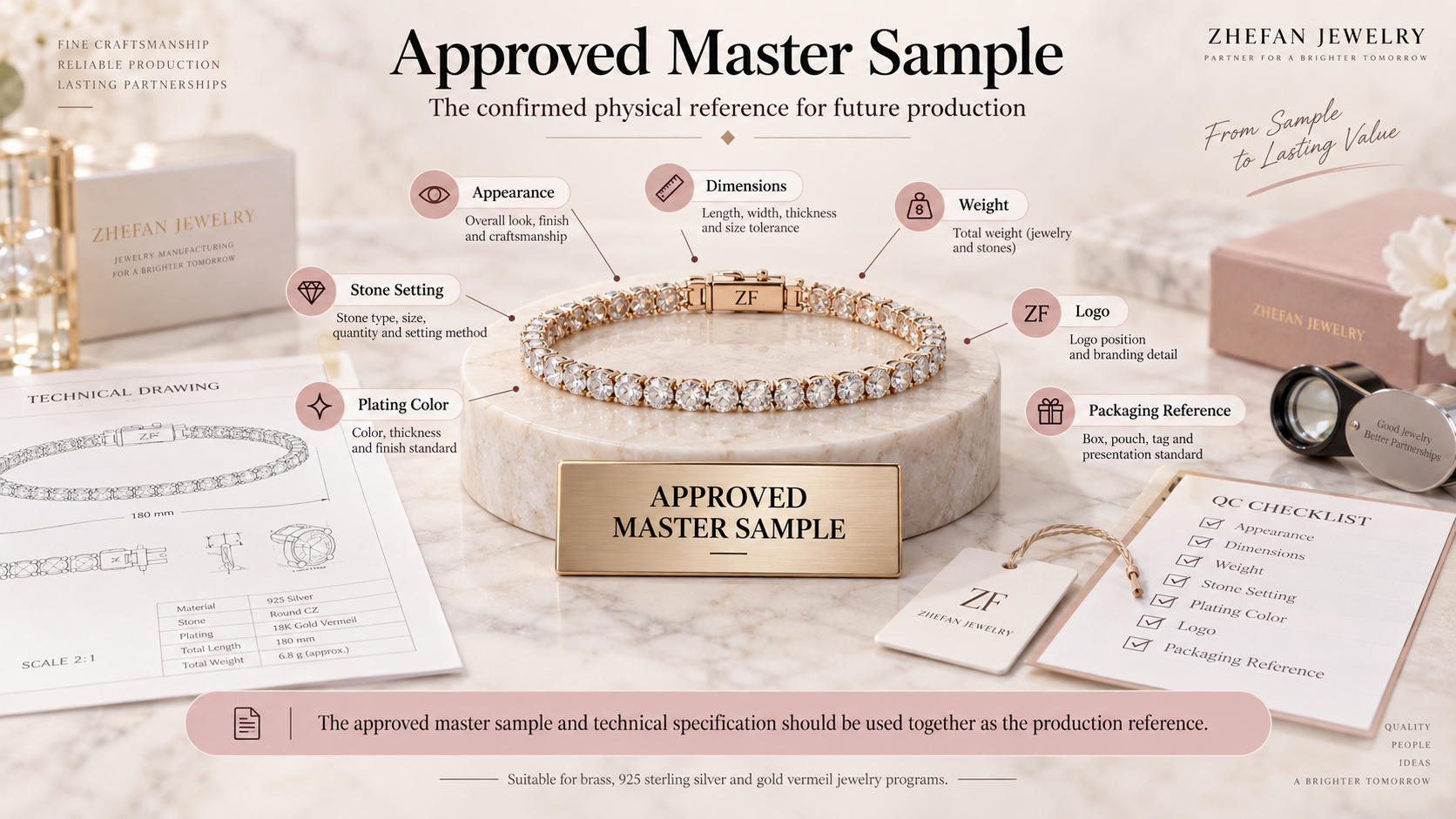
Whenever possible, a brand-changing jewelry manufacturer should provide the new factory with an approved physical product from a successful production batch.
This sample should represent the quality that customers already receive.
It can then serve as the basis for evaluating proportion, weight, polishing, stone placement, articulation, engraving, clasp behavior, and overall hand feel.
However, the sample should not replace technical documentation.
The strongest transfer system combines both.
The physical master sample defines what the product should look and feel like, while the technical specification explains how that result should be controlled and measured.
Together, they reduce subjective interpretation between the brand and the new manufacturer.
Do Not Transfer Old Manufacturing Problems Along With the Product
A manufacturer transition is also an opportunity to separate intentional design features from accidental production characteristics.
For example, an existing SKU may contain minor dimensional variation simply because the previous tooling was worn. A plating color difference may have developed over time because the previous supplier changed process conditions. A clasp may have historically been difficult to operate even though customers accepted it.
A new manufacturer should therefore conduct a structured review of the existing product rather than blindly duplicate every characteristic.
The brand and factory should determine which characteristics represent the intended design standard and which represent defects, historical compromises, or uncontrolled variation.
This is particularly important when a brand changes suppliers because of recurring quality problems.
The objective should be product continuity without defect continuity.
Reconstruct the Hidden Manufacturing Specification
Many established brands discover during a supplier transition that their original documentation is incomplete.
They may own the CAD files but not know the polishing sequence.
They may know that a necklace is “18K gold plated” without having recorded the agreed plating thickness.
They may know the stone size but not the exact stone quality or supplier standard.
They may have packaging files but no written specification for how individual pieces are protected during transportation.
This missing knowledge represents a supply-chain risk.
A capable new jewelry manufacturer should help the brand convert the physical product and historical documentation into a more complete manufacturing specification.
For plated jewelry, this can include the substrate, surface preparation, plating color target, required gold layer, barrier layer where applicable, plating thickness, and testing requirements.
For stone-set jewelry, it can include stone type, calibrated dimensions, shape tolerance, setting method, and security requirements.
For chain-based products, the specification can define chain gauge, link dimensions, finished length, extension chain, clasp configuration, and assembly method.
The goal is to turn previously informal manufacturing knowledge into controlled brand knowledge.
That makes future repeat orders easier to manage and reduces dependence on any single factory.
Treat Plating Color and Thickness as Separate Quality Requirements
Gold-plated jewelry deserves particular attention during manufacturer transfer because matching appearance does not automatically mean matching durability.
Two manufacturers may produce a similar gold color while using different preparation layers, plating thicknesses, or process conditions.
Conversely, two products with similar plating thickness may still appear different because of polishing, underlying metal color, or plating chemistry.
Established brands should therefore approve both visual appearance and measurable plating requirements.
The approved sample can define the target gold tone, while the technical specification defines the required plating construction and thickness.
Where a brand has specific durability expectations, those requirements should be discussed before production rather than after customer wear issues appear.
For projects where plating thickness is commercially important, measurement reports such as X-RAY plating thickness testing can provide additional verification between the approved specification and production result.
Need to Match an Existing Plating Standard?
Zhefan Jewelry supports customized plating color and thickness requirements for 925 sterling silver and brass jewelry, with measurable coating verification based on confirmed project specifications.
Compare the Old and New Products Side by Side
The first sample from a new manufacturer should not be evaluated in isolation.
It should be evaluated against the product customers are already buying.
Place the old approved product and the new sample side by side and compare them under the same conditions.
The evaluation should consider visual characteristics, dimensions, weight, surface finish, stone setting, plating tone, engraving, assembly, and function.
This comparison often reveals differences that are difficult to identify when looking only at drawings.
For example, a new necklace may meet the same length specification but feel different because the chain gauge changed. A ring may match the CAD but look softer because excessive polishing reduced edge definition. A bracelet may use the correct stones yet reflect light differently because the setting height changed.
These are exactly the types of changes mature jewelry brands need to identify before volume production.
Separate Prototype Approval From Production Approval
A technically successful prototype does not prove that a factory can repeat the same result across hundreds or thousands of pieces.
This is why established brands should use more than one approval stage.
The initial engineering sample proves that the factory understands the product.
The final pre-production sample establishes the approved manufacturing reference.
A controlled pilot production run then demonstrates whether the factory can repeat the approved standard across a real production batch.
This distinction matters because many manufacturing problems appear only when production moves from a small number of carefully prepared samples to normal factory conditions.
Variation in polishing, stone setting, plating, assembly, and packaging becomes easier to identify during pilot production.
The purpose of the pilot is therefore not simply to obtain more samples.
It is to test process repeatability.
Measure the New Manufacturer Against the Product, Not Against the Previous Factory
When brands move suppliers, conversations can easily become focused on whether the new factory is “better” or “worse” than the old one.
That is not the most useful benchmark.
The real benchmark should be the brand's approved product requirements.
If the new factory uses a different casting method, polishing sequence, or production layout but consistently produces the approved result, those differences may not matter.
At the same time, a factory should not be allowed to substitute materials, stones, findings, or surface treatments simply because its normal process is different.
The standard should remain the brand's product specification.
This creates a healthier relationship between brand and manufacturer because quality decisions become based on evidence rather than assumptions about how a particular factory normally works.
Transition Production in Stages Instead of Moving Every SKU at Once
For brands with large product assortments, transferring the entire collection simultaneously creates unnecessary operational risk.
A stronger strategy is to begin with a controlled group of representative SKUs.
These products should collectively test the processes that matter most to the brand, such as casting, polishing, stone setting, electroplating, engraving, chain assembly, and packaging.
Once the new manufacturer demonstrates consistent production on these items, additional SKUs can move through the same controlled process.
Complex or commercially critical products should receive more validation than simple, low-risk designs.
This staged approach gives the brand an opportunity to improve specifications, communication, and inspection standards before the majority of production is transferred.
It also reduces the possibility that one unresolved manufacturing difference affects an entire collection at the same time.
Keep Quality Standards Stable During the Transition
One common mistake is combining a manufacturer change with multiple product changes.
A brand may move to a new factory while simultaneously changing metal, reducing product weight, changing plating thickness, switching stones, and redesigning packaging.
This makes it extremely difficult to determine whether a difference in the final product is caused by the new manufacturer or by the new specification.
For established bestsellers, it is usually more controlled to reproduce the existing approved product first.
Material upgrades, cost engineering, or design modifications can then be handled as separate development projects.
Separating these decisions protects the integrity of the comparison.
Create a Formal Change-Control Process for Future Orders
The manufacturer transition is not complete when the first order ships.
Quality continuity depends on controlling what happens in later repeat orders.
Once an SKU is approved, any meaningful change to materials, stones, plating, components, tooling, production methods, or outside suppliers should be communicated before implementation.
The approved specification should carry a revision number, and the factory should work from the current version rather than relying on historical messages or informal instructions.
This becomes increasingly important as a jewelry brand grows.
Large collections may contain hundreds of variants, different plating colors, multiple stone combinations, and different packaging requirements.
Without revision control, even a capable manufacturer can produce an outdated version simply because different teams are working from different files.
A controlled change system prevents that problem.
Protect Brand Quality With Documentation That Can Move With You
A strong manufacturing relationship is valuable, but the brand should still own its product knowledge.
CAD files, technical drawings, bills of materials, logo artwork, packaging files, approved samples, test requirements, and product specifications should be organized so that they are accessible to the brand rather than existing only within a supplier's internal system.
This does not mean brands should expect access to a manufacturer's proprietary production knowledge.
It means that the information necessary to define the brand's own product should remain under the brand's control.
For established jewelry companies, this is one of the most important long-term lessons from changing manufacturers.
Good manufacturing documentation does more than support one transition.
It creates a repeatable quality system that supports future sourcing, dual sourcing, international expansion, and production scaling.
What Should an Established Jewelry Brand Expect From a New Manufacturer?
A manufacturer working with an established brand should be prepared to do more than quote a product from a photograph.
The factory should be able to interpret existing technical files, evaluate a physical reference sample, identify manufacturing risks, reproduce critical product characteristics, document sample revisions, and explain how the approved standard will be maintained during repeat production.
For brass, sterling silver, and gold vermeil jewelry, the manufacturer should also be able to discuss how material selection, polishing, stone setting, and electroplating influence both appearance and long-term product consistency.
Most importantly, communication should become increasingly specific as the project develops.
During early conversations, terms such as “same quality” may be unavoidable.
By the time production is approved, however, “same quality” should have been converted into measurable requirements.
That is what separates a controlled manufacturer transition from simple supplier replacement.

How Zhefan Jewelry Supports Manufacturer Transition Projects
For jewelry brands moving existing collections to a new production partner, Zhefan Jewelry can work from design files, technical specifications, and physical reference samples to evaluate how an established product can be reproduced within a controlled manufacturing process.
Production can be developed across 925 sterling silver, brass, and gold vermeil, with customization covering design details, stone specifications, dimensions, plating colors, plating thicknesses, logos, and packaging requirements.
For plated jewelry programs where coating thickness is an important quality requirement, plating specifications can be defined before production and verified through X-RAY thickness testing according to the confirmed project requirements.
The objective is not simply to make a visually similar sample.
The objective is to establish an approved manufacturing standard that can be repeated across future production.
For brands with existing bestsellers, retailer programs, or growing private-label collections, this quality-transfer approach can provide a more controlled path from the current supply chain to a new manufacturing partner.
Start Your Manufacturer Transition
FAQ
Can a new jewelry manufacturer reproduce exactly the same quality as my current factory?
A new manufacturer can often reproduce the key characteristics of an existing product when the brand provides a strong physical reference sample and complete technical requirements. However, exact replication should not be assumed simply because the same CAD file is used. Polishing, plating, stone setting, assembly and component sourcing can all influence the finished result. A controlled sampling and pilot-production process is therefore necessary.
Should I send my existing jewelry product to the new manufacturer?
For an established SKU, providing an approved physical production sample is highly recommended. It allows the new factory to evaluate details that may not be fully visible in drawings, including product weight, hand feel, surface reflection, articulation, clasp tension, engraving and overall finishing.
What is a master sample in jewelry manufacturing?
A master sample is the approved physical product used as the reference for future production. It should represent the final accepted design, dimensions, materials, stones, surface finish, plating appearance, branding and assembly. Production should be evaluated against both the master sample and the controlled technical specification.
How can a brand keep gold plating consistent when changing manufacturers?
The brand should define both the approved visual gold tone and the technical plating requirements. Surface preparation, underlying metal, plating construction and plating thickness can all affect the finished appearance. A physical reference sample combined with documented plating specifications and thickness testing creates a much stronger control system than approving color from photographs alone.
Should all SKUs be moved to the new factory at the same time?
For an established jewelry brand, a staged transition is usually more controlled. Moving a representative group of products first allows the brand to validate communication, production repeatability and quality standards before expanding the transfer to more complex or commercially important SKUs.
How do I know whether a new manufacturer's sample will match mass production?
A successful development sample is only the first step. The manufacturer should produce an approved pre-production sample followed by a controlled pilot batch. The pilot run helps determine whether the factory can reproduce the approved quality consistently under normal production conditions.
What documents should a jewelry brand own before switching manufacturers?
The brand should maintain the information necessary to define its products, including current design files, drawings, material specifications, stone requirements, dimensions, branding files, packaging requirements, approved product references and testing requirements. The more complete this information is, the less dependent the brand becomes on undocumented supplier knowledge.
Can I change materials while changing jewelry manufacturers?
It is possible, but doing both simultaneously makes quality comparison much more difficult. If continuity is important for an existing bestseller, it is generally more controlled to reproduce the current product first and treat material or design changes as a separate development project.
Is changing jewelry manufacturers mainly a sourcing decision?
For a new product, manufacturer selection is largely a sourcing and product-development decision. For an established collection, changing manufacturers is closer to a manufacturing-system transfer. The brand must transfer product knowledge, quality standards and approval criteria so that customers do not experience an unintended change in the product.
Recommended for you

What Is Gold Vermeil Jewelry? A Complete Guide for Brands and Retailers
PVD Coating vs Electroplating for Jewelry: A B2B Buying Guide for 925 Silver and Brass

Thick Gold-Plated Brass Jewelry vs Gold Vermeil: A B2B Material Strategy for Jewelry Brands
Product Categories
Discuss Your Ideas with a Professional Custom Jewelry Manufacturer
We provide personalized jewelry customization services for clients worldwide.
Rest assured that your privacy is important to us, and all information provided will be handled with the utmost confidentiality.
By clicking 'Send Inquiry Now' I agree to ZHEFAN JEWELRY processing my personal data.
To see how to withdraw your consent, how to control your personal data and how we process it, please see our Privacy Policy and Terms of use.
From design to production, ZHEFAN JEWELRY offers a one-stop solution to help you enhance your brand value and market competitiveness.
Get A Quote
Contact
Tel: (+86) 188 1927 7817
© 2026 Zhefan Jewelry. All Rights Reserved.
Facebook
Instagram
YouTube
Whatsapp: +8618819277817