






Email: sales3@zhefanjewelry.com
Sustainable Jewelry Sourcing from China: A Compliance-First Manufacturing Framework for Global Brands
Sustainable jewelry sourcing is no longer just about choosing eco-friendly materials. For global brands sourcing from China, the real challenge is building a supply chain with clear material specifications, market-specific compliance, plating control, traceable documentation and repeatable production. This guide explains how professional jewelry buyers can evaluate a compliant China jewelry manufacturer and build a sourcing system that supports quality, transparency and scalable growth.
- What Does Sustainable Jewelry Sourcing Actually Mean for a Brand?
- Why China Jewelry Sourcing Requires a Compliance-First Approach
- Compliance Should Start with the Destination Market
- A Test Report Is Evidence — Not the Entire Compliance System
- Material Traceability Should Be Practical, Not Marketing-Led
- Plating Is One of the Most Important Sustainability Decisions in Fashion Jewelry
- “Lead-Free, Nickel-Free, and Cadmium-Free” Should Be Defined Before Production
- Sustainable Procurement Depends on Repeatability
- How Large Jewelry Brands Should Qualify a China Manufacturer
- The Supplier Documentation Package Brands Should Build Before Scaling
- Supplier Transparency Matters More Than a Long Certificate List
- Responsible Sourcing and Commercial Performance Are Not Opposites
- Why Brand Buyers Should Separate Product Compliance from Factory Claims
- Building a Compliance-First Partnership with Zhefan Jewelry
- A Better Question to Ask Your Next Jewelry Manufacturer
- Conclusion
- FAQ
For an established jewelry brand, sustainable sourcing is no longer simply about choosing a factory that describes its materials as “eco-friendly.”
The real challenge is building a supply chain that can withstand scrutiny.
When a collection is sold across multiple markets, the manufacturer may need to support material declarations, restricted-substance requirements, plating specifications, laboratory testing, batch consistency, quality records, and increasingly detailed supplier documentation. At the same time, the factory must still meet commercial expectations for design development, target cost, production capacity, and delivery schedules.
This is why sourcing jewelry from China should not begin with the question:
“Can this factory make our design?”
A better question is
“Can this manufacturer provide enough evidence, process control, and production discipline for us to scale this design responsibly?”
For global jewelry brands, sustainable sourcing is ultimately a combination of environmental responsibility, product compliance, manufacturing control, and supply chain transparency.
What Does Sustainable Jewelry Sourcing Actually Mean for a Brand?
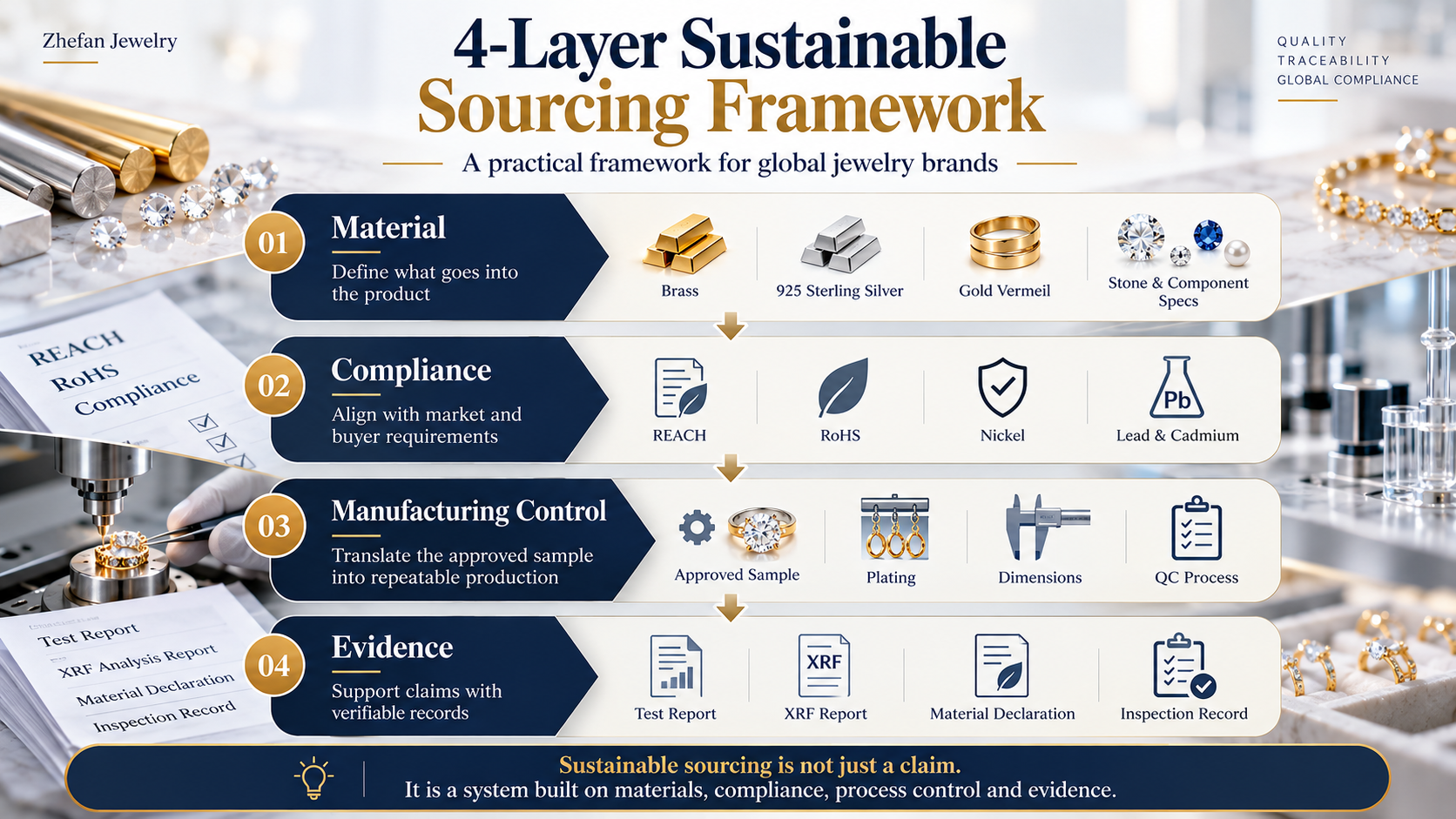
Sustainability and compliance are related, but they are not the same thing.
A jewelry product can meet a restricted-substance requirement without having a fully traceable or environmentally optimized supply chain. Likewise, a supplier may promote recycled materials or environmentally responsible practices while still lacking the technical documentation required by a retailer or importer.
Professional procurement teams therefore need to evaluate several layers together.
The first layer concerns the materials entering the product. Buyers need clarity around the metal, plating system, stones, coatings, and other components being used.
The third layer is manufacturing control. Even when an approved sample meets a specification, the same result must be reproducible across hundreds or thousands of units.
The fourth is evidence.
Claims such as "nickel-free," "lead-free," "cadmium-free," “recycled,” “responsibly sourced," or “long-lasting plating” should be connected to specifications, supplier declarations, test reports, or defined manufacturing controls whenever those claims are important to the brand.
That distinction is particularly important for larger buyers.
Their concern is rarely whether one sample looks good.
Their concern is whether the entire sourcing program can remain controlled when the collection expands.
Why China Jewelry Sourcing Requires a Compliance-First Approach
China remains an important jewelry manufacturing base because brands can access specialized casting, polishing, stone setting, electroplating, mold development, CAD engineering, and assembly capabilities within mature manufacturing clusters.
However, production capability alone does not eliminate sourcing risk.
As the number of SKUs increases, small specification gaps become more expensive.
A plating color that was never formally defined can vary between batches. A supplier may describe a component as nickel-free without clarifying whether the statement relates to material composition or nickel release. A buyer may request “gold plating” without establishing the required thickness, base metal preparation, or durability expectation.
None of these problems necessarily begins as a major manufacturing failure.
They often begin as missing specifications.
For this reason, mature jewelry sourcing programs increasingly shift compliance work upstream, before mass production begins.
Instead of testing a finished shipment and hoping it passes, buyers and manufacturers establish the product requirements first and build the manufacturing process around them.
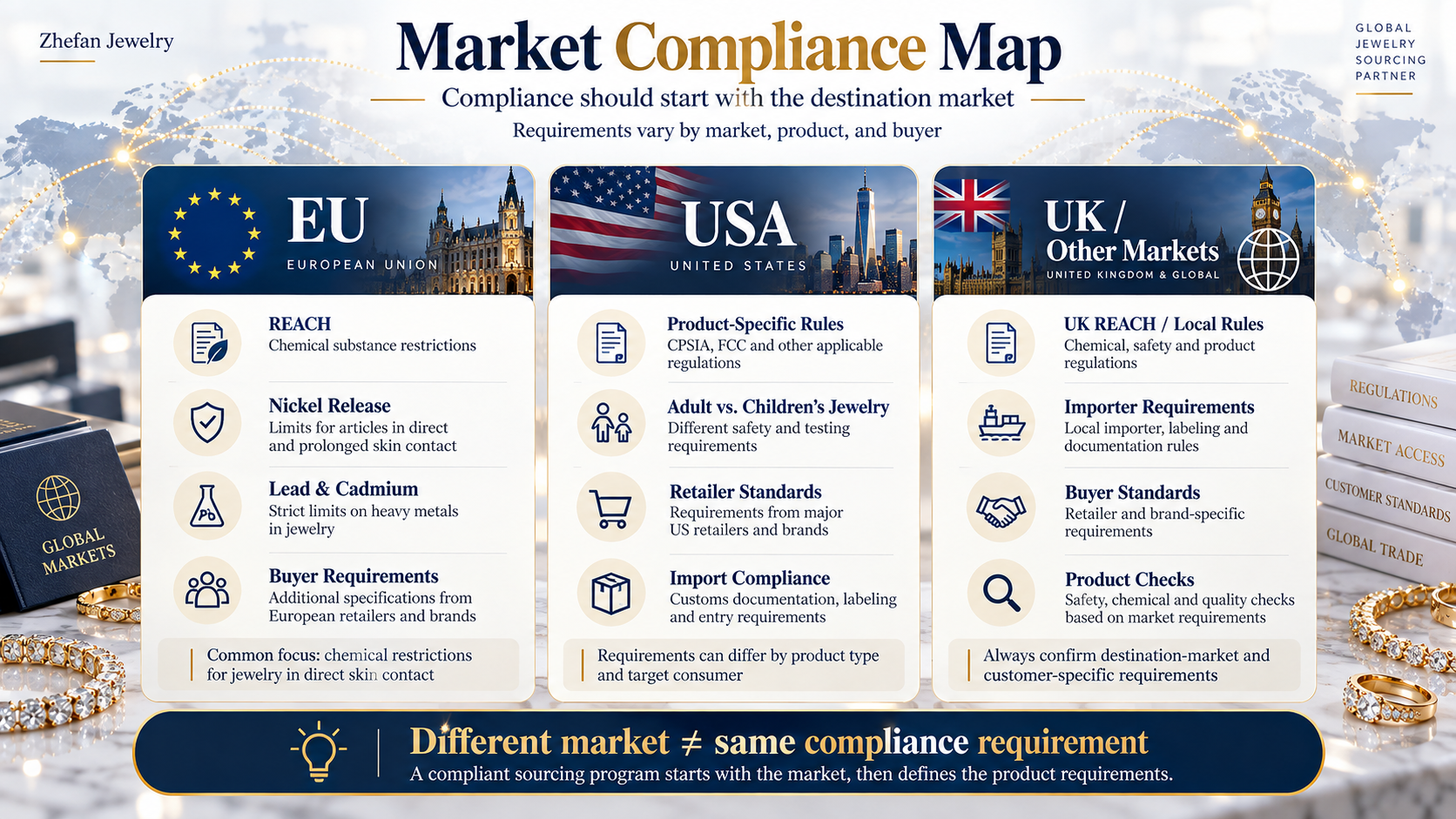
Compliance Should Start with the Destination Market
There is no single universal “jewelry compliance certificate” that automatically makes a product acceptable everywhere.
Requirements depend on factors including product category, material composition, target consumer, destination market, and retailer standards.
For jewelry entering the European market, REACH restrictions can be relevant to substances such as nickel, lead, and cadmium. In particular, European requirements address nickel release from jewelry intended for direct and prolonged skin contact and restrict specified levels of lead and cadmium in jewelry components.
For the United States, requirements depend strongly on the product category and intended consumer. Adult jewelry and children's jewelry should not automatically be treated as the same compliance case. Children's products can be subject to additional federal requirements, including lead-related requirements.
This distinction matters commercially.
A manufacturer should therefore ask where the product will be sold before recommending a compliance program.
A specification developed for a European fashion retailer may not be identical to one developed for a U.S. boutique brand or a children's accessory program.
A professional sourcing relationship begins with a market-specific product brief rather than a generic statement such as “make it compliant.”
A Test Report Is Evidence — Not the Entire Compliance System
One of the most common procurement mistakes is treating a laboratory report as the complete compliance strategy.
Testing is important, but its value depends on what was tested.
Buyers should understand whether a report represents a raw material, a component, one finished SKU, a production batch, or a broader material system.
They should also know when the test was performed and whether the tested construction matches the actual product being ordered.
Imagine that a supplier presents a nickel-related report for one brass necklace.
That does not automatically prove that every earring, bracelet, and ring produced by the factory will have identical results.
Different solder, earring posts, chains, findings, clasps, plating processes, or coatings can introduce different variables.
For enterprise sourcing, the goal should therefore be to build a compliance evidence chain.
The product specification defines what is required.
Material records support what enters production.
Process controls help maintain consistency.
Testing provides independent evidence where appropriate.
Final inspection confirms that the approved requirements have been followed.
Together, these create stronger procurement control than relying on a single certificate.
Material Traceability Should Be Practical, Not Marketing-Led
Large jewelry brands increasingly ask suppliers where materials come from and what documentation can support material claims.
But traceability should be treated carefully.
Terms such as “sustainable metal,” “ethical material," or “eco-friendly jewelry” are too broad to function as technical specifications by themselves.
Instead, procurement teams should translate sustainability expectations into information that can actually be checked.
For 925 sterling silver jewelry, for example, the buyer may need to know the required silver fineness, whether recycled content is requested, whether supporting supplier documentation is available, and whether the material specification can remain consistent across repeat production.
For brass jewelry, composition and restricted-substance requirements may matter more than a general sustainability statement.
For gold vermeil programs, the underlying sterling silver specification, gold layer specification, plating thickness, and verification method should all be clearly defined.
Responsible mineral sourcing can also become relevant where precious metals are involved. International frameworks such as the OECD Due Diligence Guidance encourage companies throughout mineral supply chains to identify and manage risks connected with sourcing minerals and metals.
For procurement teams, the important principle is simple:
Do not ask only whether a material is sustainable. Ask what evidence exists behind the claim.
Plating Is One of the Most Important Sustainability Decisions in Fashion Jewelry
Sustainability discussions in jewelry often focus heavily on raw materials while paying less attention to finishing.
That can be a mistake.
For plated jewelry, the quality of the plating system can directly affect product lifespan, customer complaints, returns, and replacement demand.
If a necklace loses color prematurely, producing another necklace requires additional material, manufacturing, packaging, and transportation.
Durability, therefore, has a sustainability dimension.
For this reason, plating should be treated as a technical specification rather than simply a color choice.
A professional production brief should define the desired finish, plating color, expected thickness or performance level, and any required verification.
Where plating thickness is important, X-ray fluorescence or other appropriate measurement methods can provide objective evidence instead of relying only on appearance.
At Zhefan Jewelry, plating specifications can be customized according to a project, and coating thickness can be checked using X-ray measurement equipment. Supporting plating-thickness reports can also be prepared when required.
This is particularly useful for brands developing different product tiers.
A promotional collection and a premium private-label line may use similar designs but require different plating specifications.
The manufacturing system should be able to distinguish those requirements clearly.
“Lead-Free, Nickel-Free, and Cadmium-Free” Should Be Defined Before Production
These terms appear frequently in jewelry sourcing conversations, but professional buyers should avoid leaving them undefined.
For example, nickel compliance may involve nickel release rather than simply asking whether nickel was intentionally added to the base metal.
This distinction is especially important for earrings, necklaces, bracelets, rings and other products worn in prolonged contact with the skin.
A buyer should therefore communicate the destination market and required standard before the sample is finalized.
At Zhefan Jewelry, projects can be developed around lead-, nickel- and cadmium-related requirements, with relevant test documentation available according to product and customer specifications.
Zhefan's certificate and testing library includes REACH, RoHS, SGS material-related reports, nickel-related testing, lead and cadmium testing and plating-thickness documentation.
For a large brand, however, the most important advantage is not simply possessing old reports.
It is the ability to define what needs to be verified for the current program.
Sustainable Procurement Depends on Repeatability
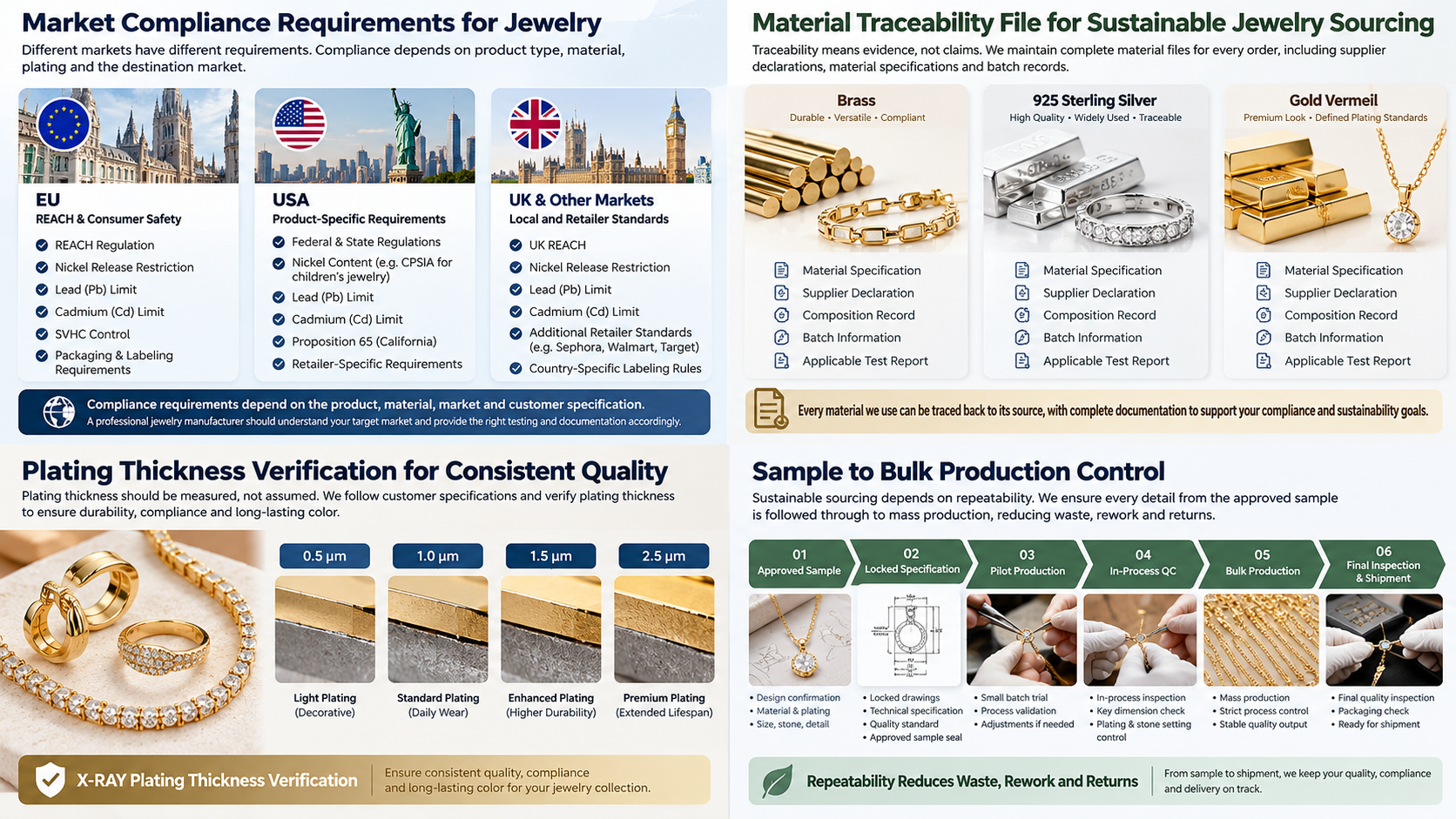
A beautifully finished prototype is not yet proof of a reliable supply chain.
The supplier must demonstrate that the same manufacturing conditions can be controlled when production moves from one sample to 500, 5,000 or multiple recurring purchase orders.
This is where quality management becomes part of sustainable sourcing.
Repeated rejects create waste.
Rework consumes additional labor, electricity and finishing materials.
Returns create additional packaging and transportation.
Incorrect plating or stone setting may require an entire lot to be refinished.
For this reason, reducing variation is not only a quality issue. It also reduces unnecessary resource consumption.
The approved sample should therefore become part of the production standard.
Dimensions, material, stone specification, chain length, clasp construction, plating finish, logo placement, packaging and other critical-to-quality requirements should be documented before bulk production.
The more important the feature is to the customer experience, the less room there should be for interpretation.
How Large Jewelry Brands Should Qualify a China Manufacturer
Large buyers should evaluate suppliers differently from buyers purchasing a small batch of ready-made jewelry.
The first stage should determine whether the factory can understand the product.
The second should determine whether it can control the product.
The third should determine whether it can document that control.
A capable supplier should be able to translate a design brief into manufacturing specifications and identify potential risks before mass production.
If a design includes delicate stone settings, unusual chain structures, complicated enamel areas or specific plating requirements, the factory should be able to explain which variables require additional control.
The conversation should gradually move from:
“Yes, we can make this.”
to:
“This is how we will make it consistently.”
That is a major difference between transactional sourcing and a long-term manufacturing partnership.
The Supplier Documentation Package Brands Should Build Before Scaling
When a program becomes larger, information should not remain scattered across email threads, WhatsApp messages and sample comments.
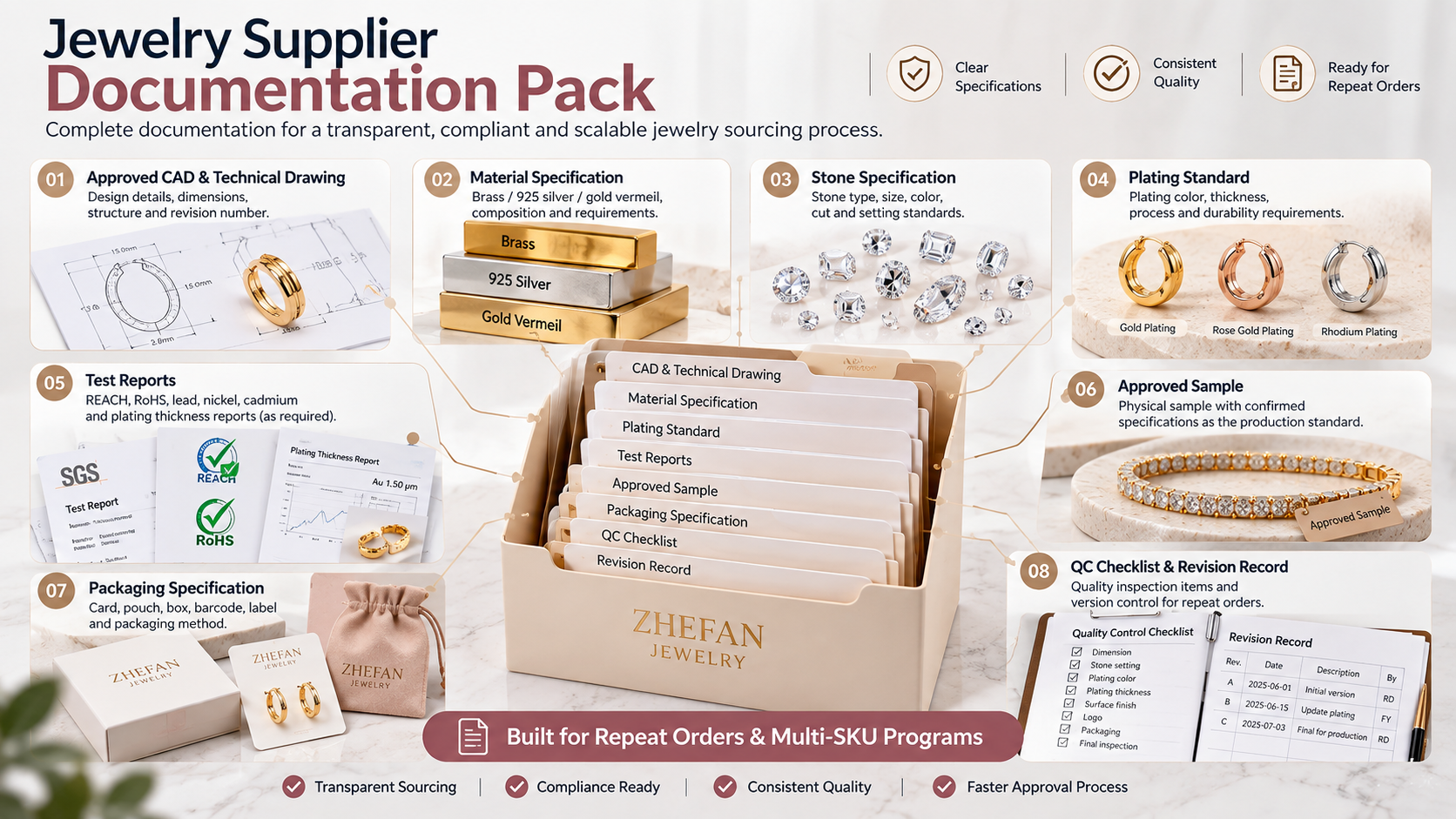
A more scalable approach is to create a product-level manufacturing record.
This can include the approved CAD or drawing revision, base material, dimensions, stone specification, plating requirement, approved color reference, packaging specification and required compliance documentation.
For more demanding programs, buyers may also maintain laboratory reports, supplier declarations, approved sample references and inspection requirements.
The purpose is not paperwork for its own sake.
The purpose is to ensure that critical information remains available when staff change, repeat orders are placed or another production batch begins months later.
Strong documentation creates continuity between design, sampling, purchasing, production and quality control.
That continuity is especially important for international brands managing dozens or hundreds of SKUs.
Supplier Transparency Matters More Than a Long Certificate List
A factory can display many certificates and still be difficult to work with.
For professional buyers, transparency is more valuable than simply the number of logos displayed on a supplier's website.
If a compliance document does not apply to the product being purchased, the manufacturer should say so.
If a claim requires new testing, that should be communicated before production.
If the buyer requests a material that creates technical limitations, the factory should identify the limitation rather than agreeing to an unrealistic specification.
This type of communication reduces purchasing risk.
It also creates a healthier relationship between brand and manufacturer because both parties understand what has been verified and what still needs to be verified.
In sustainable sourcing, credibility often comes from being precise about the limits of available evidence.
Responsible Sourcing and Commercial Performance Are Not Opposites
For many brands, sustainability programs fail internally because they are treated separately from cost, quality and lead time.
In practice, these issues are interconnected.
A durable plating specification may initially cost more but reduce complaints.
A better engineering decision can reduce unnecessary metal weight without weakening the product.
A clearly locked sample can reduce rework.
Better supplier documentation can shorten the approval process for future orders.
A stable production partner can reduce repeated factory qualification.
The goal is therefore not to choose the most expensive or most heavily certified factory.
The goal is to develop a manufacturing system where sustainability, compliance and commercial performance reinforce each other.
For procurement teams, that is a much more useful definition of responsible sourcing.
Why Brand Buyers Should Separate Product Compliance from Factory Claims
One important sourcing principle is that a factory-level claim and a product-level result are not automatically interchangeable.
A manufacturer may have experience producing REACH-related compliant products, but each new collection can contain different components, finishes and materials.
The buyer should therefore evaluate the actual configuration being manufactured.
This principle protects both parties.
It prevents the brand from assuming more than the existing evidence proves.
It also prevents the factory from making overly broad claims about products that have not yet been tested.
A mature sourcing relationship should make this distinction explicit from the beginning.
Building a Compliance-First Partnership with Zhefan Jewelry
For brands sourcing brass, 925 sterling silver and gold vermeil jewelry, Zhefan Jewelry supports both OEM and ODM development from concept and sampling through mass production.
The manufacturing conversation can begin with more than an artwork file.
Brands can specify material, stone size, dimensions, chain length, plating color, plating thickness, packaging and destination-market compliance requirements as part of the development brief.
These requirements can then be connected to the approved sample and subsequent production process.
For projects where plating performance is particularly important, coating thickness can be customized and checked using X-ray measurement equipment.
For product-safety requirements, relevant lead, nickel, cadmium, REACH, RoHS or SGS-related documentation can be reviewed according to the product and market involved rather than treating one certificate as universal evidence.
This approach is particularly valuable for established brands because the real objective is not simply producing one successful SKU.
It is creating a manufacturing system that can support repeat orders, collection extensions and larger purchasing programs without losing control of the specifications that made the original sample successful.
A Better Question to Ask Your Next Jewelry Manufacturer
When evaluating a manufacturer in China, many buyers begin with price, MOQ and production lead time.
Those remain important.
But brands building a long-term supply chain should add another question:
“If our compliance team asks you to prove how this product was specified, produced and verified six months from now, what records will you be able to provide?”
The answer reveals a great deal about the maturity of the supplier.
A strong manufacturing partner should be able to move beyond sales language and discuss specifications, evidence, production controls and verification.
That is where sustainable sourcing becomes operational rather than promotional.
And for global jewelry brands, operational sustainability is ultimately what makes responsible growth scalable.
Conclusion
Sustainable sourcing should not be treated as a marketing label attached to a jewelry collection after production.
For global brands, it should begin with the manufacturing specification.
Material decisions, chemical restrictions, plating durability, supplier documentation, testing and quality control need to work as one system.
That is particularly important when sourcing jewelry from China at commercial scale.
The strongest manufacturing partnership is therefore not the one that makes the broadest sustainability claims.
It is the one that can show how requirements move from the buyer's specification to the approved sample, into controlled production and finally into verifiable evidence.
For jewelry brands preparing to scale a new collection, that is the foundation of a more compliant, transparent and sustainable supply chain.
Planning a brass, 925 sterling silver or gold vermeil collection?
Send Zhefan Jewelry your design, target market, material requirements, plating expectations and required testing standards. Our team can review the manufacturing and compliance requirements before sampling so that critical specifications are defined before production begins.
FAQ
What should I check before choosing a sustainable jewelry manufacturer in China?
Start with the destination market, material specification, product construction, and compliance requirements rather than sustainability claims alone. Evaluate whether the manufacturer can document materials, plating specifications, testing requirements, sample approvals, production controls, and final inspection.
Does a REACH or RoHS report mean every product from a jewelry factory is compliant?
Not automatically. Test reports normally relate to a particular material, component, sample, or tested product configuration. Buyers should confirm whether the report is applicable to the actual SKU being purchased and whether additional testing is necessary.
What documents should a jewelry brand request from a manufacturer?
The required documentation depends on the market and product, but a professional sourcing file may include material specifications, approved drawings, plating requirements, supplier declarations, applicable laboratory reports, approved sample records, and inspection requirements.
How can jewelry brands verify plating thickness?
Plating thickness can be measured using appropriate analytical equipment such as X-ray fluorescence measurement. Buyers should define their required plating specification before production and request measurement documentation when thickness is commercially important.
Is nickel-free jewelry the same as REACH-compliant jewelry?
Not necessarily. REACH contains multiple chemical restrictions, and nickel requirements for jewelry relate particularly to nickel release from articles in direct and prolonged contact with the skin. Compliance should therefore be evaluated against the applicable product and market requirement rather than relying only on a “nickel-free” label.
Can Zhefan Jewelry provide lead-, nickel- and cadmium-related testing?
Zhefan Jewelry has supporting testing documentation covering areas including REACH, RoHS, SGS material testing, nickel, lead, and cadmium requirements. Testing requirements for a new program should still be confirmed according to the specific material, product construction, and destination market.
Can plating specifications be customized for different jewelry collections?
Yes. Different commercial collections may require different plating colors, thicknesses, and performance expectations. Defining these requirements during sampling helps ensure that the approved finish can be translated into repeat production.
Why is compliance important for sustainable jewelry sourcing?
Compliance reduces the risk of rejected products, rework, recalls, and unnecessary replacement production. When compliance requirements are integrated with material control, durable finishing, and repeatable manufacturing, they support both responsible sourcing and better commercial performance.
Recommended for you

What Is Gold Vermeil Jewelry? A Complete Guide for Brands and Retailers

Thick Gold Plated Jewelry Manufacturer for 925 Silver & Brass Jewelry

How to Choose a Gold Vermeil Jewelry Manufacturer

Gold Vermeil vs. Gold-Plated Jewelry: Which Fits Your Luxury Jewelry Brand?

Can Silver or Brass Be PVD Coated? A Professional Guide for Jewelry Brands

How to Make Bulk Jewelry Match the Approved Sample: A Production Control System for Jewelry Brands
Product Categories
Discuss Your Ideas with a Professional Custom Jewelry Manufacturer
We provide personalized jewelry customization services for clients worldwide.
Rest assured that your privacy is important to us, and all information provided will be handled with the utmost confidentiality.
By clicking 'Send Inquiry Now' I agree to ZHEFAN JEWELRY processing my personal data.
To see how to withdraw your consent, how to control your personal data and how we process it, please see our Privacy Policy and Terms of use.
From design to production, ZHEFAN JEWELRY offers a one-stop solution to help you enhance your brand value and market competitiveness.
Get A Quote
Contact
Tel: (+86) 188 1927 7817
© 2026 Zhefan Jewelry. All Rights Reserved.
Facebook
Instagram
YouTube
Whatsapp: +8618819277817