






Email: sales3@zhefanjewelry.com
How to Make Bulk Jewelry Match the Approved Sample: A Production Control System for Jewelry Brands
Approving a beautiful jewelry sample is only the beginning. The real manufacturing challenge is making sure hundreds or thousands of production pieces still match what your product team approved. This guide explains how jewelry brands can lock specifications, control production changes, verify first production units, manage plating and stone consistency, and protect quality across bulk and repeat orders.
- How Can I Make Sure Bulk Jewelry Matches the Approved Sample?
- Why Can Bulk Jewelry Look Different Even After the Sample Was Approved?
- Treat the Approved Sample as a Manufacturing Standard, Not a Photograph
- Define What Must Match Before You Define How to Inspect It
- Lock the Material and Component Structure Behind the Sample
- Control Plating as a Specification, Not Just a Color Name
- Stone Consistency Needs Its Own Production Standard
- The First Production Piece Is More Important Than Another Perfect Development Sample
- Do Not Allow Production Changes to Happen Informally
- Compare Production at the Stage Where the Difference Is Created
- Bulk Inspection Should Use the Sample and the Specification Together
- Separate Critical, Major, and Minor Differences
- Repeat Orders Need More Control Than Most Brands Expect
- What Should a Jewelry Brand Ask Its Manufacturer Before Releasing a Large Order?
- A Practical Bulk-to-Sample Control Framework
- How Zhefan Jewelry Supports Bulk-to-Sample Consistency
- Quality Consistency Is a System, Not a Promise
- Planning a Bulk or Repeat Jewelry Order?
- FAQ
How Can I Make Sure Bulk Jewelry Matches the Approved Sample?
To make bulk jewelry match an approved sample, the sample must become a controlled manufacturing standard rather than simply a visual reference.
The manufacturer should freeze the product specifications after approval, assign the approved version a revision number, use the same confirmed materials and components, verify the first production units before releasing the full run, control any material or process substitutions, and inspect bulk goods against both the physical sample and measurable specifications.
For jewelry brands, the objective is not to expect every handmade or processed piece to be mathematically identical. The objective is to define which variations are acceptable, which characteristics cannot change, and what evidence must be reviewed before the production lot is released.
That distinction is what turns sample approval into scalable manufacturing control.
Why Can Bulk Jewelry Look Different Even After the Sample Was Approved?
This is one of the most frustrating situations for a jewelry brand.
The development sample looks right. The plating tone is right. The stones sit correctly. The necklace moves well. The logo is clean. The product team approves it.
Then the bulk order arrives.
The gold tone is slightly warmer. Some stones sit higher than others. A bracelet feels lighter. The clasp tension is different. The polished surface is less refined. A logo has shifted by a fraction that becomes obvious once hundreds of units are placed next to one another.
The natural reaction is to ask:
“We approved the sample. Why doesn't the production look the same?”
The answer is that a sample proves that one acceptable piece can be produced. It does not automatically prove that the manufacturing process can repeatedly produce that result at scale.
A development sample may receive more individual attention than a production unit. Bulk manufacturing introduces additional variables: larger material batches, multiple operators, repeated casting cycles, larger stone quantities, polishing variation, plating-bath conditions, component replenishment, tooling wear, and packaging-line handling.
For an established jewelry brand, therefore, the question should not only be
“Do we like the sample?”
The stronger question is
“Has everything that makes this sample acceptable been converted into a repeatable production standard?”
That is where bulk consistency begins.
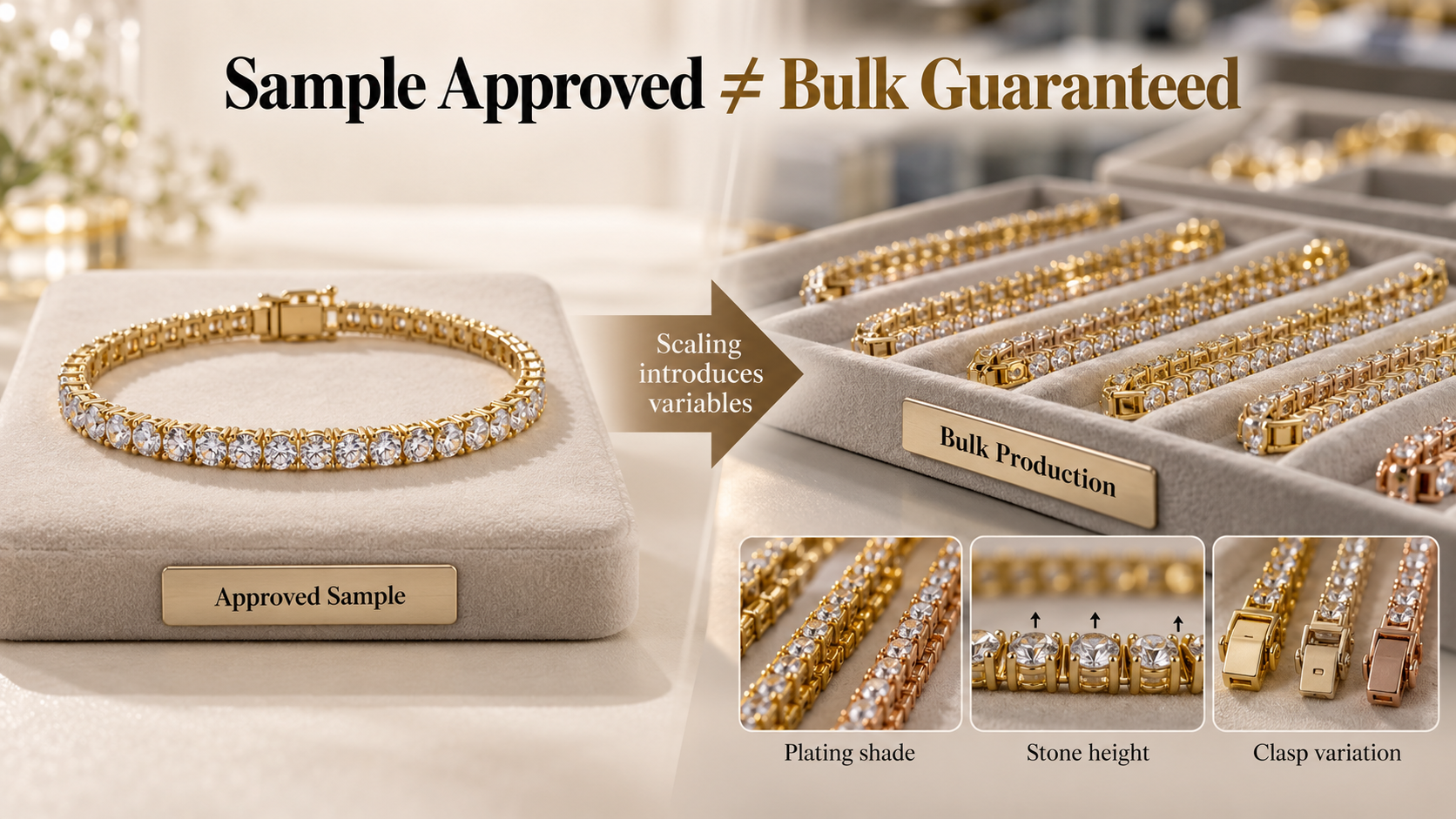
Treat the Approved Sample as a Manufacturing Standard, Not a Photograph
Many production disputes happen because the buyer and factory believe they approved the same thing when, operationally, they approved different things.
A buyer may approve the overall look.
The designer may be focused on proportion.
The merchandiser may be focused on retail price.
The factory may understand the approval as permission to begin production.
The QC team, meanwhile, may not know which details are critical to the brand and which variations are commercially acceptable.
A physical sample by itself cannot communicate all of this.
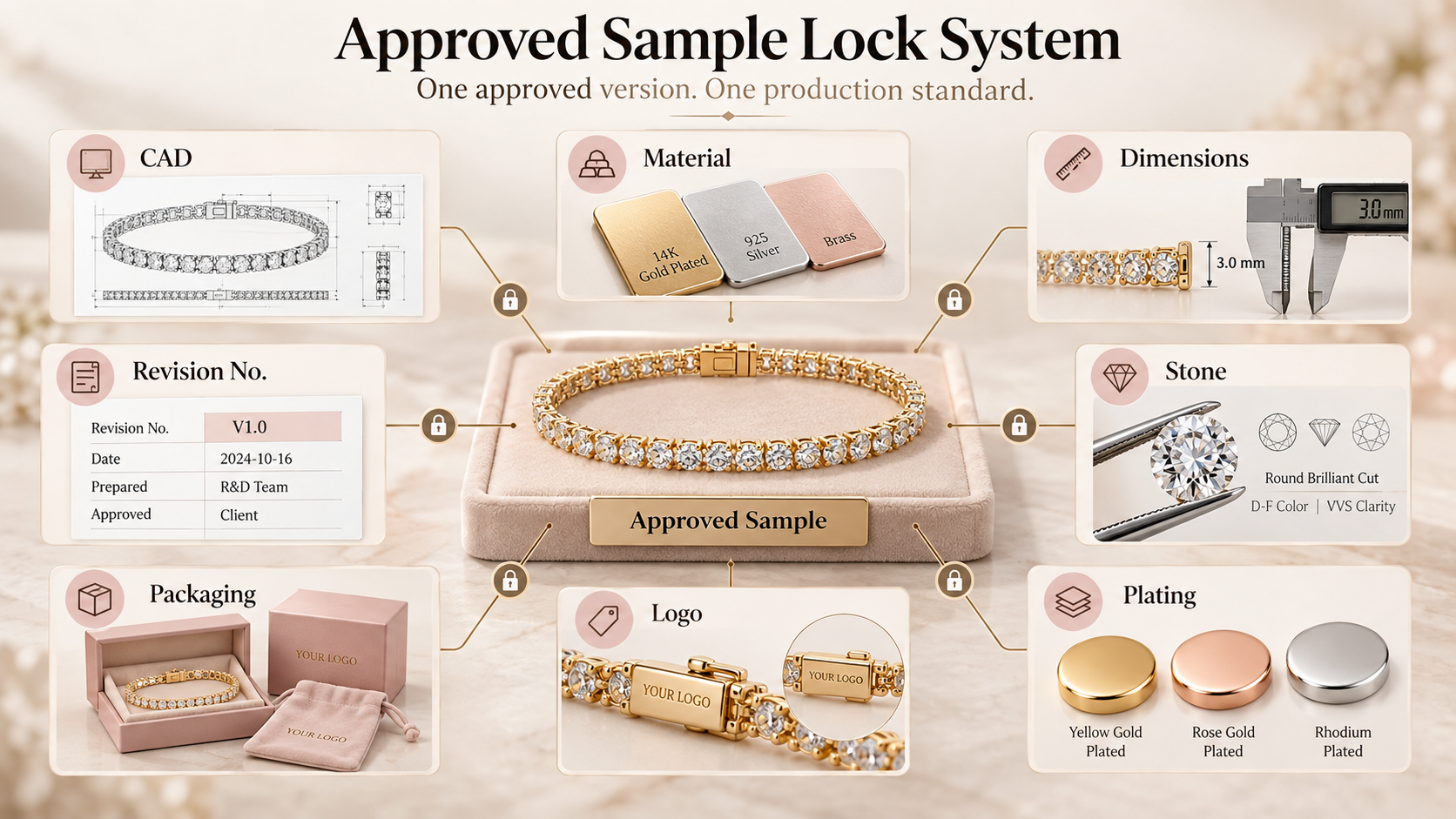
Once a jewelry sample is approved, it should be connected to an Approved Sample Lock File containing the information required to reproduce it.
That file should establish the approved material, dimensions, weight expectations where relevant, stone specification, stone size and layout, plating color, plating construction or thickness requirement, surface finish, logo position, chain or findings, clasp construction, packaging, and other product-specific requirements.
The approved physical piece and the technical file must represent the same revision.
If the CAD says one dimension, the quotation says another, and the physical sample contains a third, the project has not actually been frozen.
For larger jewelry programs, every production-critical document should therefore refer to one SKU and one revision.
Instead of approving “the gold bracelet sample,” a controlled project may identify it as something similar to:
Style TB204 / Revision C / Production Approved / 18K Gold Color / Approved September 2026.
The exact naming convention is less important than ensuring that purchasing, production, and quality teams are all working from the same version.
Define What Must Match Before You Define How to Inspect It
“Must match the sample” sounds clear, but it is not an inspection specification.
Two people may look at the same jewelry piece and disagree about whether it matches.
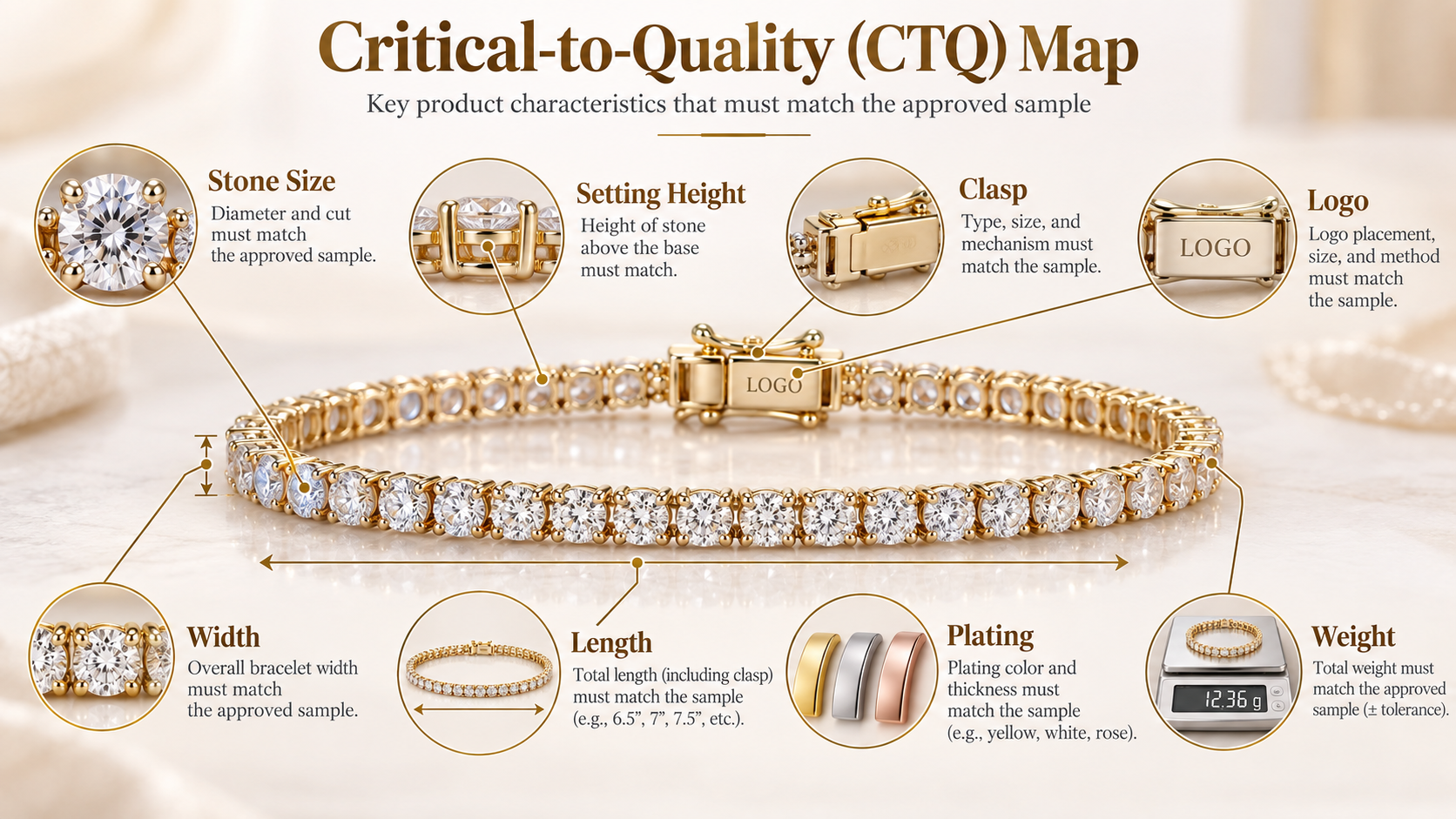
A professional bulk-production standard converts the important characteristics of the sample into critical-to-quality characteristics, or CTQs.
For a sterling silver necklace, one CTQ may be pendant dimensions.
For a tennis bracelet, stone alignment and articulation may matter more.
For earrings, post position and closure function may be critical.
For a gold-plated brass collection, plating color and surface preparation may have a greater commercial impact than a very small dimensional difference.
This is why a jewelry brand should not copy generic tolerances from another product.
Tolerance should follow the construction, function, manufacturing method, and customer expectation of the actual SKU.
The technical team should identify what affects appearance, function, durability, fit, branding, compliance, and customer experience and then define how those characteristics will be evaluated.
This produces a much stronger instruction than simply telling the factory:
“Please make the bulk exactly like the sample.”
Lock the Material and Component Structure Behind the Sample
A product can look similar to the sample during final inspection while being technically different underneath.
This is particularly important for jewelry.
A change in base metal, chain, clasp, solder, stone batch, earring post, plating underlayer, or coating process may not be immediately obvious in photographs.
Yet that change can affect weight, skin-contact performance, durability, color, movement, or repeat-order consistency.
For this reason, sample approval should freeze not only the visible design but also the Bill of Materials and key production inputs.
For a brass or 925 sterling silver design, the record should identify the approved metal construction.
For stone-set jewelry, it should identify the approved stone dimensions, appearance requirements, and relevant matching criteria.
For plated jewelry, the approved surface and plating requirements should be recorded separately from the base material.
For branded products, logo artwork and placement should have their own controlled version.
A manufacturer should not silently replace a component simply because a visually similar alternative is available.
If a production-critical input changes, the buyer should know before the change reaches thousands of units.
Control Plating as a Specification, Not Just a Color Name
Plating is one of the most common reasons a bulk order can appear different from an approved jewelry sample.
Descriptions such as “18K gold color,” “light gold,” “champagne gold” or “rose gold” are useful commercially, but they do not fully define a manufacturing standard.
The final appearance of plated jewelry can also be affected by surface preparation, polishing, the base material, intermediate layers, plating chemistry, process conditions, and finishing.
That is why the approved physical sample remains useful for visual comparison, while measurable process specifications provide additional control.
If plating thickness is commercially important, it should be stated before mass production rather than discussed after the goods are finished.
For projects where verification is required, X-ray fluorescence testing can be used to assess plating thickness or material composition at agreed measurement locations, depending on the product and testing objective.
The important principle is that a brand should not approve appearance while leaving the technical plating expectation undefined.
A sample may tell the factory what the product should look like.
The plating specification helps explain how that appearance and performance should be reproduced.
Stone Consistency Needs Its Own Production Standard
Stone-set jewelry introduces another type of production drift.
A necklace containing one center stone and a tennis bracelet containing dozens of repeated stones do not create the same manufacturing risk.
As the number of stones increases, variations in diameter, cut, color, setting depth, prong position, and alignment become more visible across a large batch.
For this reason, phrases such as “use the same CZ as the sample” are often too vague for serious production programs.
The approved product should be connected to a defined stone specification and, when appearance is especially important, an accepted reference range.
The factory should also evaluate the finished setting rather than checking loose stones alone.
The stone can technically meet the purchase specification, while the finished product still looks different because the setting height, spacing, or prong work has changed.
This is especially relevant to tennis bracelets and tennis necklaces because small inconsistencies repeat across an entire line of stones and can become visually obvious.
The First Production Piece Is More Important Than Another Perfect Development Sample
One of the best ways to reduce sample-to-bulk differences is to verify a piece produced under actual production conditions.
This is different from repeatedly asking the sample room to make another highly polished prototype.
The first production verification should come from the intended manufacturing route using the approved materials, tooling, production processes, finishing sequence, stone-setting method, and components.
The purpose is not to ask:
“Can the sample team make this product correctly again?”
It is to answer:
“Can the normal production process reproduce the approved standard?”
If the first production pieces reveal a change in dimensions, setting quality, polishing, clasp performance, or plating appearance, the issue can be corrected before it is multiplied across the full purchase order.
For higher-value programs or technically sensitive designs, this release point can save significantly more time and cost than discovering the same issue during final inspection.
Do Not Allow Production Changes to Happen Informally
A strong bulk-jewelry program needs change control.
Imagine that the original clasp becomes unavailable during production.
The factory finds another clasp that looks nearly identical.
Should production continue?
For a low-risk decorative component, perhaps the replacement can be approved quickly.
For a component affecting dimensions, function, weight, logo positioning, skin contact, or product durability, the decision may require a new sample or additional verification.
The important point is that the change should not be invisible to the buyer.
A professional process records what is changing, why it is changing, which SKUs are affected, and whether the change influences any approved critical specification.
The buyer then approves or rejects that deviation before it becomes part of the production lot.
This is particularly important for brands managing multiple collections, because undocumented substitutions may not cause an obvious problem on the first order but can make future replenishment increasingly difficult to control.
Compare Production at the Stage Where the Difference Is Created
Final inspection is important, but relying only on final inspection is inefficient.
By the time a finished jewelry piece has been cast, polished, stone-set, plated, assembled, branded, and packed, a defect created during an earlier operation may already contain significant labor and material cost.
Some inconsistencies are also easier to identify before later processes hide them.
Casting and dimensional issues should be identified before expensive finishing work.
Surface defects should be corrected before plating.
Stone-setting problems should be identified before the entire piece is completed.
Plating problems should be evaluated before thousands of products reach individual packaging.
Packaging and labeling should be checked before cartons are sealed for shipment.
The objective of in-process control is therefore not simply to “inspect more.”
It is to compare the product with the approved standard at the point where a meaningful deviation can still be corrected efficiently.
For large-volume jewelry orders, that distinction has a direct effect on rework, production delay, and launch risk.
Bulk Inspection Should Use the Sample and the Specification Together
A physically approved sample is extremely valuable because some characteristics are difficult to communicate completely through numbers.
Polish level, visual proportion, tactile feel, stone presentation, and subtle color differences may still require comparison against an approved physical reference.
But the sample should not be the only acceptance criterion.
Dimensions, product length, stone sizes, logo position, weight where applicable, plating requirements, component identity, and packaging details are better controlled using measurable specifications.
A strong final-inspection system therefore uses both.
The sample communicates the approved product.
The specification defines what can be objectively measured.
The inspection plan defines how the lot will be evaluated.
Where an acceptance-sampling system is appropriate, buyers and suppliers may agree to use an AQL-based approach based on a recognized framework such as ISO 2859-1. The specific inspection level and acceptance criteria should be selected according to the product and commercial risk rather than copied from another jewelry order.
An AQL plan also does not replace product specifications.
A sampling system can tell you how many units to inspect and how to evaluate a lot, but it cannot decide whether an uneven prong, loose clasp, incorrect plating color, or misplaced logo is acceptable unless those defects have already been defined.
Separate Critical, Major, and Minor Differences
Not every difference between two jewelry pieces has the same commercial importance.
A tiny cosmetic mark in an area that is invisible during normal use is not the same as an unsafe sharp edge.
A slightly different internal polishing mark is not equivalent to an incorrect metal.
A packaging scuff is not the same as a loose stone.
Brands should therefore agree with their manufacturer on how defects are classified.
Critical issues generally require the strongest control because they can affect safety, compliance, or fundamental product suitability.
Major defects can make the product commercially unacceptable or cause a customer return.
Minor defects are smaller workmanship variations that do not normally prevent the product from being sold or used as intended.
The exact classification should reflect the brand's retail positioning and the product itself.
A premium department-store program and a promotional jewelry program may legitimately establish different cosmetic standards even when they use similar manufacturing processes.
That expectation needs to be defined before production, not negotiated after the shipment has been completed.
Repeat Orders Need More Control Than Most Brands Expect
The first bulk order is not the end of the consistency problem.
For established brands, repeat production can be more important.
A replenishment order placed six months later may involve a new metal batch, a new stone batch, a maintained or repaired mold, a different production schedule, or replenished components.
If the factory only works from the latest purchase order and a few photographs, small differences can accumulate over time.
This creates what procurement teams often experience as production drift.
The solution is controlled product history.
The approved sample, final specification, revision record, component requirements, plating reference, and agreed deviations should remain connected to the SKU.
When a repeat order begins, the factory should confirm whether any critical input has changed since the previous accepted production.
If nothing has changed, the production team can work against the retained standard.
If something important has changed, that change can be reviewed before production begins.
This is how a brand moves from “reordering the same design” to maintaining a repeatable manufacturing program.
What Should a Jewelry Brand Ask Its Manufacturer Before Releasing a Large Order?
The most useful supplier question is not simply
“Do you have QC?”
Almost every manufacturer can answer yes.
A stronger conversation is
“Show us how our approved sample becomes the production standard used by your production and QC teams.”
The answer should explain how specifications are frozen, how revisions are controlled, how materials and components are identified, how first production pieces are verified, how plating and stone requirements are communicated, how deviations are approved, and how final inspection compares the shipment against the approved version.
For a purchasing team, this reveals much more than a generic factory-quality statement.
It shows whether the manufacturer's quality system is actually connected to the buyer's product.
That distinction becomes increasingly important as order quantities, SKU counts, and replenishment frequency grow.
A Practical Bulk-to-Sample Control Framework
|
Control Point |
What the Brand Should Lock |
What Production Should Verify |
Main Risk Prevented |
|
Approved version |
SKU, revision, approved sample, and technical file |
Correct version released to production |
Wrong sample or old revision used |
|
Material |
Base metal, findings, and key components |
Approved inputs used |
Undocumented substitution |
|
Dimensions |
Critical measurements and acceptable ranges |
First production and sampled units |
Fit and proportion drift |
|
Stones |
Type, size, appearance, and setting standard |
Matching and setting consistency |
Uneven color, alignment, or stone height |
|
Surface finish |
Polish, texture, and visual standard |
Pre-plating surface quality |
Plating magnifying existing defects |
|
Plating |
Color, construction, and thickness are where specified. |
Process record and verification where required. |
Shade or durability inconsistency |
|
Function |
Clasps, hinges, links, and moving parts |
Functional testing |
Customer-use failures |
|
Branding |
Logo, hallmark, and placement |
Correct artwork and position |
Brand presentation errors |
|
Packaging |
Card, pouch, label, barcode, and pack-out |
Final packed-product check |
Retail or fulfillment errors |
|
Change control |
Approved inputs and revision history |
Buyer authorization for material changes |
Silent production drift |
|
Repeat order |
Retained specification and approved reference |
Revalidation before production |
Batch-to-batch inconsistency |
How Zhefan Jewelry Supports Bulk-to-Sample Consistency
For jewelry brands, wholesalers, and private-label programs, Zhefan Jewelry supports OEM and ODM manufacturing across 925 sterling silver, brass, and gold vermeil jewelry.
The objective after sample approval is not simply to send the sample to production and inspect finished goods at the end.
Product requirements can be translated into controlled production references covering material, dimensions, stone specifications, plating color and thickness where required, surface finish, logo details, chain or clasp configuration, and packaging.
For projects where plating verification is important, X-ray fluorescence testing can be discussed and plating-thickness reports can be provided according to the agreed project requirements.
Different plating colors and thicknesses can also be developed according to the product positioning, target price, wear expectation, and market requirements rather than applying one generic plating specification to every collection.
For brands with restricted-substance requirements, project-specific requirements for lead, nickel, and cadmium can be confirmed before production together with available testing documentation.
Zhefan's manufacturing approach also incorporates multiple polishing and quality-inspection stages. However, the value of a quality-control system is not simply the number of inspections performed.
The more important question is whether those inspections are checking the characteristics that were actually approved by the buyer.
That is why the approved product specification should remain the reference from development through bulk production and subsequent repeat orders.
Quality Consistency Is a System, Not a Promise
No serious jewelry brand should depend on a supplier simply promising:
“Don't worry. Bulk production will be exactly the same.”
Reliable manufacturing does not come from reassurance.
It comes from controlled specifications, approved references, first-production verification, process control, documented changes, appropriate inspection, and traceability.
The approved sample is the starting point.
The manufacturing system behind it determines whether that approval survives the transition to 500, 5,000, or 50,000 pieces.
For procurement and product-development teams, this also changes the way manufacturers should be evaluated.
The best question is no longer:
“Can this supplier make one beautiful sample?”
It becomes:
“Can this supplier reproduce our approved product consistently, explain deviations before they affect the order, and maintain the same standard when we reorder?”
For a growing jewelry brand, that is the difference between successful sampling and reliable supply.
Planning a Bulk or Repeat Jewelry Order?
If your team already has an approved sample, technical drawing, or existing product and needs a manufacturer to reproduce it at scale, send Zhefan Jewelry your design files or reference sample together with the material, plating, stone, dimensions, quantity, packaging requirements, and target market.
Our OEM/ODM team can review the product requirements before production and help convert the approved design into a clearly defined manufacturing specification.
Talk to Zhefan Jewelry About Your Bulk Production Requirements
FAQ
Is an approved jewelry sample enough to guarantee bulk quality?
No. An approved sample proves that an acceptable piece can be produced, but it does not by itself prove that hundreds or thousands of pieces can be reproduced consistently. The sample should be supported by a controlled specification, revision record, approved materials, measurable critical requirements, first-production verification, and a defined bulk-inspection process.
What is the difference between a prototype and a production-approved sample?
A prototype primarily validates the design, proportion, construction, or concept. A production-approved sample should represent the materials, dimensions, stones, finishing, plating, branding, and components intended for bulk manufacturing. Some companies refer to the final approved reference as a master sample or golden sample, but the terminology matters less than defining exactly what has been approved.
How can I prevent plating color from changing between the sample and bulk production?
Approve a physically plated reference and document the plating requirements before production. The manufacturer should control the base material, surface preparation, and plating process and compare finished production against the approved reference. Where plating thickness is specified, an appropriate measurement method such as XRF can be used according to the agreed project requirements.
Should every bulk jewelry piece be measured against the sample?
Not necessarily. The appropriate inspection method depends on the characteristic and risk. Some critical or functional features may require 100% checking, while other workmanship or dimensional characteristics may be inspected using an agreed sampling plan. The important point is to define the inspection method before production.
What happens if a component becomes unavailable after sample approval?
The manufacturer should not silently substitute a production-critical component. The proposed replacement should be documented and assessed for its effect on appearance, dimensions, function, durability, material requirements, or compliance. If the change affects an approved critical characteristic, the buyer may require additional verification or a revised sample before production continues.
How can I make repeat jewelry orders match the original order?
Maintain the approved reference sample, final specification, revision number, material and component requirements, plating reference and approved deviations for each SKU. Before a repeat order enters production, confirm whether any key material, supplier, component, tooling or manufacturing condition has changed.
What should I request before approving a bulk jewelry shipment?
The exact evidence depends on the product, but a professional release process normally compares the shipment against the approved sample and specification and verifies relevant dimensions, workmanship, stone setting, surface finish, plating, product function, branding, quantity, packaging, and required documentation.
What information should I send Zhefan Jewelry for a bulk-production review?
Send your approved physical sample or clear reference, CAD or technical drawings if available, required material, dimensions, stones, plating requirements, logo details, packaging, estimated quantity, and destination market. If there are characteristics that your brand considers non-negotiable, identify them before quotation and production so they can be incorporated into the manufacturing specification.
Recommended for you
PVD Coating vs Electroplating for Jewelry: A B2B Buying Guide for 925 Silver and Brass

Thick Gold Plated Jewelry Manufacturer for 925 Silver & Brass Jewelry

Can Silver or Brass Be PVD Coated? A Professional Guide for Jewelry Brands

Thick Gold-Plated Brass Jewelry vs Gold Vermeil: A B2B Material Strategy for Jewelry Brands
Product Categories
Discuss Your Ideas with a Professional Custom Jewelry Manufacturer
We provide personalized jewelry customization services for clients worldwide.
Rest assured that your privacy is important to us, and all information provided will be handled with the utmost confidentiality.
By clicking 'Send Inquiry Now' I agree to ZHEFAN JEWELRY processing my personal data.
To see how to withdraw your consent, how to control your personal data and how we process it, please see our Privacy Policy and Terms of use.
From design to production, ZHEFAN JEWELRY offers a one-stop solution to help you enhance your brand value and market competitiveness.
Get A Quote
Contact
Tel: (+86) 188 1927 7817
© 2026 Zhefan Jewelry. All Rights Reserved.
Facebook
Instagram
YouTube
Whatsapp: +8618819277817