



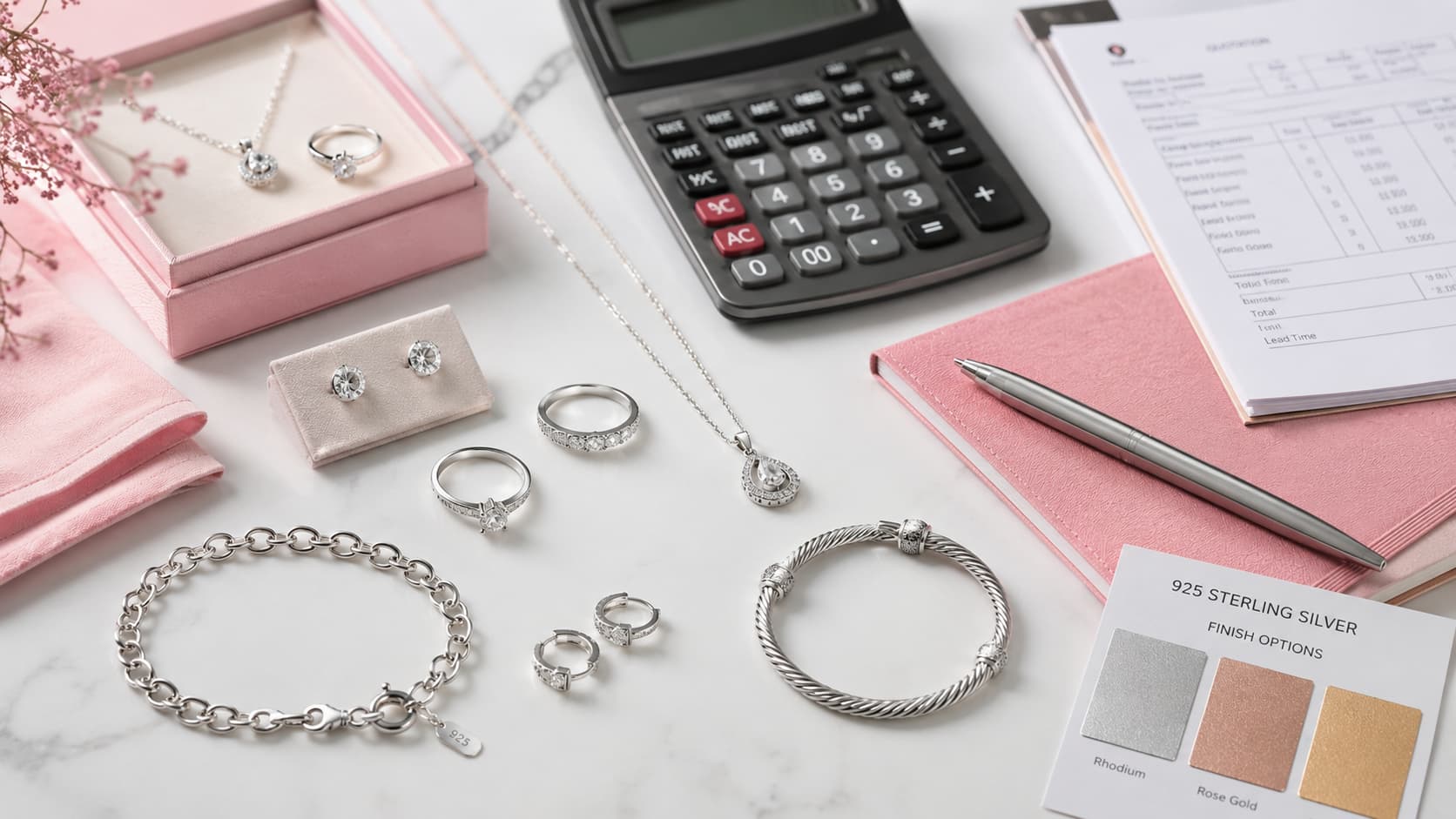
How to Improve Margins When Sourcing Custom Sterling Silver Jewelry
Jewelry margins are not really decided at the point of sale — they are mostly locked in earlier, during sourcing. By the time a piece is priced for retail, its silver weight, plating spec, mold cost, MOQ structure, and quality control process have already determined how much room is actually left for profit.
This guide focuses specifically on where margin is won or lost when sourcing custom sterling silver jewelry — cost structure, common margin leaks, MOQ planning, and how to compare quotes properly. For a broader look at sourcing 925 silver categories, OEM/ODM basics, and material verification, see our 2026 wholesale custom sterling silver jewelry guide.
Why Margins Are Decided Before Production Starts
925 sterling silver, usually 92.5% silver and 7.5% other metal, typically copper, sits in a useful spot for wholesale brands: it is a recognized precious metal, which supports a higher retail position than base-metal jewelry, while costing meaningfully less than solid gold per troy ounce.
That gap between material cost and retail positioning is where margin potential comes from — but how much of that potential actually survives into your final profit depends on decisions made well before the product ever reaches a customer: how the piece is designed, which supplier produces it, how MOQ is structured, and how quality is verified before shipment.
Unnecessary silver weight increases unit cost before the product even reaches plating or packaging.
A clear quote helps you understand what is included and what may become an extra cost later.
MOQ by style, size, or plating color affects cash flow and unsold inventory risk.
Defects that pass into the market become returns, replacements, or brand reputation costs.
Cost Structure of Custom Sterling Silver Jewelry
Before you can protect margin, it helps to see clearly what is actually driving cost on a typical custom order:
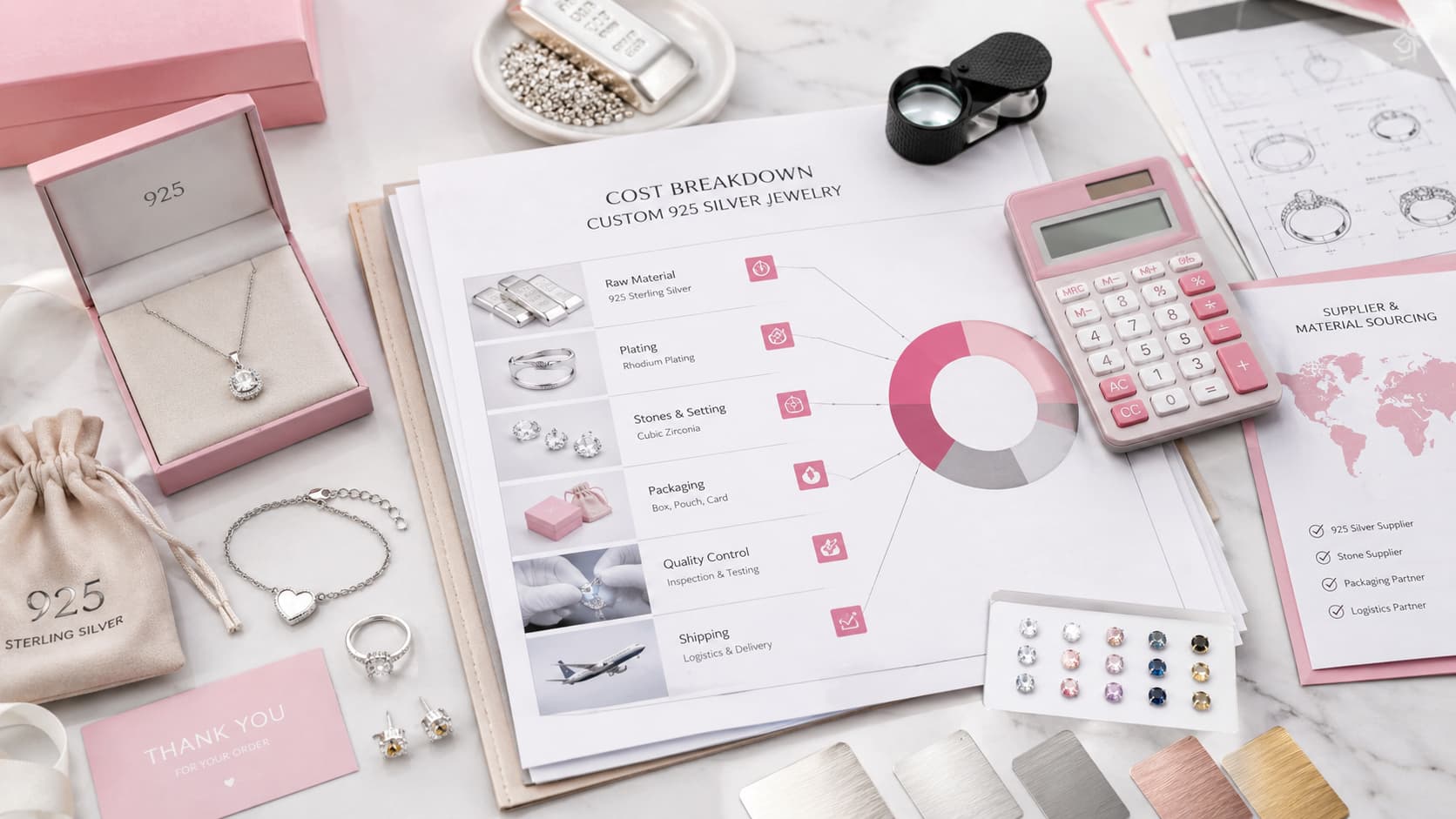
Directly affects raw material cost. Confirm net weight, hollowing feasibility, and wall thickness.
Impacts labor cost and perceived value. Confirm CZ, zircon, moissanite, and setting method.
Affects appearance and return risk. Confirm rhodium or gold plating specs, thickness, and e-coating.
Affects first-order cost. Confirm OEM mold fee, ownership, and reuse terms.
Affects brand value and unit cost. Confirm box, pouch, backing card, barcode, and insert details.
Helps prevent costly returns. Ask for inspection reports, material reports, and plating checks.
Affects cash flow. Confirm MOQ per style, color, size, and category.
Affects landed cost. Confirm air, sea, courier, destination, and Incoterms.
Looking at a quote through this lens — rather than just the final unit price — makes it much easier to spot where one supplier's number is actually lower, and where it is just hiding a cost you may encounter later.
Common Margin Leaks When Sourcing Sterling Silver Jewelry
A lot of profit loss does not come from one obvious mistake. It often comes from small sourcing decisions that quietly increase cost, reduce consistency, or create return risk. These are the most common margin leaks to watch for:
More silver cost without more perceived value. Use CAD to optimize wall thickness and hollow structure where appropriate.
Tarnish complaints and returns can erase unit-price savings. Confirm plating specs and testing method.
Lost stones lead to replacements and complaints. Use secure setting methods and sample testing.
Splitting MOQ across too many styles increases unsold inventory risk. Start with a focused collection.
Less technical control can slow corrections. Verify factory capability and quote transparency.
Defects become return cost. Ask for QC photos, inspection records, and clear checking standards.
Late packaging confirmation can cause rework and delays. Confirm packaging before bulk production.
Stockouts reduce sales after a style proves demand. Plan reorder lead time early.
Optimize Silver Weight Without Weakening the Design
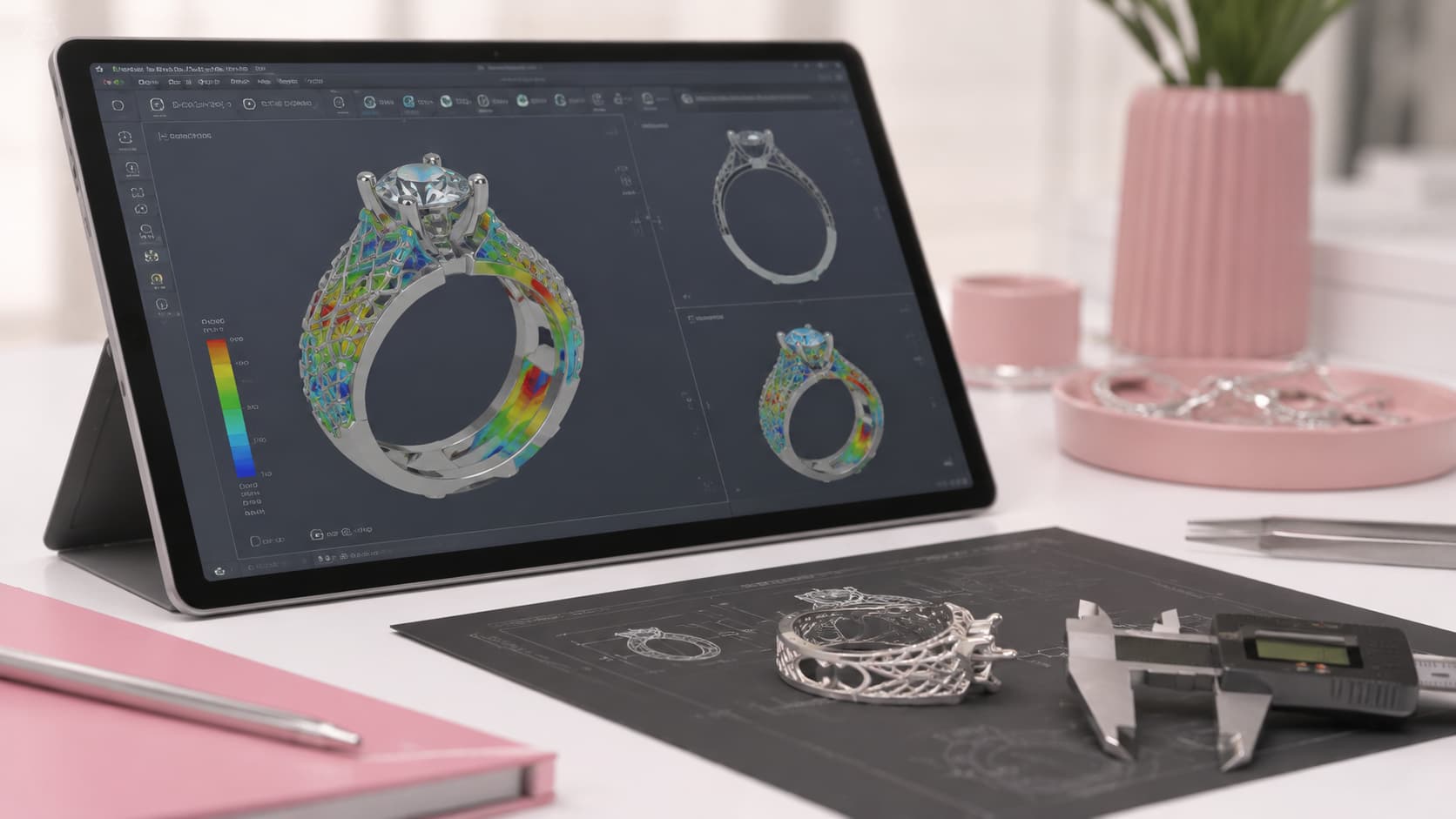
Silver weight is usually one of the biggest line items in unit cost, which makes it the first place to look for legitimate savings — without cutting corners on durability. During the CAD design phase, designers can review thick bands, hollow statement pieces, and calibrate wall thickness for strength rather than unnecessary mass.
How much weight can realistically be reduced depends heavily on the specific design, size, and how much structural support the piece needs for daily wear. There is no single fixed percentage that applies across all styles, so it is worth asking your manufacturer for design-specific recommendations rather than assuming a blanket reduction target.
Choose Stones and Finishes That Raise Perceived Value
Beyond the base silver, stone and finish choices are where you can add perceived value without jumping to fine-jewelry pricing:
When mechanically set rather than glued, higher-grade CZ can read as more premium and hold up better over time.
Moissanite offers a harder, higher-brilliance alternative to CZ at a price well below many natural stones.
Can help improve brightness and tarnish resistance compared with unplated silver, depending on plating thickness, wear conditions, and care.
Can help improve color retention on gold-toned silver pieces, depending on plating specifications and use conditions.
OEM vs ODM: How Tooling Affects First-Order Margin
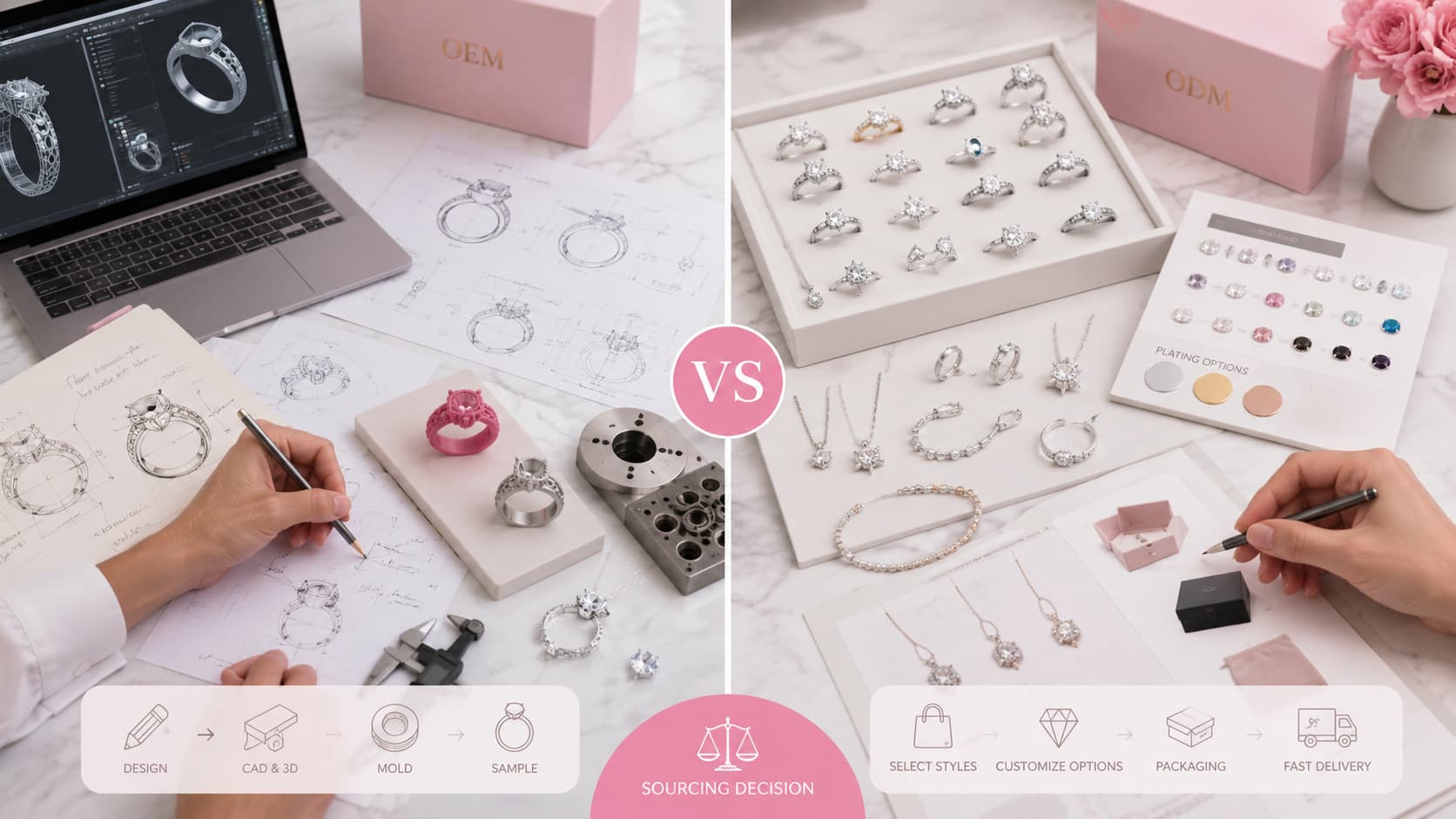
Tooling decisions have an outsized effect on your first-order economics. ODM means customizing an existing factory design, which avoids new mold fees and can be more cost-efficient for testing a collection. OEM means building a fully custom design from your own sketches or CAD files, usually with a one-time mold fee and a longer sampling timeline, but with stronger design exclusivity.
| Buyer Situation | Better Starting Point | Margin Logic |
|---|---|---|
| First test order | ODM | Lower development cost and faster market validation. |
| Proven bestseller | OEM | More exclusivity and stronger long-term control over the design. |
| Complex or unique design | OEM | Better control over structure, mold, stone setting, and brand differentiation. |
| Seasonal trend or short launch window | ODM | Faster launch and lower tooling risk. |
A common and practical approach is to start core collections with ODM to keep upfront tooling costs low, then move specific proven bestsellers into OEM once you are confident they justify the mold investment. Mold fees vary significantly by design complexity, so get a specific quote rather than assuming a standard cost.
Factory Direct vs Trading Company: Hidden Cost Differences
Many suppliers found through general sourcing platforms are trading companies rather than factories — they source from multiple manufacturers and manage logistics and communication on your behalf. This is not automatically a problem, but it can add a layer of intermediary cost and reduce how much technical detail you get directly.
| Factor | Factory Direct | Trading Company |
|---|---|---|
| Pricing transparency | Can usually explain cost breakdown by component | Often quotes a bundled price without detail |
| Technical communication | Direct access to engineering and production details for mold, plating, and QC questions | Communication passes through an intermediary |
| Mold correction speed | Faster, since the factory controls tooling and sample adjustment | Slower, dependent on the underlying factory's schedule |
| Quality control visibility | Can typically provide inspection records or photos from production | May have limited visibility into the production floor |
Neither model is inherently better in every case, but knowing which one you are working with helps you set realistic expectations for pricing transparency, technical control, and how quickly issues get resolved.
MOQ and Cash Flow Planning for Sterling Silver Jewelry
Minimum order quantities directly affect how much capital sits in inventory versus how much stays liquid. The goal is not always to chase the lowest unit price; it is to find the balance between unit cost, launch risk, stock depth, and reorder flexibility.
Confirm whether MOQ is counted by design or across an entire category.
A silver, gold, and rose gold finish may each require separate minimum quantities.
Rings and some bracelets may split MOQ by size, affecting total stock commitment.
Some manufacturers may discuss more flexible first-order options when a project includes mold development or clear repeat-order potential.
A lower MOQ reduces cash tied up in inventory and lowers the risk of unsold stock, but it sometimes comes with a higher per-unit price. The better question is which combination of MOQ and unit cost minimizes total risk for a given style.
QC and Compliance: Protecting Margins from Returns
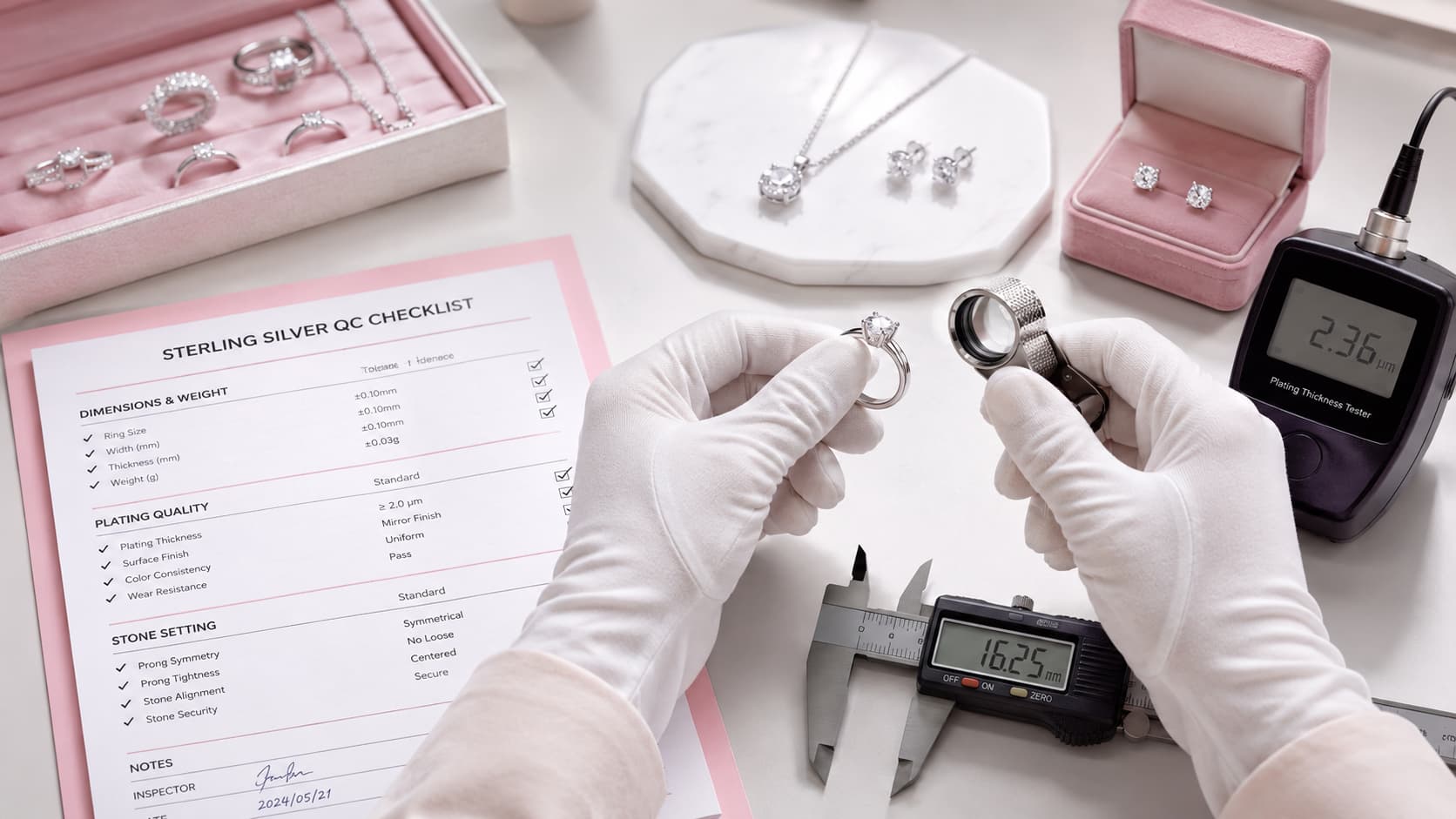
Quality control is not just a quality issue — every avoidable defect that reaches a customer becomes a margin cost, whether through a return, a replacement, or a damaged brand reputation. For sterling silver jewelry, QC should focus on plating consistency, stone setting security, material authenticity, surface finishing, and packaging accuracy.
For more detail on inspection stages and finished product control, review ZHEFAN JEWELRY's quality control practices.
Ask for the specific plating method and thickness, rather than accepting “high-quality plating” as a description.
Mechanically set stones generally hold up better over time than glued ones; ask how setting security is verified.
Lead-free, nickel-free, and cadmium-free production should be backed by applicable documentation where relevant.
Wrong cards, boxes, labels, or barcodes can create rework, delays, and brand presentation issues.
Selling jewelry that does not meet a market's compliance requirements may create compliance risk, product complaints, or retail-channel rejection, so documentation should be confirmed before production rather than assumed afterward.
Quote Comparison Checklist for Buyers
When you are comparing quotes from different suppliers, a lower number on its own does not tell you much. Use these questions to compare quotes on equal footing:
| Quote Item | Risk with a Vague Quote | Better Question to Ask |
|---|---|---|
| Silver weight | Hidden weight reduction lowers cost but may also lower quality | What is the net silver weight per piece? |
| Plating | Vague “high quality” claim | What plating method and thickness are included? |
| Stones | Cheap stones or glue setting | What grade and setting method are used? |
| Mold | Unclear ownership or reuse terms | Is the mold fee one-time? Who owns the mold? |
| Packaging | Not included in the quoted price | Is private label packaging included, or quoted separately? |
| QC | No inspection detail provided | Can you share QC records or inspection photos? |
| Compliance | No documentation offered | What test reports are available for my target market? |
| Shipping | Unit price excludes landed cost | What is the estimated total landed cost? |
Asking these questions upfront — and getting specific answers rather than reassurances — is one of the most effective ways to avoid margin surprises after an order is already in production.
Why Work with ZHEFAN JEWELRY for Margin-Conscious Silver Jewelry Sourcing?
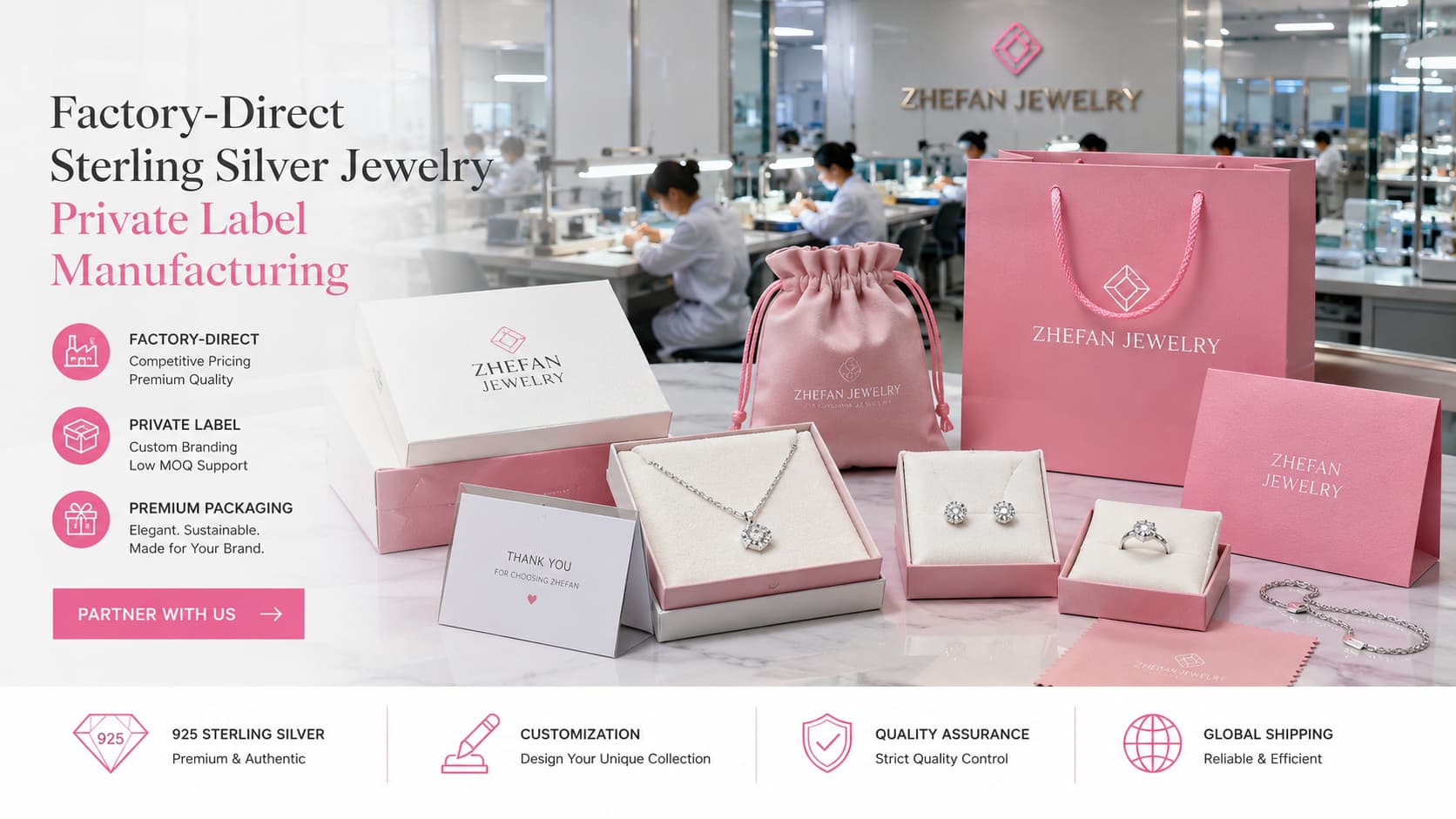
ZHEFAN JEWELRY has factory-based jewelry manufacturing experience dating back to 1997, with production based across Guangzhou and Meizhou. A few specifics relevant to sourcing with margin protection in mind:
Technical communication can cover cost breakdowns, plating specs, tooling details, and production feasibility.
CAD support can be arranged quickly for straightforward concepts, depending on project complexity.
Standard sample support may be arranged in about 5 working days for simpler styles, depending on design and material requirements.
You can start with lower-cost ODM customization and move proven designs into exclusive OEM tooling later.
Production includes structured polishing and inspection stages, including multiple rounds of polishing and quality checks.
Support for lead-free, nickel-free, cadmium-free production and RoHS, REACH, or SGS documentation is available for applicable projects.
Sample support and small-batch trial order options can be discussed for qualified first-time projects.
Production support can help brands move from trial orders into repeat wholesale programs.
More detail on the company's background is available on the About Us page, and inspection practices are explained on the Quality Control page.
FAQ
Why are margins determined during sourcing rather than at retail pricing?
Retail price is just one side of the equation — the other is unit cost, which is largely fixed by decisions made during sourcing: silver weight, plating spec, mold cost, MOQ, and quality control. A higher retail price cannot fully offset a design that uses more silver than necessary or a quote that hides costs that surface later.
How does CAD hollowing reduce silver weight without weakening the design?
CAD hollowing removes silver from thicker, non-structural areas of a design while preserving the parts that provide strength — wall thickness, support points, and load-bearing sections. How much weight can be removed depends on the specific design, size, and durability requirements, so ask for a design-specific recommendation rather than expecting a fixed percentage.
Should I choose OEM or ODM for better margins on my first order?
ODM is typically more cost-efficient for a first order because it avoids new mold fees, making it a lower-risk way to test a design before committing further. OEM makes more sense once a design has proven itself and the exclusivity is worth the mold investment.
How can I tell if a quote is hiding costs that will surface later?
Ask specifically about net silver weight, plating method and thickness, stone setting method, mold ownership, whether packaging is included, and estimated total landed cost. Vague answers on any of these are a signal to ask more questions before committing.
What is the most effective way to reduce tarnish-related returns?
Confirming specific plating method and thickness, and whether e-coating or anti-oxidation finishing is available, is more useful than relying on a general “tarnish-resistant” claim. Actual performance still depends on wear conditions and care, so setting realistic expectations with your own customers also helps reduce return rates.
Does a lower MOQ always mean a better deal?
Not necessarily. A lower MOQ reduces cash tied up in inventory and lowers the risk of unsold stock, but it sometimes comes with a higher per-unit price. The better question is which combination of MOQ and unit cost actually minimizes your total risk for a given style.
How do I verify a supplier's quality control process before placing a bulk order?
Ask for inspection records, QC photos from previous orders, and details on what is checked at each stage, including dimensions, plating consistency, stone setting, and surface finish. A supplier that can show documentation from past production runs is a stronger signal than one that only describes the process verbally.
What is the difference between unit price and landed cost in silver jewelry sourcing?
Unit price usually refers to the product cost quoted by the supplier. Landed cost includes the product cost plus packaging, testing, freight, duties, handling, and other costs required to get the product into your warehouse or fulfillment system. Margin calculations should be based on landed cost, not factory unit price alone.
Want Help Working Through the Cost Structure of a Specific Design?
Share your target product category, reference design, estimated silver weight, plating preference, stone setting needs, packaging requirements, MOQ expectations, and target market with ZHEFAN JEWELRY. Our team can help evaluate OEM/ODM feasibility, cost structure, QC requirements, and a factory-direct production plan for your sterling silver jewelry collection.



Facebook
Instagram
YouTube
Whatsapp: +8618819277817