






Email: sales3@zhefanjewelry.com
Gold Vermeil Jewelry Manufacturing Process: From Design to Production
Master the technical standards of the gold vermeil jewelry manufacturing process. Zhefan Jewelry breaks down the transition from 3D CAD design and precision casting to the critical 2.5-micron gold plating phase. Learn how we ensure superior thickness and bonding for high-end market durability. Essential reading for brands sourcing professional-grade vermeil production.
- Quick Answer
- Key Takeaways
- What Does the Gold Vermeil Jewelry Manufacturing Process Include?
- What Makes Gold Vermeil Jewelry Manufacturing Different?
- How Should Product Requirements Be Defined Before Manufacturing Begins?
- Why Product Definition Comes First
- How Does a Jewelry Design Become a Production-Ready Technical Definition?
- Why Reference Images Are Not Complete Specifications
- When Should Materials, Dimensions and Components Be Confirmed?
- Material Requirements
- Dimensional Requirements
- Component Requirements
- Finish Requirements
- How Are Gold Vermeil Jewelry Components Produced or Prepared?
- What Should the Buyer Control?
- Why the Manufacturing Method Should Not Be Assumed Too Early
- Why Does Surface Preparation Matter Before the Gold Finish?
- Surface Preparation Should Follow the Intended Appearance
- Critical Geometry Should Remain Controlled
- How Should the Gold Vermeil Finish Be Defined During Production?
- Avoid Assuming One Universal Gold Vermeil Finish Specification
- Keep the Finish Connected to the Correct Revision
- When Are Stones, Charms, Clasps and Other Components Assembled?
- Control the Interface, Not Only the Component
- Where Does Quality Control Fit Into the Manufacturing Process?
- Quality Review Should Use Defined Requirements
- How Does the Manufacturing Process Change by Jewelry Category?
- Gold Vermeil Earrings
- Gold Vermeil Necklaces
- Gold Vermeil Rings
- Gold Vermeil Bracelets
- Why Does Revision Control Matter From Design to Production?
- What Happens When Revisions Are Mixed?
- Use One Current Requirement Package
- Which Manufacturing Details Should the Buyer Define and Which Should the Manufacturer Confirm?
- Buyer Requirements May Include
- Manufacturer-to-Confirm Fields May Include
- TBD Fields May Include
- What Information Should a Brand Prepare Before Discussing Production?
- Common Gold Vermeil Jewelry Manufacturing Process Planning Mistakes
- Treating a Reference Image as a Complete Specification
- Locking the Manufacturing Process Before the Product Is Clearly Defined
- Assuming Every Jewelry Product Follows the Same Sequence
- Leaving Finish Requirements Until the End
- Mixing Drawing or Specification Revisions
- Treating Quality Control as Only a Final Inspection
- Guessing Unresolved Manufacturing Details
- Final Gold Vermeil Jewelry Manufacturing Process Checklist
- Frequently Asked Questions
- Discuss Your Gold Vermeil Jewelry Production Requirements
Quick Answer
The gold vermeil jewelry manufacturing process typically moves from design requirements and technical definition to material and component preparation, surface preparation, gold finishing, assembly, quality review and production handoff.
The exact sequence can vary by jewelry category, product geometry, construction method, stones, component design and other project-specific requirements.
For B2B projects, the most important control point is not a universal number of manufacturing steps. It is a clear specification and revision trail that connects each production stage to the intended product requirements.
A manufacturing process cannot be controlled clearly if the product being manufactured has not first been defined clearly.
Key Takeaways
- Product requirements should be defined before manufacturing steps are treated as fixed.
- Reference images communicate visual direction, while technical documents define measurable production requirements.
- For gold vermeil projects, the silver base and final gold finish should be treated as separate controlled requirements.
- Material, dimensions, components and finish requirements should remain connected to the correct product revision.
- The exact manufacturing sequence can vary across earrings, necklaces, rings, bracelets and other jewelry constructions.
- Quality review should be tied to defined requirements rather than vague descriptions such as “high quality.”
- Unresolved technical details should be marked as Manufacturer to Confirm or TBD rather than guessed.
What Does the Gold Vermeil Jewelry Manufacturing Process Include?
A useful way to understand the gold vermeil jewelry manufacturing process is to treat it as a series of control stages rather than one universal factory sequence.
For a custom project, the process may include:
| Stage | Main Question |
|---|---|
| Design requirements | What product is being developed? |
| Technical definition | How is the design translated into measurable requirements? |
| Material definition | What materials and components apply? |
| Component preparation | How are the required parts produced or prepared? |
| Surface preparation | What surface condition is required before the final finish? |
| Gold finish | What finish requirement applies to the project? |
| Assembly | How are components combined into the intended configuration? |
| Quality review | Which requirements must be checked? |
| Production handoff | Which current revision becomes the production reference? |
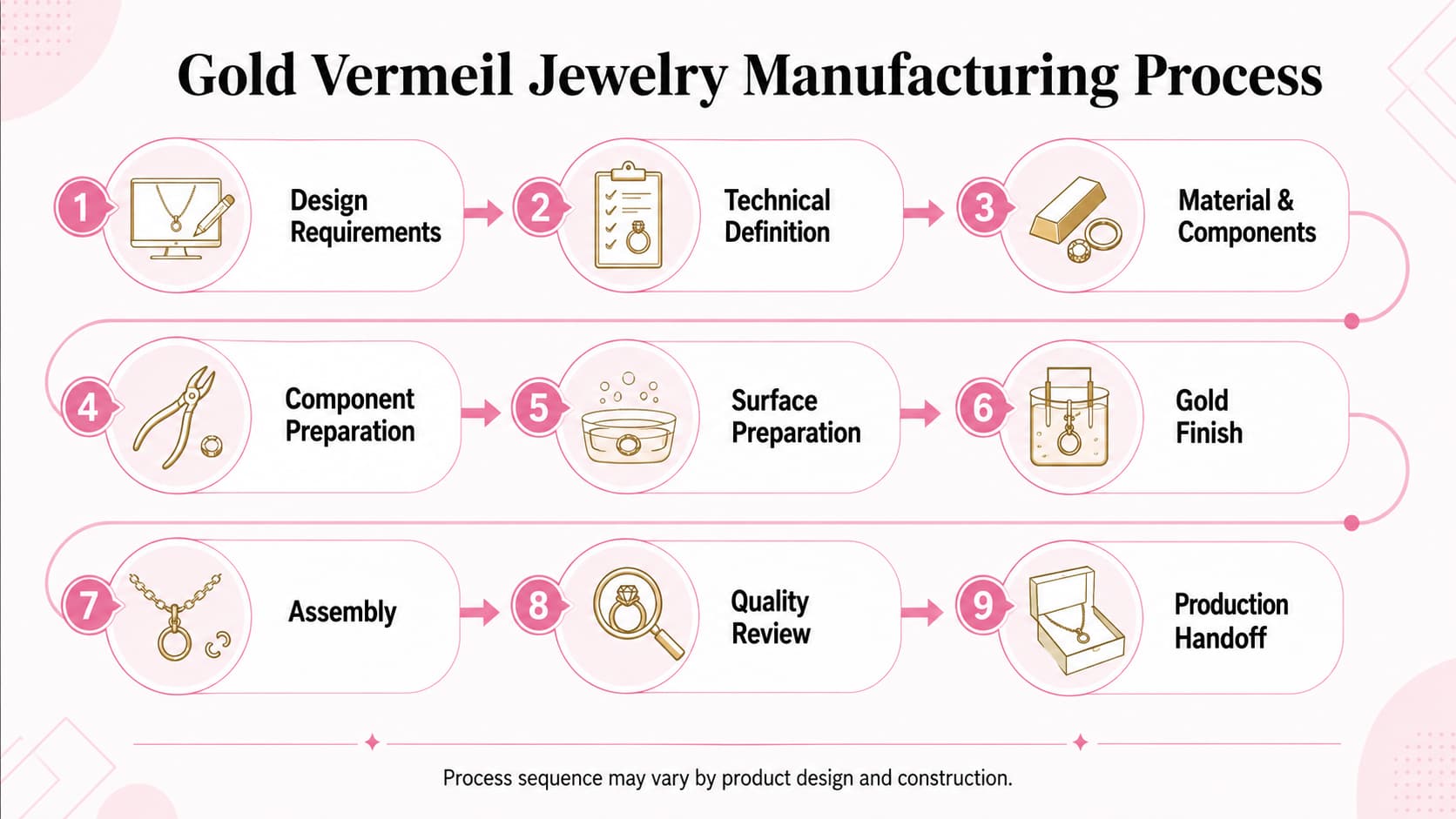
This framework helps brands, product-development teams and sourcing teams separate the product requirement from the manufacturing decisions used to achieve it.
It is not a universal fixed sequence for every jewelry design.
A pair of earrings, a pendant necklace, a stone-set ring and a charm bracelet can require different component relationships, process controls and assembly sequences.
What Makes Gold Vermeil Jewelry Manufacturing Different?
For B2B product development, an important characteristic of a gold vermeil project is that both the silver base and the gold finish should be defined as controlled parts of the product specification.
For a product intended to be specified or marketed as gold vermeil, the production documents should make clear:
- the required silver base;
- which components the material requirement applies to;
- any component-material exceptions;
- the intended gold tone or finish direction;
- the intended surface appearance;
- any confirmed project-specific technical finish requirement;
- any market-specific verification or labeling requirements that apply.
This is different from using a broad description such as “gold color jewelry,” where the base material may otherwise remain unclear.
It also means that product development should not treat the gold finish as an isolated cosmetic decision made only at the end of production.
The substrate, product geometry, surface condition and final finish all belong to the same controlled product definition.
Exact technical finish values, verification methods and market requirements should not be assumed to be universal. They should be confirmed for the specific product and target market.
For broader commercial product references, brands can review Zhefan Jewelry's gold vermeil jewelry range.
For material-positioning considerations, see gold vermeil vs gold-plated jewelry.
How Should Product Requirements Be Defined Before Manufacturing Begins?
Manufacturing starts with product definition.
A visual concept may show what the jewelry should look like, but the production team still needs to understand what the product actually is.
Typical project inputs can include:
- product category;
- style or SKU reference;
- intended dimensions;
- base material requirement;
- component configuration;
- finish direction;
- stones or decorative elements where applicable;
- branding requirements where applicable;
- packaging requirements where relevant;
- current drawing or document revision.
The objective is not to force every technical decision to be finalized immediately.
Instead, the project should distinguish between requirements that are already fixed and requirements that still need technical review.
Why Product Definition Comes First
If the product definition changes, downstream requirements may also change.
For example, changing:
- a pendant dimension;
- a ring band width;
- an earring post configuration;
- a bracelet chain width;
- a clasp type;
- a charm attachment point;
can affect component preparation, interface geometry, assembly relationships and other later-stage decisions.
How Does a Jewelry Design Become a Production-Ready Technical Definition?
A design reference and a production specification do not serve the same purpose.
A sketch can communicate the overall idea.
A reference image can communicate visual direction.
A CAD model, dimensional drawing, component map or other controlled technical document can define measurable requirements where appropriate.
| Design Input | Production Function |
|---|---|
| Sketch | Communicates the concept |
| Reference image | Communicates visual direction |
| CAD file | Defines geometry where applicable |
| Dimensional drawing | Defines measurable dimensions |
| Component map | Identifies component relationships |
| Artwork file | Controls branding or decorative graphics |
| Specification sheet | Connects product requirements to one controlled revision |
Not every project requires every file type.
A relatively simple product may need fewer controlled documents than a multi-component design.
Why Reference Images Are Not Complete Specifications
A reference image usually cannot fully define:
- finished dimensions;
- hidden connections;
- ring sizes;
- clasp interfaces;
- post dimensions;
- pendant bails;
- chain widths;
- component orientation;
- tolerances;
- finish references.
Reference images can still be useful, but they should support rather than replace measurable production information where dimensions and interfaces matter.
When Should Materials, Dimensions and Components Be Confirmed?
Materials, dimensions and components should be confirmed before downstream decisions depend on them.
That does not mean every field must already be finalized.
| Status | Meaning |
|---|---|
| Confirmed | The buyer requirement is fixed |
| Manufacturer to Confirm | The point requires technical or production review |
| TBD | The buyer decision remains open |
This structure prevents incomplete specifications from being filled with guessed values.
Material Requirements
The project should identify the intended base material and any relevant component-material requirements.
For a gold vermeil project, the required silver base should be stated explicitly rather than inferred from a product image or commercial name alone. If different components use different materials or constructions, those exceptions should be documented.
Dimensional Requirements
Relevant dimensions depend on the product category. They can include:
- finished overall dimensions;
- component dimensions;
- chain dimensions;
- pendant dimensions;
- ring dimensions;
- charm dimensions;
- clasp dimensions;
- connector dimensions;
- interface dimensions.
Only dimensions that are already defined should be treated as confirmed.
Component Requirements
A product specification may need to identify components such as:
- chains;
- clasps;
- posts;
- backs;
- jump rings;
- pendants;
- charms;
- settings;
- connectors;
- decorative components.
Each component should be associated with the correct product and current revision.
Finish Requirements
The intended finish should be defined early enough that later production decisions can reference it.
Depending on the project, the finish definition can include:
- gold tone or color direction;
- surface appearance;
- controlled visual reference;
- project-specific technical requirements;
- verification requirements where applicable.
The detailed technical definition of a gold vermeil finish belongs in a dedicated finish-specification guide rather than being repeated in full within this manufacturing-process article.
How Are Gold Vermeil Jewelry Components Produced or Prepared?
Component production can vary significantly according to product geometry and construction.
There is no single component-production method that applies to every gold vermeil jewelry design.
Depending on the product, general jewelry manufacturing methods may include:
- casting;
- forming;
- cutting;
- chain or wire preparation;
- component fabrication;
- machining;
- other component-specific preparation methods.
Not every project requires every method. A cast ring, a chain necklace, a hoop earring and a charm bracelet can follow different component-production paths.
What Should the Buyer Control?
The buyer does not necessarily need to prescribe every manufacturing method.
Instead, the buyer should define the product requirements that need to be achieved. These can include:
- geometry;
- dimensions;
- visible proportions;
- component relationships;
- functional interfaces;
- finish direction;
- branding;
- final product configuration.
The manufacturer can then review which production method is technically appropriate for the product.
Why the Manufacturing Method Should Not Be Assumed Too Early
If a production method is fixed before the geometry and technical requirements are sufficiently understood, the instruction may become unnecessarily restrictive.
A useful distinction is Product requirement versus Manufacturing method. Unless a particular process itself is a confirmed project requirement, the product requirement should normally be defined first.
Why Does Surface Preparation Matter Before the Gold Finish?
Surface preparation affects the condition on which the final finish is presented.
It is therefore more than a cosmetic consideration.
Depending on the product and required appearance, surface preparation may involve processes intended to:
- smooth selected surfaces;
- remove unwanted surface irregularities;
- prepare surfaces for downstream finishing;
- preserve intentional textures;
- maintain defined edges or geometry;
- prepare different areas for different appearance requirements.
The exact preparation sequence can vary according to the design.
Surface Preparation Should Follow the Intended Appearance
A highly polished surface and an intentionally textured surface are different product requirements.
If the design includes:
- polished areas;
- matte areas;
- brushed details;
- recessed textures;
- decorative relief;
those requirements should be identified before finishing.
Critical Geometry Should Remain Controlled
Where dimensions, edge definitions or component relationships are important, surface preparation should not unintentionally alter the intended product geometry. The specification should therefore identify dimensions or visual details that are critical to the finished design.
How Should the Gold Vermeil Finish Be Defined During Production?
The gold finish should be connected to a controlled project requirement.
A vague phrase such as “premium gold finish” does not provide a production team with a clear technical reference.
Depending on the project, the finish definition can include:
- silver base requirement;
- gold tone or color reference;
- surface appearance;
- controlled finish reference;
- project-specific technical finish requirements;
- applicable verification requirements;
- destination-market requirements where relevant.
Exact technical values should only be included when they have been confirmed for the specific project.
Avoid Assuming One Universal Gold Vermeil Finish Specification
Products sold into different markets or developed for different brand requirements may require different documentation. The manufacturing process should therefore reference the confirmed finish requirements for the project rather than assuming one universal technical specification.
Keep the Finish Connected to the Correct Revision
If the project changes from one gold tone, surface appearance or technical finish requirement to another, the revised requirement should be clearly identified. Otherwise, a production team may be working from an outdated visual or technical reference.
When Are Stones, Charms, Clasps and Other Components Assembled?
The assembly sequence depends on the construction of the product.
There is no single assembly order that applies to all gold vermeil jewelry.
Depending on the design, assembly may involve:
- charm attachment;
- pendant-to-chain connection;
- clasp connection;
- post or back installation;
- jump-ring connections;
- stone-setting relationships;
- connector alignment;
- component orientation;
- decorative element placement.
Some operations may occur before other finishing stages, while others may occur afterward.
The suitable sequence depends on the product construction and project requirements.
Control the Interface, Not Only the Component
For B2B production, it is important to define how components relate to one another.
- Where does a charm attach?
- Which chain link receives the charm?
- How does a pendant connect to a chain?
- Which side of an earring carries a decorative component?
- Which connector joins the clasp to the chain?
- What orientation should a pendant or charm maintain?
A component can be individually correct while still being assembled incorrectly if the interface has not been defined.
Where Does Quality Control Fit Into the Manufacturing Process?
Quality control should not be treated only as one isolated final inspection.
Different requirements can be checked at different points in the production process.
| Control Point | What It Can Verify |
|---|---|
| Before downstream processing | Geometry, dimensions, components and product identity |
| During finishing or assembly | Surface appearance, component relationships and visible construction |
| Final review | Finished configuration against controlled product requirements |
The exact control points depend on the product. A multi-component product may require different checks from a relatively simple chain-based design.
Quality Review Should Use Defined Requirements
Expressions such as:
- “high quality”;
- “premium finish”;
- “perfect alignment”;
- “best workmanship”;
do not provide measurable production criteria on their own.
Where possible, quality review should refer to:
- drawings;
- confirmed dimensions;
- component maps;
- finish references;
- approved visual references;
- agreed inspection criteria;
- other controlled requirements.
How Does the Manufacturing Process Change by Jewelry Category?
The general manufacturing-control framework can apply across different jewelry categories, but the product-specific control points change.
| Product Category | Process-Specific Factors to Define |
|---|---|
| Earrings | Posts, backs, hoop geometry, pair configuration, charms |
| Necklaces | Chain length, pendant, bail, clasp, extender |
| Rings | Ring size, band dimensions, setting geometry, stones |
| Bracelets | Length, chain, clasp, extender, charms |
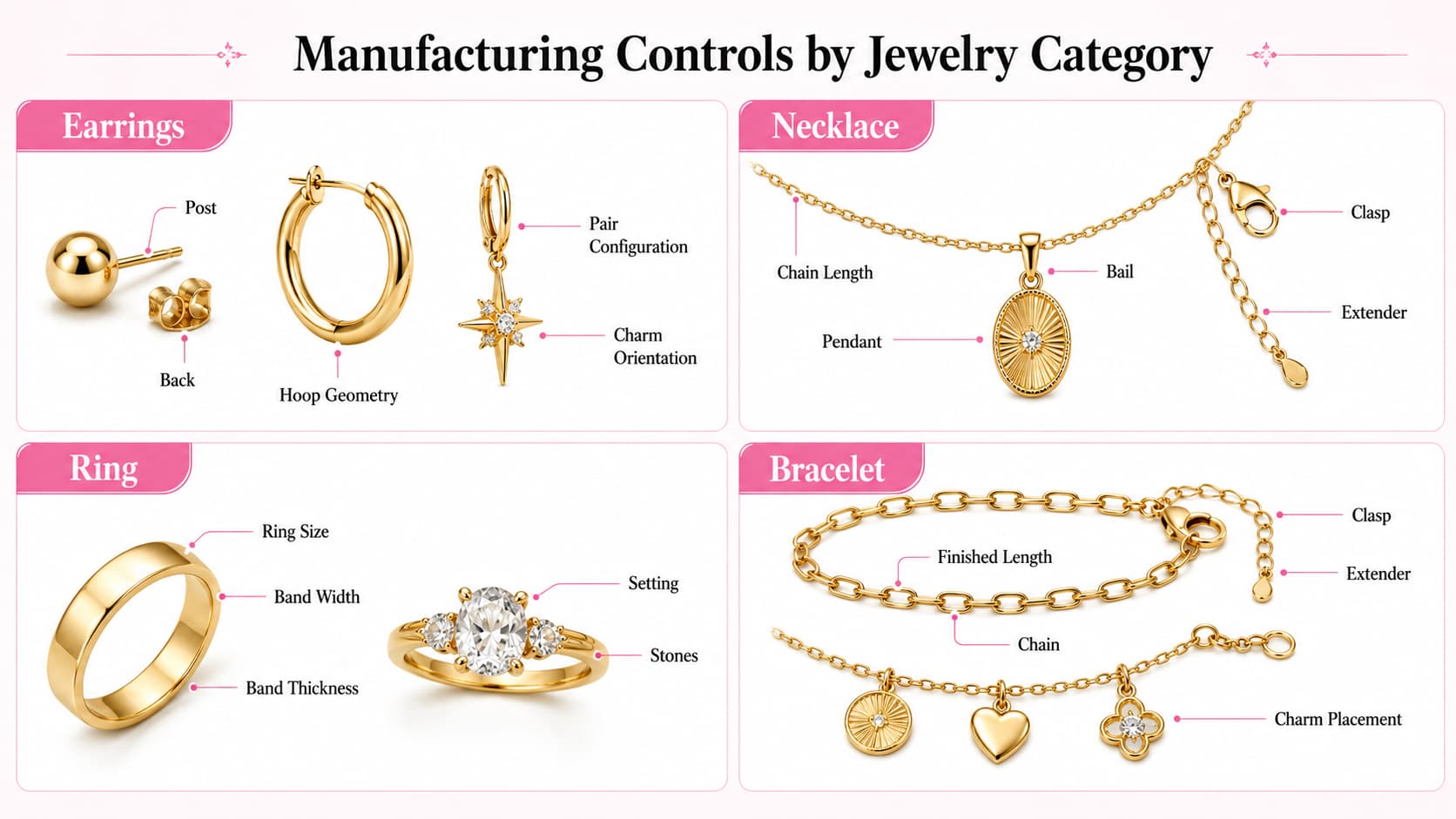
Gold Vermeil Earrings
Earring projects may require control of:
- pair consistency;
- post position;
- post dimensions;
- earring backs;
- hoop geometry;
- charm orientation;
- left/right configuration where applicable.
Brands can review Zhefan Jewelry's gold vermeil earrings for relevant product references.
Gold Vermeil Necklaces
Necklace projects may require control of:
- finished chain length;
- pendant size;
- bail geometry;
- clasp;
- extender;
- pendant orientation;
- connector relationships.
Relevant commercial product references are available in Zhefan Jewelry's custom gold vermeil necklaces.
Gold Vermeil Rings
Ring projects may require control of:
- ring size;
- band width;
- band thickness;
- setting geometry;
- stone configuration;
- decorative orientation;
- finish.
Brands can review Zhefan Jewelry's gold vermeil rings for relevant product references.
Gold Vermeil Bracelets
Bracelet projects may require control of:
- finished length;
- adjustable range;
- chain geometry;
- clasp;
- extender;
- charm placement;
- component attachment points.
Zhefan Jewelry's gold vermeil bracelets provide the commercial entry point to the existing bracelet technical content cluster.
Why Does Revision Control Matter From Design to Production?
A production process is only as controlled as the version of the requirements being used.
Useful revision-control fields can include:
- product ID;
- SKU;
- specification revision;
- CAD revision;
- drawing revision;
- component revision;
- finish reference;
- branding artwork revision;
- packaging artwork revision;
- issue date.
What Happens When Revisions Are Mixed?
Suppose one dimensional drawing contains an updated pendant size while another component map still shows the previous geometry.
Even if both documents are individually clear, they no longer define the same product.
Use One Current Requirement Package
A practical approach is to identify:
- which specification is current;
- which drawings belong to it;
- which artwork belongs to it;
- which previous files have been replaced;
- which fields remain open.
This creates a clearer handoff between product development and production.
Which Manufacturing Details Should the Buyer Define and Which Should the Manufacturer Confirm?
The buyer does not need to decide every manufacturing detail.
A useful project structure separates buyer-controlled product requirements from manufacturing-dependent decisions.
| Status | Meaning |
|---|---|
| Confirmed | The buyer requirement is fixed |
| Manufacturer to Confirm | The point requires technical or production review |
| TBD | The buyer decision remains open |
Buyer Requirements May Include
- product category;
- intended geometry;
- visual design;
- confirmed dimensions;
- base material;
- finish direction;
- branding;
- product configuration;
- packaging requirement where applicable.
Manufacturer-to-Confirm Fields May Include
- production feasibility;
- certain component interfaces;
- suitable manufacturing methods;
- assembly sequence;
- manufacturing-dependent limitations;
- process-specific technical details.
TBD Fields May Include
- an undecided variant;
- an optional component;
- an alternative finish;
- packaging artwork not yet finalized;
- another buyer decision still under review.
An unresolved field is safer when clearly marked as open than when completed with an invented technical value.
What Information Should a Brand Prepare Before Discussing Production?
Before discussing a custom gold vermeil jewelry project with a manufacturer, a brand can organize the information it already knows.
Useful inputs can include:
- product category;
- style or SKU;
- design reference;
- technical drawings where available;
- CAD files where available;
- base material requirement;
- dimensions;
- finish direction;
- component requirements;
- stone requirements where applicable;
- variant information;
- branding requirements;
- packaging requirements where relevant;
- destination-market requirements where relevant;
- unresolved technical questions.
Not every project will have all of these fields finalized.
The goal is to make the current project status clear and distinguish confirmed requirements from open technical questions.
For supplier-evaluation considerations beyond production workflow, see how to choose a gold vermeil jewelry manufacturer.
Common Gold Vermeil Jewelry Manufacturing Process Planning Mistakes
Treating a Reference Image as a Complete Specification
Reference images communicate appearance but may not define dimensions, interfaces, materials or hidden components. Use them as supporting documents rather than as the entire production definition.
Locking the Manufacturing Process Before the Product Is Clearly Defined
The appropriate process depends on the product. If geometry, materials or components are still changing, manufacturing decisions may also need to change.
Assuming Every Jewelry Product Follows the Same Sequence
Earrings, necklaces, rings and bracelets can require different control points and process sequences. Use one workflow framework, but do not assume one universal production path.
Leaving Finish Requirements Until the End
Finish requirements can influence production planning, surface preparation and review. Define the finish direction early enough that downstream decisions can reference it.
Mixing Drawing or Specification Revisions
Multiple revisions can create conflicting production instructions. One current controlled requirement package is easier to manage.
Treating Quality Control as Only a Final Inspection
Some requirements are more effectively checked before later finishing or assembly stages. Quality review should occur where the relevant requirement can be verified most clearly.
Guessing Unresolved Manufacturing Details
Do not invent:
- tolerances;
- plating values;
- process sequences;
- component dimensions;
- testing methods;
- production methods;
simply to complete a specification. Mark unresolved fields as Manufacturer to Confirm or TBD.
Final Gold Vermeil Jewelry Manufacturing Process Checklist
Before a custom gold vermeil jewelry project moves into production discussion, confirm that the project has addressed the following control areas:
| Control Area | Check |
|---|---|
| Product identity | Product name, SKU or style reference is clear |
| Revision | Current specification or drawing version is identified |
| Base material | Silver base requirement is defined |
| Dimensions | Critical dimensions are confirmed or marked open |
| Components | Chain, clasp, posts, charms, stones or other parts are identified where relevant |
| Finish | Gold tone, surface appearance and finish requirements are defined or marked for confirmation |
| Technical files | Current drawing, CAD or component references are identified where available |
| Assembly | Important component relationships and orientation are documented |
| Quality | Key review criteria are connected to defined requirements |
| Open fields | Manufacturer-to-confirm and TBD items are clearly separated |
| Handoff | One current production requirement package can be identified |
A strong manufacturing workflow is not defined by how many steps appear in a process chart. It is defined by whether each important stage is connected to the correct product requirement and current revision.
Frequently Asked Questions
What are the main stages in the gold vermeil jewelry manufacturing process?
The gold vermeil jewelry manufacturing process can include design definition, technical documentation, material and component preparation, surface preparation, gold finishing, assembly, quality review and production handoff. The exact sequence depends on product category, geometry, components and project-specific requirements.
What makes gold vermeil jewelry manufacturing different from generic jewelry production?
For a product intended to be specified or marketed as gold vermeil, both the silver base and final gold finish should be controlled in the product specification. The exact finish values, verification requirements and production sequence remain project-specific rather than universal.
Does every gold vermeil jewelry design follow the same production process?
No. Earrings, necklaces, rings and bracelets can require different component-production, finishing, assembly and quality-control steps. The overall manufacturing framework may be similar, but the detailed sequence should follow the specific product construction.
When should gold vermeil finish requirements be defined?
Gold vermeil finish requirements should be defined before downstream production decisions depend on them. Buyers should identify the intended gold tone, surface appearance and any confirmed technical or verification requirements instead of relying on vague descriptions.
What technical information should be confirmed before production?
Relevant information can include product identification, dimensions, base material, components, finish requirements, technical drawings, CAD references, branding requirements and current document revisions. Unresolved fields should be marked as Manufacturer to Confirm or TBD rather than guessed.
How can the manufacturing process differ between earrings, necklaces, rings and bracelets?
Earrings may require post, back and pair-configuration controls; necklaces may require chain, pendant, bail and clasp controls; rings may require sizing, band and setting controls; bracelets may require length, chain, clasp, extender and charm controls.
Where should quality control occur in the manufacturing process?
Quality review can occur at multiple points depending on the requirement being checked. Geometry and dimensions may be reviewed before downstream processing, component relationships can be checked during assembly, and the final product can be reviewed against controlled product requirements.
What should a brand send to discuss a custom gold vermeil jewelry project?
A brand can prepare the product category, design reference, technical files where available, material and dimension requirements, finish direction, components, variants, branding, packaging requirements where relevant, destination-market requirements where relevant and unresolved technical questions.
Discuss Your Gold Vermeil Jewelry Production Requirements
If your team has a gold vermeil jewelry concept, technical drawing or defined product requirements, prepare the product category, dimensions, base material, finish direction, components, variants and unresolved technical questions before discussing the project with a manufacturer.
Zhefan Jewelry's existing gold vermeil product categories provide commercial reference points across earrings, necklaces, rings and bracelets.
Share Your Project Requirements
Recommended for you

What Is Gold Vermeil Jewelry? A Complete Guide for Brands and Retailers

Thick Gold Plated Jewelry Manufacturer for 925 Silver & Brass Jewelry

How to Choose a Gold Vermeil Jewelry Manufacturer

Gold Vermeil vs. Gold-Plated Jewelry: Which Fits Your Luxury Jewelry Brand?

Can Silver or Brass Be PVD Coated? A Professional Guide for Jewelry Brands

How to Make Bulk Jewelry Match the Approved Sample: A Production Control System for Jewelry Brands
Product Categories
Discuss Your Ideas with a Professional Custom Jewelry Manufacturer
We provide personalized jewelry customization services for clients worldwide.
Rest assured that your privacy is important to us, and all information provided will be handled with the utmost confidentiality.
By clicking 'Send Inquiry Now' I agree to ZHEFAN JEWELRY processing my personal data.
To see how to withdraw your consent, how to control your personal data and how we process it, please see our Privacy Policy and Terms of use.
From design to production, ZHEFAN JEWELRY offers a one-stop solution to help you enhance your brand value and market competitiveness.
Get A Quote
Contact
Tel: (+86) 188 1927 7817
© 2026 Zhefan Jewelry. All Rights Reserved.
Facebook
Instagram
YouTube
Whatsapp: +8618819277817