




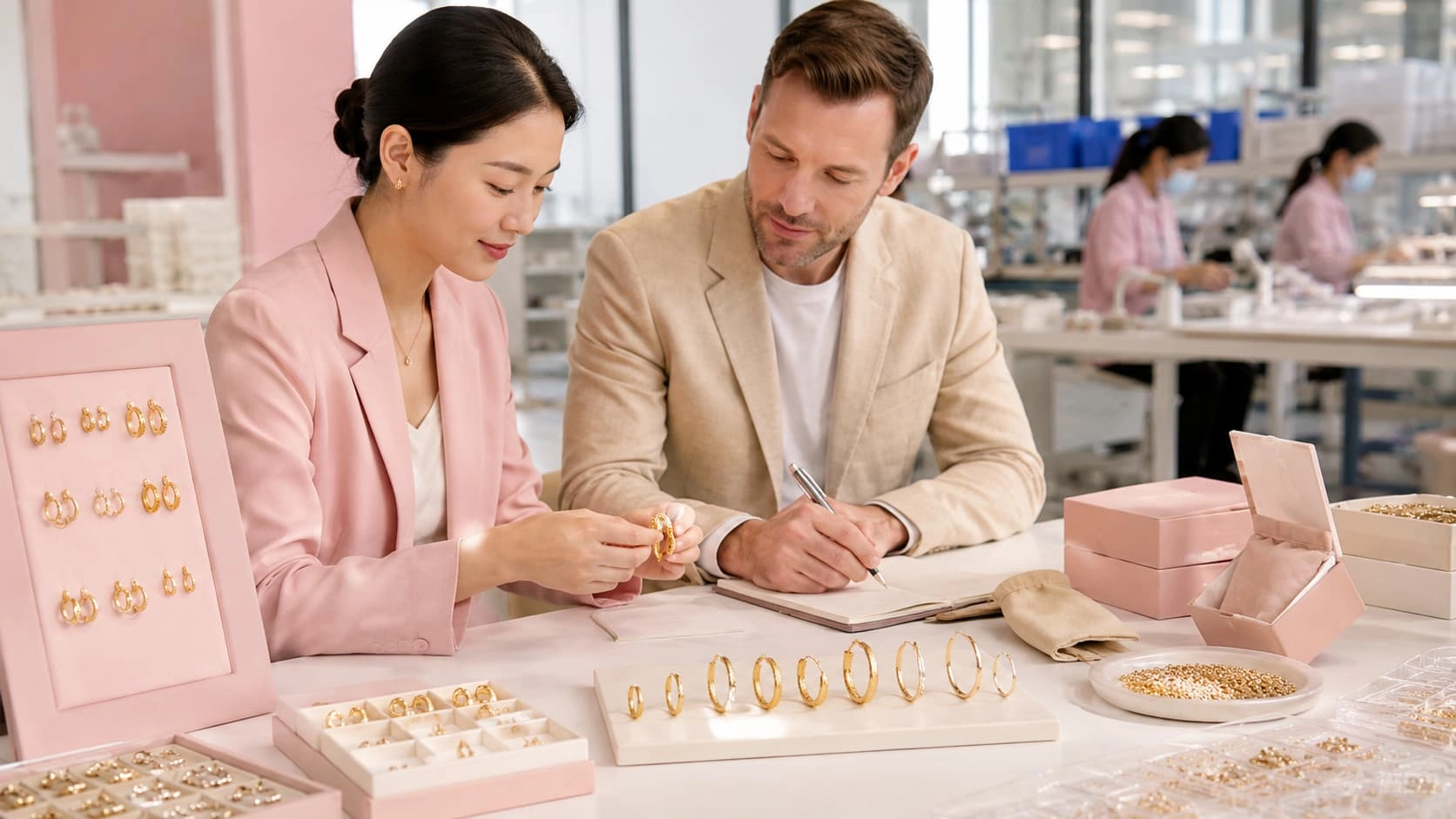
How to Source Custom Brass Huggie Earrings from China: Factory Vetting & QC Guide
Sourcing jewelry from China usually isn't the hard part — finding a manufacturer who behaves like a factory, gives real plating specs instead of vague “high quality” claims, and has a quality control process you can verify is the part that determines whether your brand gets consistent product or a string of returns.
This guide focuses specifically on that part of the process: how to vet a Chinese brass jewelry supplier, what to put in your RFQ, what specifications to confirm before production, and how pre-shipment quality control should work. If you're earlier in the process and deciding what to launch with, see our guide to launching a jewelry brand with custom brass huggie earrings. If you've already chosen brass huggies and want the full rundown on materials, customization, and production specs, see our custom wholesale brass huggie earrings sourcing guide.
Why Source Brass Huggie Earrings from China?
China's jewelry manufacturing clusters — particularly around Guangzhou and the wider Guangdong region — bring a fairly mature, end-to-end supply chain together in one area. Raw brass casting, polishing, stone setting, and electroplating facilities are often located within a practical production network. For buyers, that density tends to translate into a few practical advantages:
Established production experience helps support the detailed shapes and smooth finishing that huggie hoops require.
Buyers can compare basic gold plating, thickened plating, rose gold, rhodium, and protective coating options.
Backing cards, branded boxes, pouches, barcode labels, and retail-ready packaging can be planned with production.
A brand can test a small project first, then move toward larger volumes once a style proves demand.
That said, “made in China” does not guarantee quality on its own. Sourcing well depends on vetting the specific factory you are working with, not just the region. Buyers comparing broader material options can also review ZHEFAN’s brass jewelry manufacturing range.
What to Prepare Before Contacting Suppliers
Before reaching out to factories, it helps to have a clear brief ready. Vague inquiries get vague answers; specific inquiries tend to get specific, useful quotes. At minimum, have these ready:
Confirm whether you need plain, CZ, pearl, enamel, or mixed-style brass earrings.
Visual references help the factory understand size, shape, clasp structure, and surface details.
State whether you want 6mm, 8mm, 10mm, or a custom stacking size set.
Specify 14K gold, 18K gold, rhodium, rose gold, white gold, or other finish requirements.
Clarify CZ, pearl, moissanite, enamel, plain polished, hammered, matte, or twisted finishes.
Your sales market affects compliance requirements, while the launch date affects sampling and production planning.
What to Include in Your RFQ
A well-structured request for quote gets faster, more accurate responses and makes it much easier to compare different suppliers on equal terms. A solid RFQ for custom brass huggie earrings should cover:
| RFQ Item | What to Specify |
|---|---|
| Product type | Brass huggie earrings, with reference images or sketches |
| Size | 6mm / 8mm / 10mm / custom |
| Plating | 14K gold / 18K gold / rhodium / rose gold |
| Plating durability requirement | Standard plating vs. thickened plating / anti-oxidation coating |
| Stone or finish | CZ / pearl / moissanite / enamel / plain polished |
| Logo and packaging | Laser engraving, backing card design, box or pouch type |
| Estimated quantity | Per style and total |
| Target market | US / EU / other, since this affects compliance needs |
| Compliance requirement | Lead-free, nickel-free, cadmium-free; SGS / RoHS / REACH where relevant |
| Target launch date | So the factory can confirm a realistic timeline |
| Shipping destination | Affects freight method and lead time planning |
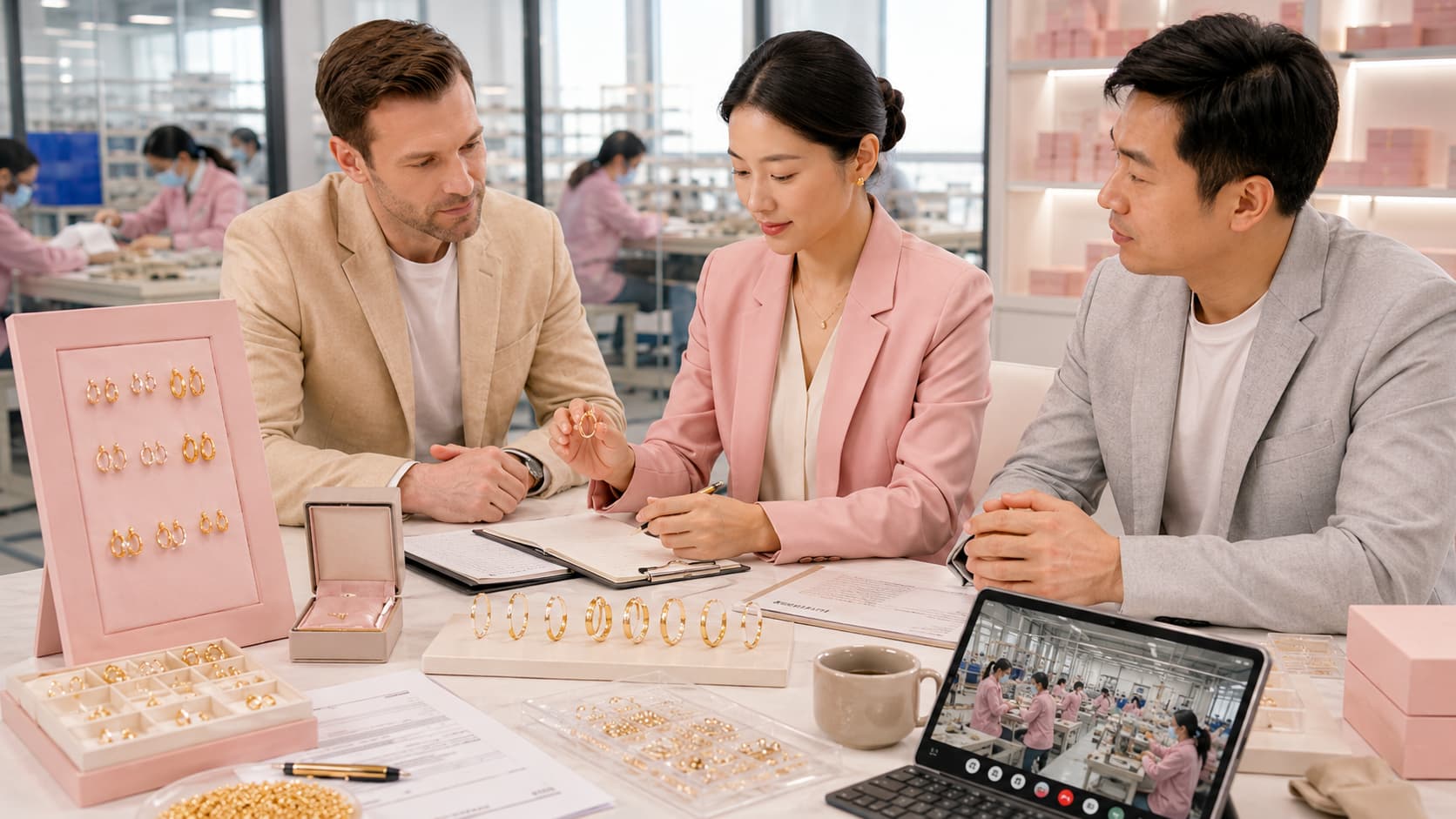
Factory vs. Trading Company: How to Verify the Supplier
A significant share of “suppliers” found through general web searches or marketplaces are trading companies that source from multiple factories rather than producing in-house. That is not automatically a problem, but it changes what you should expect in terms of technical detail, pricing, and control over production.
Neither model is inherently wrong — some trading companies are well-run and responsive — but knowing which one you are dealing with helps you set the right expectations for pricing, lead time, and how much technical detail you will get directly.
| Verification Point | Factory Signal | Trading Company / Risk Signal |
|---|---|---|
| Production video or photos | Shows actual casting, polishing, plating, and QC areas | Only shows finished product photos |
| Technical answers | Can explain plating specs, hinge mechanism, mold process, and QC steps in detail | Mostly repeats “best quality” or “high quality” without specifics |
| Sample revisions | Can explain how and where a sample detail would be adjusted | Vague or unable to explain the production process |
| QC documentation | Can provide inspection photos, test reports, or process documentation | No data offered, or only generic claims |
| Business consistency | Company name, address, and contact details match across website, documents, and communication | Inconsistent company names or details across channels |
Brass Huggie Earring Specifications to Confirm
Before approving a quote, get specific written answers on the following — these are the details that most affect quality and consistency at scale:
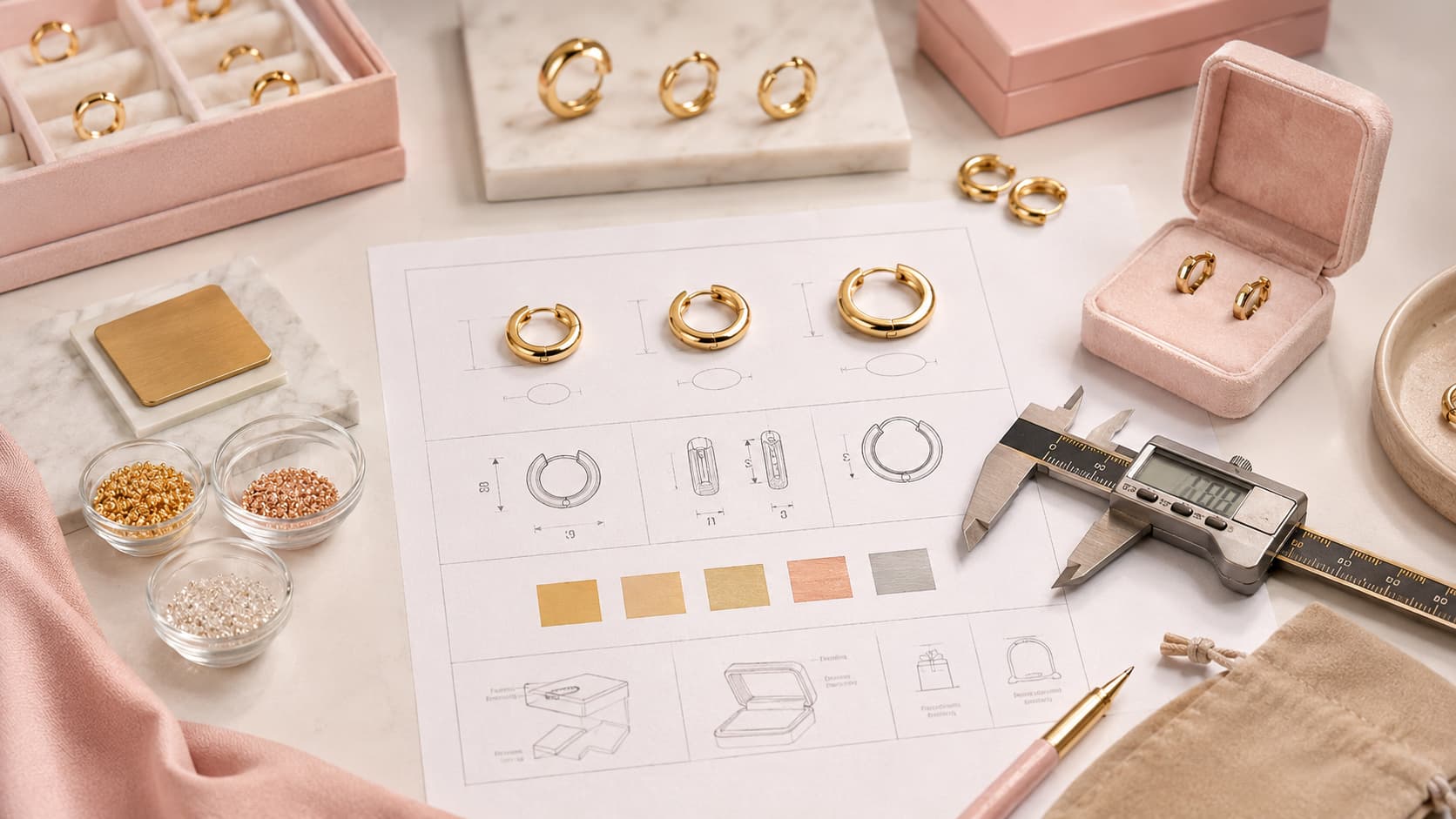
Ask for brass alloy composition, such as H65 or an equivalent material standard.
Confirm 14K / 18K gold, rose gold, rhodium, white gold, or custom finish.
Ask whether the quote covers standard plating, thickened plating, and protective e-coating options.
Confirm how closure security and repeated opening/closing are checked.
Ask whether stones are mechanically set or glued, and how security is verified.
Confirm hammered, twisted, matte, enamel, or other available surface finishes.
Check laser engraving or stamping options for private label projects.
Clarify backing card, pouch, box, barcode, and label options.
Ask for lead-free, nickel-free, cadmium-free production and applicable test reports.
Avoid accepting vague descriptions like “high-quality plating” without a specific answer on plating method and what testing, if any, backs that claim.
OEM/ODM Process for Sourcing from China
Once you have selected a supplier, a typical custom order moves through several stages. For more details on ZHEFAN’s customization workflow, you can review the OEM/ODM jewelry manufacturing service page.
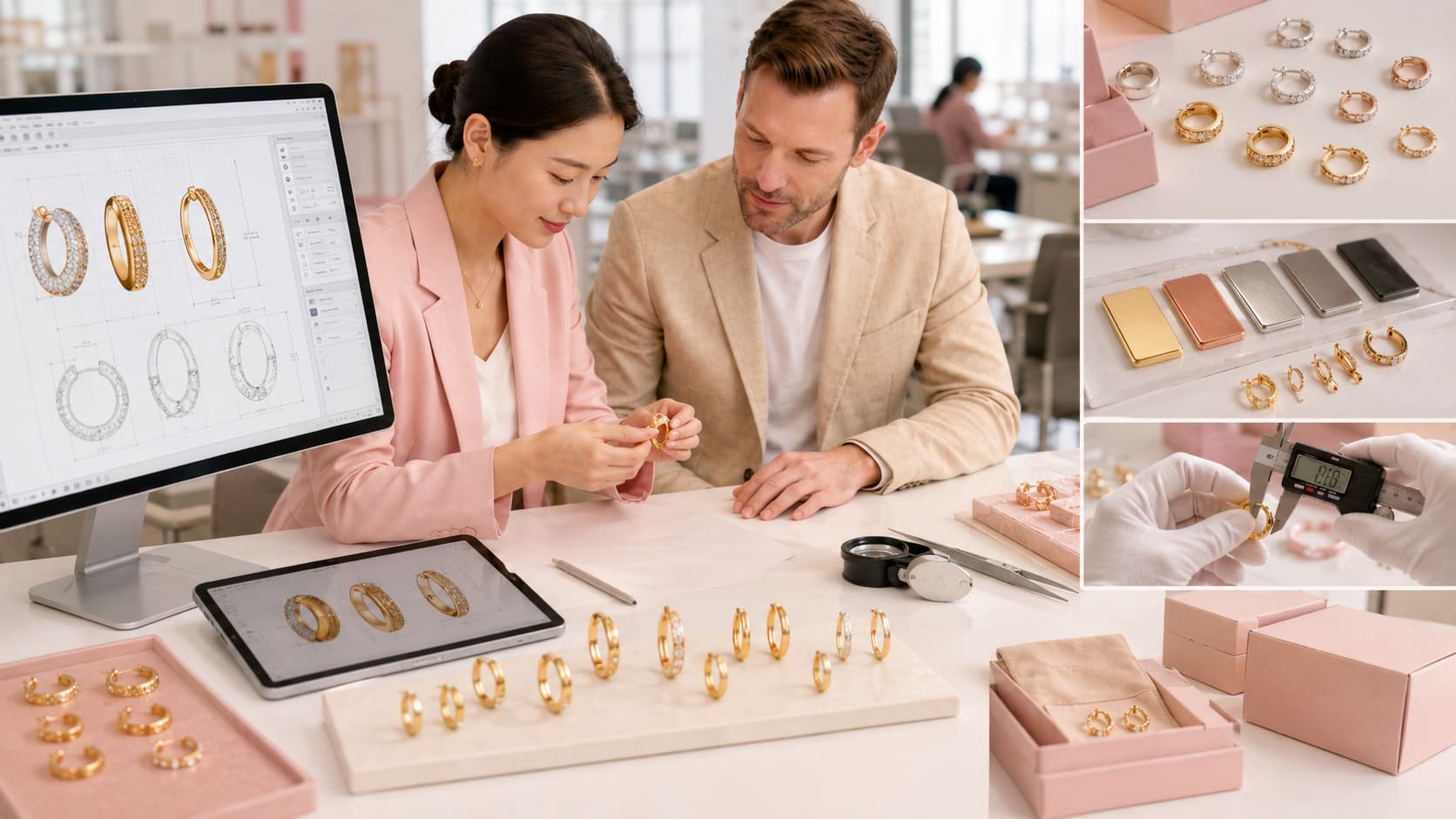
RFQ submission — you send your specifications, reference materials, estimated quantity, and target market requirements.
CAD / design confirmation — a digital design draft is prepared for review. Straightforward designs may move quickly after details are confirmed, while complex structures may require more review time.
Sample development — standard ODM styles can often be prepared in around 5 working days after details are confirmed. OEM designs requiring a new mold may take around 15 working days or longer depending on structure, stone setting, plating, and sample complexity.
Sample testing and approval — you check hinge security, weight, plating color accuracy, stone setting, and overall fit before signing off.
Pre-production confirmation — packaging, labeling, material, plating, and any final adjustments are locked in.
Bulk production — casting, polishing, stone setting, plating, and surface finishing are arranged at scale.
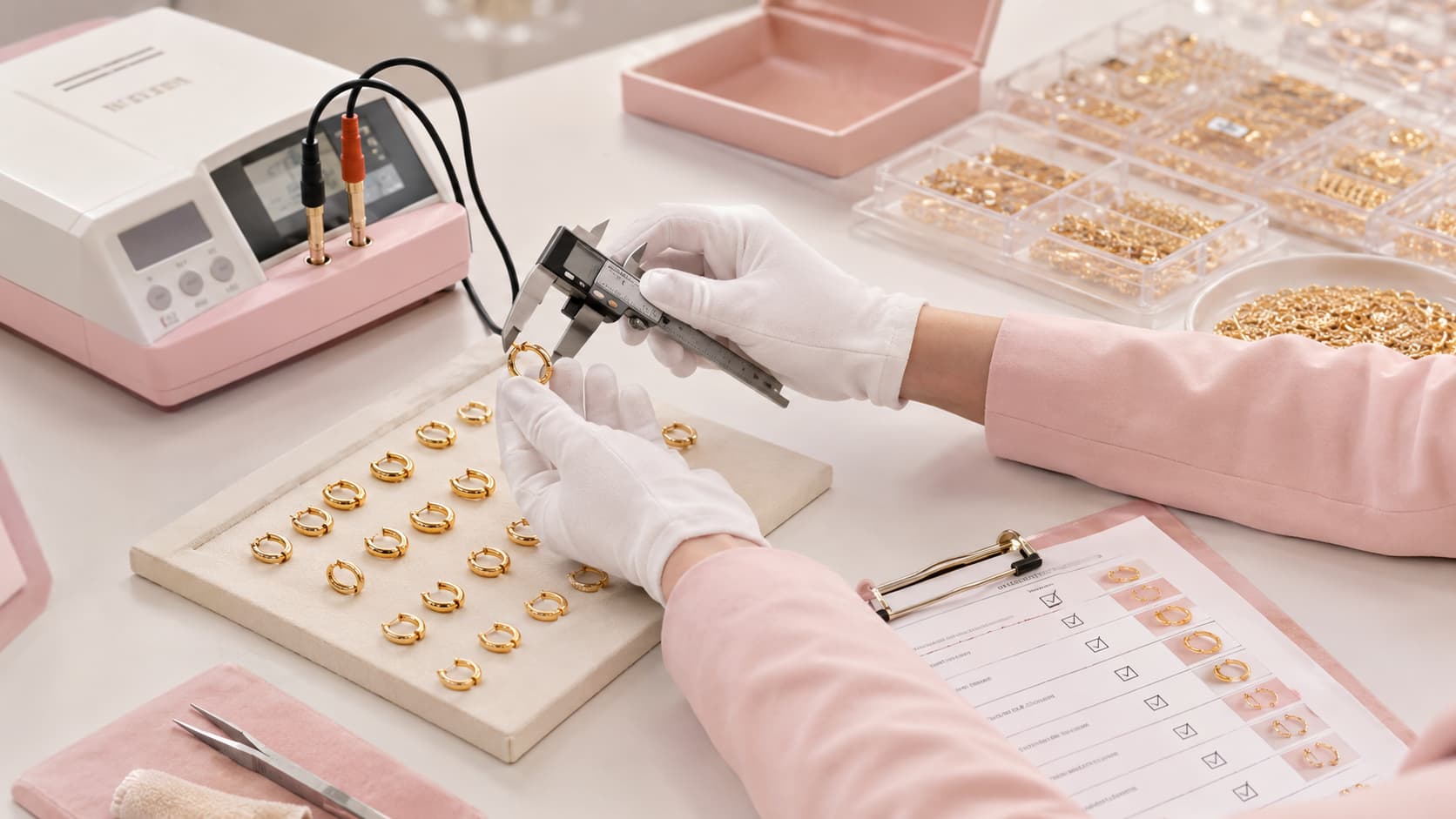
QC inspection — dimensional accuracy, plating consistency, hinge function, and stone setting security are checked before packing.
Packaging and shipping — final packing is completed and handed off to the chosen freight method.
Bulk production timelines should be confirmed based on order quantity, plating method, packaging requirements, stone-setting details, QC requirements, and shipping schedule. Standard custom orders are often planned around roughly 20–25 days from sample approval, but complex or larger projects can take longer.
Quality Control Checklist Before Shipment
A reliable manufacturer should be able to walk you through pre-shipment QC, ideally with photos or a written inspection record. Key checks for gold-plated brass huggie earrings include measurable dimensions, surface finish, plating consistency, closure function, and packaging accuracy.
ZHEFAN JEWELRY’s inspection structure can be reviewed in more detail on the Quality Control page.
Check consistency across the batch, not only the approved sample.
Color and finish should match across all pieces from the same order.
Confirm secure closure, proper tension, and no looseness.
Check that stones do not shift, loosen, or fall out during handling.
Inspect for scratches, casting marks, burrs, or rough edges.
Look for visible variation between pieces from the same batch.
Confirm the correct backing cards, boxes, pouches, barcodes, and labels.
Ask whether AQL sampling is used and which inspection level applies.
Compliance for US and EU Markets
For US and EU buyers, compliance requirements depend on the product structure, market, importer requirements, and retail channel. At minimum, buyers should confirm lead-free, nickel-free, and cadmium-free production and request applicable third-party test documentation such as SGS, REACH, or RoHS where relevant.
Important for fashion jewelry sold through regulated retail or online channels.
Especially important when marketing earrings for sensitive-skin audiences.
Helps address heavy metal concerns for jewelry sold into stricter markets.
SGS, REACH, RoHS, or other applicable documentation may be requested based on market and buyer needs.
Avoid describing a product as “hypoallergenic” in your own marketing unless you have test documentation to support that claim. Alloy composition, plating layer, and the metal used for the earring post all affect actual skin safety, not just the base metal.
Cost, MOQ, and Lead Time Factors
Rather than comparing suppliers on a single quoted unit price, it helps to understand what is actually driving that number:
Heavier or thicker huggies usually require more brass and more finishing time.
Basic plating, thickened plating, gold, rose gold, rhodium, and e-coating options affect cost differently.
Stone quantity, size, and setting method influence labor time and quality control requirements.
OEM designs may require mold development, while ODM styles can reduce upfront tooling risk.
Backing cards, gift boxes, pouches, barcode labels, and custom inserts add different cost layers.
Certified reports or third-party testing may be needed for specific markets or retail channels.
Per-unit pricing typically improves at higher volumes, but buyers should balance unit cost with inventory risk.
Air freight is faster but more expensive than sea freight, which affects launch planning and reorder timing.
A lower quote that skips plating thickness disclosure or compliance testing is not necessarily a better deal once you factor in potential returns, product complaints, or compliance issues.
Why Work with ZHEFAN JEWELRY as Your China Brass Jewelry Manufacturer?
ZHEFAN JEWELRY has factory-based production experience dating back to 1997, with production bases in Guangzhou and Meizhou and a monthly output capacity of around 600,000 pieces. A few specifics relevant to sourcing decisions include:
Technical communication can cover plating, hinge mechanisms, tooling, sampling, and production feasibility.
ZHEFAN supports both fully custom designs and customization of existing base styles.
Production includes multiple rounds of polishing and quality checks, supporting more consistent finished products.
Lead-free, nickel-free, cadmium-free production and RoHS, REACH, or SGS support are available for applicable projects.
Testing support is available for applicable projects so buyers can review plating specs with measurable data.
Custom backing cards, branded boxes, pouches, and retail packaging can be developed for private label projects.
Sample support and small-batch trial order options can be discussed for qualified first-time projects.
Production capacity supports buyers moving from trial orders into larger repeat programs.
You can review the company's certifications and background on the About Us page, and find more detail on inspection stages on the Quality Control page.
FAQ
How do I find a reliable brass huggie earrings manufacturer in China?
Start by asking for production video or photos, specific answers about plating specs and QC processes, and compliance documentation rather than general claims. A manufacturer that can speak in specifics — plating method, hinge testing, inspection process — is generally a stronger signal than one that only offers broad reassurances.
What should I ask before ordering custom brass earrings from China?
At minimum: MOQ per style, sample cost and lead time, plating method and thickness, stone setting method, compliance documentation such as lead-free, nickel-free, cadmium-free, SGS, RoHS, or REACH support, packaging turnaround, and total production lead time.
How can I tell if a supplier is a factory or a trading company?
Ask for a production video or live video tour of the casting, polishing, and plating areas. A direct factory can usually answer detailed technical questions about metallurgy, tooling, and QC processes; a trading company may rely more on general statements and have less direct control over production timelines.
What certifications should brass earrings have for US and EU markets?
Requirements depend on the product structure, importer requirements, and retail channel. Buyers commonly ask for lead-free, nickel-free, and cadmium-free production, supported by applicable SGS, RoHS, or REACH documentation where relevant.
What affects the price of gold-plated brass huggie earrings?
Material weight, plating type and thickness, stone setting method, whether a new mold is needed, packaging complexity, compliance testing, and order quantity all factor into the final unit price — not just the base metal cost.
How long does sampling and bulk production take?
Sampling can often take around 5 working days for standard ODM styles, while designs requiring a new mold may take around 15 working days or longer depending on structure, stone setting, plating, and complexity. Bulk production timelines are usually confirmed based on order quantity, packaging, QC requirements, and shipping schedule.
Can I customize logo and packaging for private label brass earrings?
Yes. Standard options include laser-engraved or stamped logos, custom backing cards, and private label packaging such as branded boxes or pouches.
Should I choose OEM or ODM for my first China order?
If you have original sketches or CAD files and want an exclusive design, OEM is the right path, though it usually involves mold costs and a longer sampling timeline. If you want to launch faster and with lower upfront cost, ODM — customizing an existing base design — is generally the more practical starting point, especially for a first order.
Ready to Source Custom Brass Huggie Earrings from China?
Share your reference designs, size range, plating requirements, target market, packaging needs, estimated quantity, and shipment destination with ZHEFAN JEWELRY. Our team can help confirm OEM/ODM feasibility, sample options, QC requirements, and a factory-direct production plan.




Facebook
Instagram
YouTube
Whatsapp: +8618819277817