






Email: sales3@zhefanjewelry.com
Do Consumers Care About Recycled Silver in Gold Vermeil Jewelry?
Consumers are paying more attention to sustainability, material origin, and transparency in jewelry, but recycled silver alone does not determine a purchase. This article examines how recycled silver can influence consumer trust, perceived value, and demand for gold vermeil jewelry, while explaining why design, quality, price, and credible supporting evidence still matter.
For brands developing recycled silver and gold vermeil jewelry, Zhefan Jewelry supports 925 sterling silver product development, gold vermeil specifications, CAD and sample confirmation, quality control, and project-specific testing. Where recycled silver is required, material scope, supplier documentation, and traceability should be confirmed separately before the claim is used in consumer-facing communication.
- How Recycled Silver Fits into Consumer Purchase Decisions
- Do Jewelry Consumers Actually Care About Recycled Materials?
- What Makes Recycled Silver Valuable to Consumers?
- Material Origin
- Transparency and Traceability
- Brand Values and Product Story
- Is Recycled Silver Enough to Influence a Purchase Decision?
- Will Consumers Pay More for Recycled Silver Jewelry?
- When Does Recycled Silver Become a Real Selling Point?
- Why Vague Recycled-Silver Claims Can Undermine Consumer Trust
- Where Recycled Silver Fits in a Gold Vermeil Value Proposition
- Recycled Silver Adds a Material-Origin Layer
- Sustainability Cannot Replace Gold Vermeil Quality
- How Should Brands Turn Consumer Demand into a Product Brief?
- How Zhefan Builds Evidence into Recycled-Silver Gold Vermeil Projects
- Product and Gold Vermeil Requirements
- Testing and Compliance Evidence
- Production Quality and Bulk Consistency
- Project Review
- Conclusion
- References
- FAQ
How Recycled Silver Fits into Consumer Purchase Decisions
Consumers are increasingly exposed to sustainability, responsible sourcing, jewelry transparency, jewelry traceability, and material-origin claims. But interest in sustainability is not proof that recycled silver alone determines a purchase. Design, aesthetics, perceived quality, price, trust, and the relevance of a sustainability attribute all contribute to consumer value judgments. [1,4]
For a Gold Vermeil brand, the real business question is not whether consumers simply "like sustainability." It is whether a recycled-silver attribute can increase trust, perceived value, purchase consideration, or willingness to pay enough to justify the additional sourcing, documentation, and communication required. A 2026 study of 357 consumers examining luxury jewelry made with alternative recycled materials found that sustainability mattered, but aesthetic value was the strongest predictor in the model, and environmental concern did not automatically translate into higher spending. [4]
This article focuses on that gap. It examines consumer demand for sustainable jewelry, what creates value around recycled silver, whether that value is enough to influence a purchase or price premium, when recycled silver becomes a credible selling point, and how brands can translate consumer interest into a Gold Vermeil product brief and supplier requirement.
Do Jewelry Consumers Actually Care About Recycled Materials?
Four ideas are often treated as interchangeable even though they describe different stages of consumer behavior: awareness, preference, purchase behavior, and willingness to pay. Sustainability and recycled-material attributes can matter, but caring about an issue is not the same as buying a product because of it.
Awareness. Consumers may notice sustainability, recycled-content, responsible-sourcing, and traceability claims when brands make them visible.
Preference. Some consumers may favor brands whose stated values and communication align with their own priorities.
Purchase. Preference is only one input into a real transaction and still competes with design, price, perceived quality, convenience, and brand trust.
Willingness to pay. Accepting a premium is a separate behavior from general sustainability awareness and should not be inferred from it.
The Responsible Jewellery Council's ESG Toolkit discusses the broader attitude-behavior gap in sustainable consumption and notes that mistrust of labels or poorly substantiated claims can prevent stated interest from becoming actual purchasing behavior. The 2026 luxury-jewelry study reaches a compatible conclusion from a consumer-value perspective: environmental concern did not automatically convert into greater spending, while aesthetic value remained the strongest predictor in the researchers' model. [2,4]
Key takeaway: consumer interest in sustainable jewelry does not mean recycled materials alone will determine the purchase. Aesthetics, price, product quality, trust, and personal values still interact in the final decision. [4]
What Makes Recycled Silver Valuable to Consumers?
Recycled silver can create value, but the mechanism matters. Its strongest role is usually not to replace design or quality; it is to add a material-origin and credibility layer for consumers who care about how jewelry is sourced and described.
Material Origin
Recycled silver gives a jewelry brand a material-origin story that is different from a purely aesthetic or plating claim. For consumers who care about circularity or reduced reliance on newly extracted materials, that story can add meaning to the product. The RJC's decarbonization work treats recycled materials as one of the practical levers available to the watch and jewelry sector when reducing impacts. [1]
Transparency and Traceability
A sustainability attribute becomes more credible when a brand can explain what the claim covers and what evidence supports it. This is where jewelry transparency and jewelry traceability matter. A recycled-silver claim is more useful when the brand can define the recycled-content scope, identify the relevant product components, and retain documentation that supports the consumer-facing wording. [2,3] A recycled-material claim has more consumer value when its scope is clear and the claim is backed by credible evidence. [2]
Brand Values and Product Story
Recycled silver can support a jewelry brand's sustainability positioning when it is relevant to the target audience and backed by evidence. Transparent sustainability communication can strengthen confidence in the material story, but it should not be presented as proof that the brand will automatically earn loyalty, higher conversion, or a premium price. [1]
Is Recycled Silver Enough to Influence a Purchase Decision?
Usually not by itself. Recycled silver is better understood as one value layer within a broader purchase decision rather than the entire value proposition.
|
Buying Factor |
Role in the Consumer Decision |
|
Design / Aesthetics |
Creates initial attraction and perceived desirability |
|
Product Quality |
Supports confidence, satisfaction, and repeat purchase |
|
Price |
Sets affordability and value comparison |
|
Brand Trust |
Reduces perceived risk |
|
Material Transparency |
Supports credibility |
|
Sustainability |
Adds ethical or environmental value for relevant consumers |
|
Recycled Silver |
Adds a specific material-origin attribute |
|
Traceability / Evidence |
Helps make the recycled claim believable |
In the 2026 study, aesthetic value was the strongest predictor within the researchers' model, while sustainability also played a significant role. That result should not be converted into a universal ranking for all jewelry consumers or markets, but it is a useful warning against treating a recycled-material story as a substitute for design and product quality. [4]
Will Consumers Pay More for Recycled Silver Jewelry?
There is evidence that sustainability and recycled-material attributes can influence willingness to pay, but brands should not assume that a fixed recycled-material price premium exists. The same 2026 study found significant relationships between multiple value dimensions and willingness to pay more for sustainable luxury jewelry made with alternative recycled materials, while also identifying an attitude-behavior gap. [4]
Willingness to pay describes what a consumer reports or indicates they may accept. Actual price acceptance is what the consumer pays in a real transaction. These are not the same, and turning survey intent into a pricing rule would overstate the evidence.
Important limitation: the study examined luxury jewelry made with alternative recycled materials among consumers in the Bangkok Metropolitan Region. It should not be used to claim a specific price premium for recycled 925 silver or gold vermeil jewelry in the United States, Europe, or other markets. [4]
When Does Recycled Silver Become a Real Selling Point?
Consumer research points toward conditions rather than guarantees. Recycled silver is more likely to function as a meaningful selling point when it fits the brand's audience, the product already meets design and quality expectations, and the material claim can be explained and verified.
|
Brand / Market Condition |
Likely Role of Recycled Silver |
|
Sustainability is already central to the brand identity |
Stronger strategic fit |
|
Customers actively ask about material origin |
Stronger strategic fit |
|
The brand can provide evidence and traceability |
Stronger trust potential |
|
Design and quality already meet target expectations |
Sustainability can add another value layer |
|
The collection competes mainly on low price |
Recycled material may play a smaller role |
|
The recycled claim has weak documentation |
Higher credibility and claim risk |
|
A large price premium depends only on the recycled claim |
Weak strategy |
Working model: audience fit + credible evidence + product quality + clear communication create stronger potential for recycled silver to become a real selling point. This is an editorial synthesis of the available evidence rather than a published formula. [1,2,4]
Why Vague Recycled-Silver Claims Can Undermine Consumer Trust
Vague environmental claims. Terms such as "eco-friendly," "green," "sustainable," and "responsible" can become misleading when the business cannot define what the claim actually covers. RJC guidance favors clear, supportable claims over broad environmental language. [2,3]
Unsupported recycled-content claims. A brand should be able to define the recycled percentage or claim scope where applicable, state which product components are covered, identify the relevant supplier or chain-of-custody evidence, and confirm that the evidence applies to the marketed SKU. A whole-product sustainability message should not be implied when only one component or attribute has been verified. [2,3]
Sustainability overshadowing product quality. A recycled-material story cannot compensate for weak design, poor finishing, inconsistent color, or a product that does not meet the target customer's expectations. Sustainability is one dimension of perceived value, not a replacement for aesthetic or functional value. [4]
Where Recycled Silver Fits in a Gold Vermeil Value Proposition
For gold vermeil brands, recycled silver should be treated as an additional material-origin layer within the product proposition. It can strengthen the silver-base story when the claim is real and documented, but it does not redefine the technical requirements that make the product Gold Vermeil.
Recycled Silver Adds a Material-Origin Layer
When a Gold Vermeil product uses a sterling-silver base, a verified recycled-silver attribute can add a material-origin dimension to that base. In other words, recycled silver and gold vermeil jewelry should be understood as a product that combines two separate ideas: a recycled-content claim about the silver base and a gold vermeil specification about the surface construction. Those claims should be verified independently rather than used interchangeably.
This distinction is important for 925 sterling silver gold vermeil jewelry because material origin, silver composition, and plating construction answer different questions. A recycled-origin claim does not by itself prove silver fineness or the gold vermeil build, and a gold vermeil specification does not prove recycled content.
Sustainability Cannot Replace Gold Vermeil Quality
A recycled-silver claim does not reduce the need to control sterling-silver composition, surface preparation, plating requirements, approved color against a master sample, component scope, sample-to-bulk consistency, and final quality inspection. For brands, the practical rule is simple: sustainability can strengthen the value proposition only after the underlying product specification is credible.
How Should Brands Turn Consumer Demand into a Product Brief?
Consumer-facing language becomes useful only when it can be translated into something specific enough to source, verify, and defend. For responsible jewelry sourcing, the bridge should move from consumer expectation to a measurable B2B requirement.
|
Consumer-Facing Promise |
B2B Requirement |
|
"Made with recycled silver" |
Define recycled-content scope and percentage where applicable |
|
"Traceable material" |
Request relevant supplier or chain-of-custody evidence |
|
"Gold Vermeil" |
Define "silver base," "gold specification," "component scope," and "target-market terminology." |
|
"Responsible sourcing" |
Define which evidence and supplier scope support the claim |
|
"Premium quality" |
Define sample approval and quality-control requirements |
This is where recycled silver content, jewelry traceability, and supplier documentation become commercially important. A marketing claim should be built only after the business can define the material scope and keep evidence that supports the claim. [2,3]
How Zhefan Builds Evidence into Recycled-Silver Gold Vermeil Projects
For a jewelry brand, a recycled-silver gold vermeil project should connect three things: the product specification, the supporting evidence, and the final consumer-facing claim. At Zhefan Jewelry, these requirements are reviewed before sampling and bulk production rather than being added as marketing language afterward.
Product and Gold Vermeil Requirements
Zhefan can review the 925 sterling silver base, recycled-silver requirement where applicable, gold vermeil construction, plating color and thickness, product components, approved sample, and target market requirements.
For Gold Vermeil projects, material composition, plating construction, component scope, and test locations should be confirmed separately. A product name alone is not enough to prove the complete specification.
Testing and Compliance Evidence
Depending on the project, Zhefan can discuss verification such as XRF analysis, plating-thickness testing, salt spray testing, adhesion testing, surface inspection, and third-party laboratory testing.
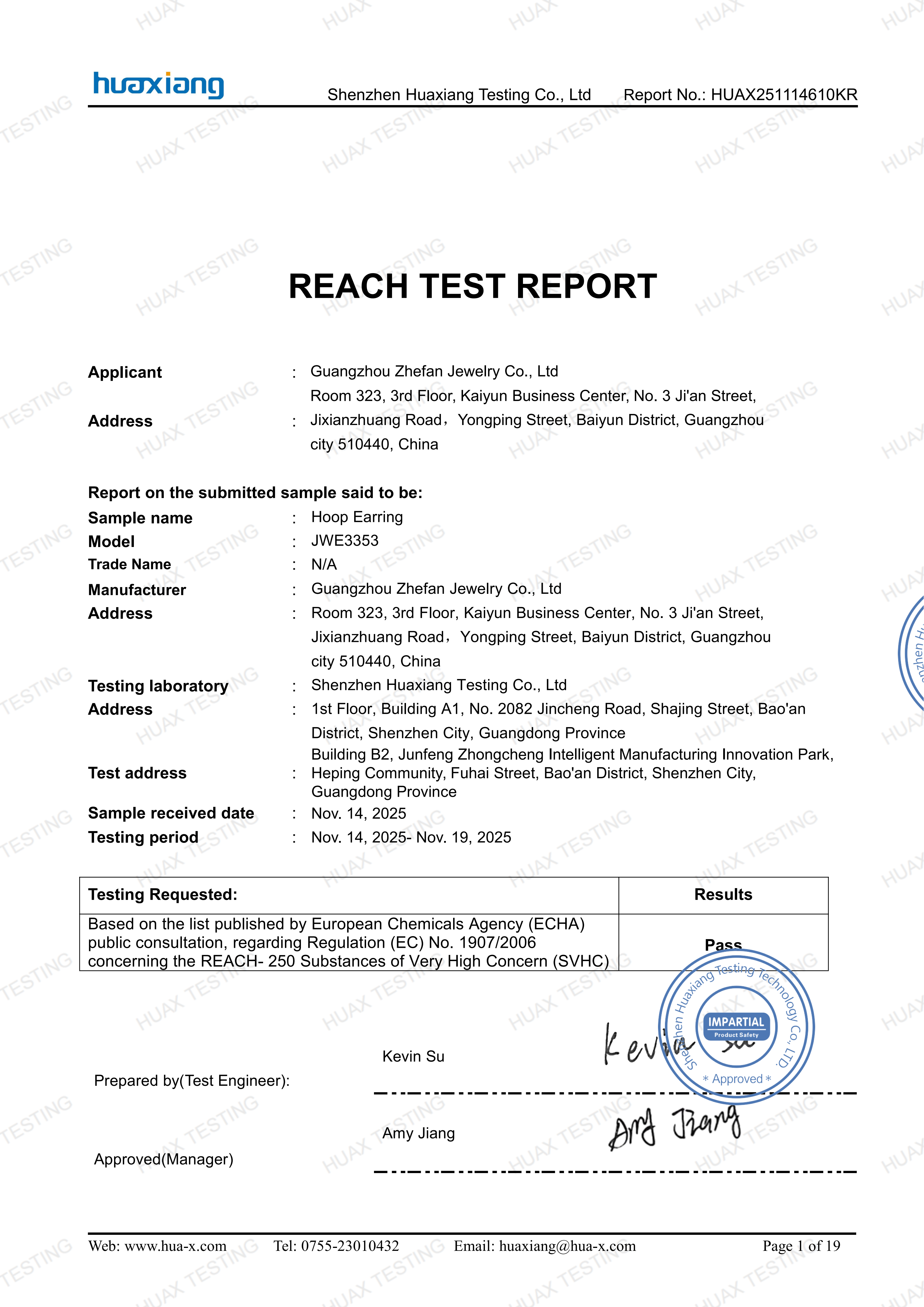
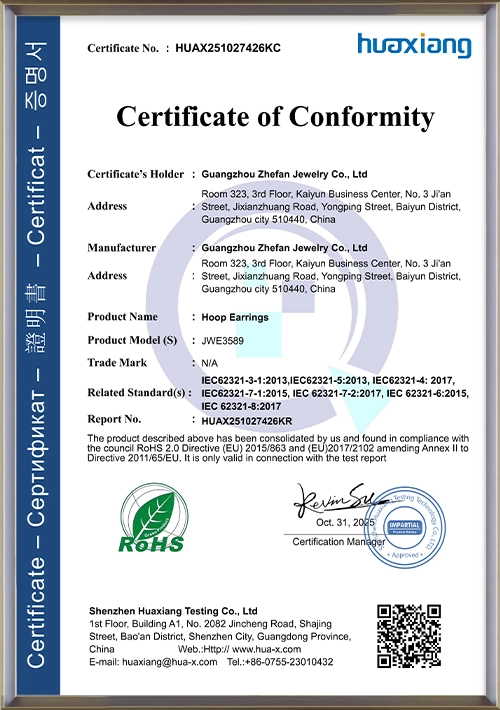
Existing company evidence also includes sample-specific REACH and RoHS test reports with "Pass" results. These reports must remain tied to the tested model and report scope rather than being presented as universal certification for every Zhefan product. Brass Jewelry Sourcing Guide.
If a buyer requires a specific Gold Vermeil thickness report or a defined salt-spray duration, the applicable report or additional project testing should be confirmed against the actual SKU before the claim is used.
Production Quality and Bulk Consistency
Testing does not replace manufacturing control. Zhefan applies Zhefan Jewelry's proprietary 6-polishing & 6-inspection process, covering multiple polishing stages and inspection checkpoints from raw materials through final post-plating inspection.
For repeat orders, the approved sample, CAD revision, material specification, plating requirements, color reference, and applicable test records can be used to support sample-to-bulk and repeat-order consistency.
Project Review
Brands can submit their product design, 925 sterling silver requirements, recycled-content requirements where applicable, gold vermeil specifications, target market, and required testing documents. Zhefan can then review what can be confirmed through the product specification, existing evidence, and project-specific testing before bulk production.
Conclusion
Consumers can care about recycled silver, particularly when sustainability, transparency, and material origin align with their values. But recycled silver is rarely the only reason a jewelry purchase happens. Consumer value still depends on aesthetics, price, quality, trust, and how relevant the sustainability attribute is to that buyer. [1,4]
For Gold Vermeil brands, the practical takeaway is to treat recycled silver as one verified layer of the product value proposition, not as a substitute for product quality or an unsupported sustainability slogan. The strongest approach connects a credible consumer promise to a defined material specification, supporting evidence, and manufacturing control. [2,3]
References
[1] Responsible Jewellery Council. (2025). Accelerating Decarbonization in the Watch & Jewelry Sector 2025. Source
[2] Responsible Jewelry Council. (2026). The RJC ESG Toolkit. Source
[3] Responsible Jewellery Council. (2025). Claims Guide. Source
[4] Boonpitak, P., & Kongarchapatara, B. (2026). Consumer Willingness to Pay More for Sustainable Luxury Jewelry: Effects of Value Perceptions and the Moderating Impact of Pro-Environmental Self-Identity. Sustainability, 18(6), 2786. Source
FAQ
Should recycled-silver claims be approved at SKU level before a private-label collection launches?
Yes. For Private Label Gold Vermeil Jewelry, recycled-silver wording should be connected to the actual SKU rather than applied automatically to an entire collection. The brand should define the recycled silver content or claim scope, identify which components are covered, and confirm that the supporting material records match the final production version. This helps keep product pages, packaging, and wholesale claims aligned with what can actually be documented.
Can one recycled-silver claim cover every component in a Gold Vermeil piece?
Not automatically. A piece of recycled silver and gold vermeil jewelry may contain a main body, chain, clasp, post, solder, or other findings that come from different material sources. A recycled silver chain of custody should therefore be reviewed against the components actually covered by the documentation. If only part of the finished SKU is supported, the consumer-facing claim should not imply broader recycled content than the available evidence can confirm.
What should brands reapprove if the silver source changes on a repeat Gold Vermeil order?
For an OEM gold vermeil jewelry program, a change in silver source should trigger a review of the approved material specification and supporting documentation. The 925 sterling silver jewelry supplier change and retesting scope may also include the recycled-content evidence, component BOM, material composition, plating response, and any testing affected by the change. The original approved sample remains useful, but it should not replace review of a material change that could affect product claims or production consistency.
Should recycled-silver evidence and Gold Vermeil plating evidence be kept separate?
Yes. A gold vermeil jewelry manufacturer should distinguish material-origin evidence from plating evidence. Recycled-silver documentation supports where the silver comes from, while a 2.5 Micron Gold Vermeil specification relates to the gold-plating construction and its measurement. Neither document proves the other. Keeping these evidence layers separate makes it easier for brands to understand exactly what each report or specification supports.
How should recycled-silver wording stay consistent across product pages, packaging, and wholesale materials?
A sustainable jewelry manufacturer and the buyer should work from one approved claim scope before consumer-facing materials are finalized. If the verified recycled silver content applies only to certain SKUs or components, the same boundary should be reflected across product pages, packaging, line sheets, and retailer information. Consistent wording reduces the risk of one sales channel making a broader sustainability claim than the underlying product evidence supports.
When should recycled silver be treated as a collection story rather than the main product selling point?
For brands working with a demi-fine jewelry manufacturer, recycled silver may work best as one part of a wider material and brand story when customers also prioritize design, gold vermeil quality, price, and product finish. Recycled silver and gold vermeil jewelry does not need to rely on sustainability as its only selling point. When the material claim is documented and relevant to the target audience, it can strengthen the collection's positioning without replacing the product qualities that drive the purchase itself.
Recommended for you

What Is Gold Vermeil Jewelry? A Complete Guide for Brands and Retailers

Thick Gold Plated Jewelry Manufacturer for 925 Silver & Brass Jewelry

How to Choose a Gold Vermeil Jewelry Manufacturer

Gold Vermeil vs. Gold-Plated Jewelry: Which Fits Your Luxury Jewelry Brand?

Can Silver or Brass Be PVD Coated? A Professional Guide for Jewelry Brands
PVD Coating vs Electroplating for Jewelry: A B2B Buying Guide for 925 Silver and Brass
Product Categories
Discuss Your Ideas with a Professional Custom Jewelry Manufacturer
We provide personalized jewelry customization services for clients worldwide.
Rest assured that your privacy is important to us, and all information provided will be handled with the utmost confidentiality.
By clicking 'Send Inquiry Now' I agree to ZHEFAN JEWELRY processing my personal data.
To see how to withdraw your consent, how to control your personal data and how we process it, please see our Privacy Policy and Terms of use.
From design to production, ZHEFAN JEWELRY offers a one-stop solution to help you enhance your brand value and market competitiveness.
Get A Quote
Contact
Tel: (+86) 188 1927 7817
© 2026 Zhefan Jewelry. All Rights Reserved.
Facebook
Instagram
YouTube
Whatsapp: +8618819277817