






Email: sales3@zhefanjewelry.com
Gold Vermeil Bracelet Clasps & Jump Rings: What to Specify for Custom Production
Getting gold vermeil bracelet clasp specifications right separates quality custom production from costly mistakes. Zhefan Jewelry breaks down exactly which clasp types, jump ring gauges, and plating thicknesses manufacturers need to specify for flawless results. Learn the technical standards that protect your designs and margins.
- Quick Answer
- Key Takeaways
- What Should a Bracelet Hardware Specification Include?
- What Should Be Specified for a Gold Vermeil Bracelet Clasp?
- Clasp Type
- Clasp Dimensions
- Orientation and Operation
- Material and Finish
- What Should Be Specified for Bracelet Jump Rings?
- Function and Location
- Jump Ring Dimensions
- Closure or Assembly Method
- How Should the Clasp and Jump Ring Fit Together?
- How Should Material and Gold Finish Be Documented Across Hardware?
- Finish Consistency
- Product Terminology and Market Requirements
- How Should Chain Ends and Connectors Be Documented?
- Chain-End Interface
- Connector Components
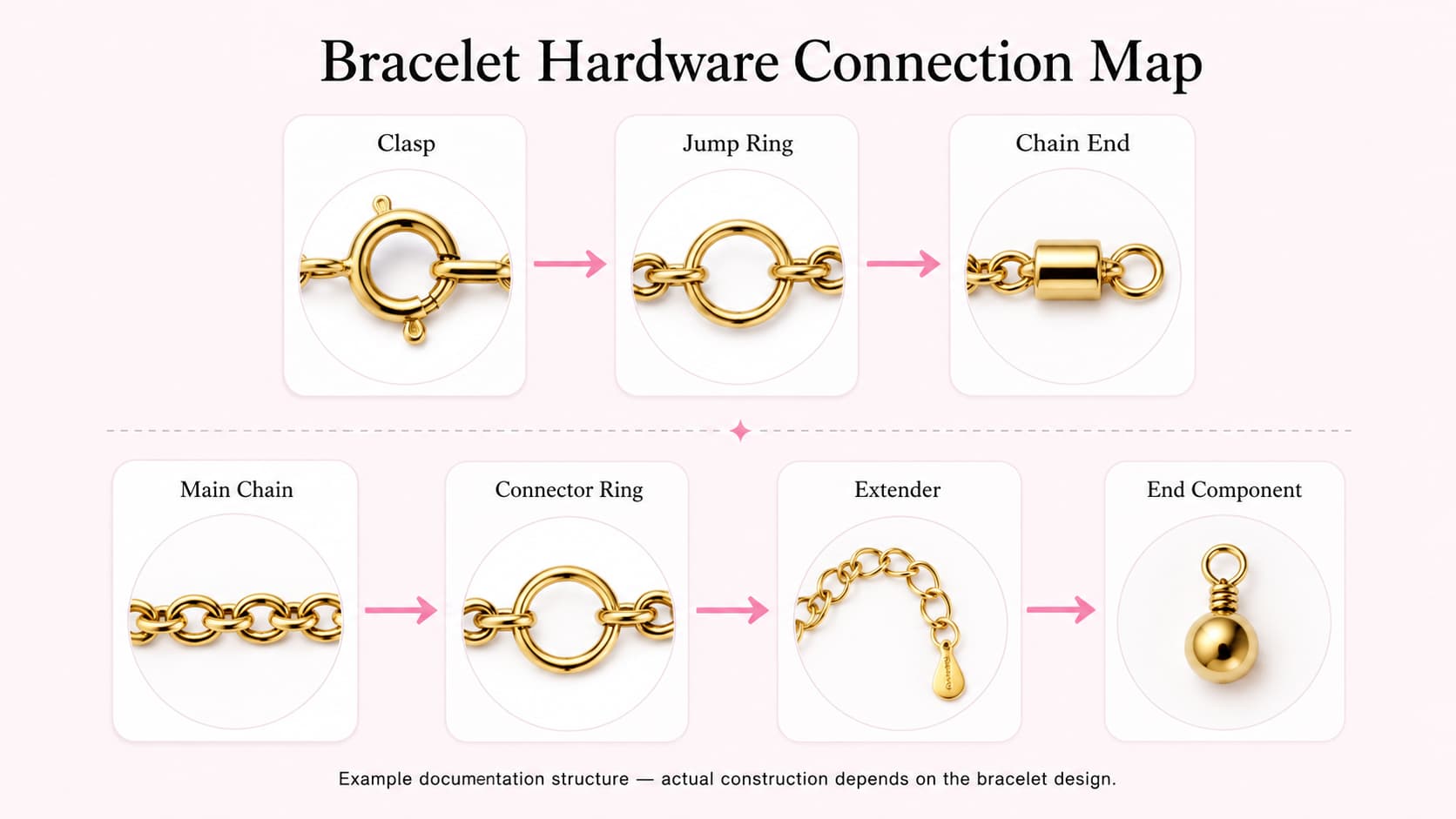
- How to Create a Bracelet Hardware Connection Map
- Why Use a Connection Map?
- What Changes for Adjustable Bracelets?
- Extender-Side Jump Rings
- End Components
- Common Clasp & Jump Ring Specification Mistakes
- Specifying Only the Clasp Type
- Leaving Jump Rings Undefined
- Using Reference Photos Instead of Dimensions
- Assuming All Hardware Uses the Same Material
- Ignoring the Interface Between Components
- Mixing Hardware Versions Across Drawings
- Treating Hardware as a Generic Afterthought
- Gold Vermeil Bracelet Hardware Specification Template
- Final Gold Vermeil Bracelet Hardware Checklist
- Frequently Asked Questions
- Define Your Custom Gold Vermeil Bracelet Hardware Requirements
Quick Answer
Gold vermeil bracelet clasp specifications should define the clasp and jump rings as individual production components rather than grouping them under a generic “hardware” description.
For the clasp, jewelry brands should document the required type, dimensions, base material, finish, orientation and connection details. Each important jump ring should also be identified by its location and function, with relevant dimensions, material, finish and assembly requirements clearly recorded.
The clasp, jump rings and chain ends should then be reviewed as one connected interface. Even when the individual components are correctly specified, unclear connection geometry or inconsistent hardware requirements can still create ambiguity during production.
Key Takeaways
- Specify the clasp and jump rings separately instead of using one generic “hardware” field.
- Record measurable clasp dimensions rather than relying only on a clasp name or reference image.
- Identify each important jump ring by its location and function.
- Document base material and finish requirements for important visible hardware components.
- Review the clasp, jump ring and chain-end dimensions as one connected system.
- State the required assembly method when the connection method should not be left open to interpretation.
- Use a controlled drawing or hardware connection map when several similar rings or connectors are used.
What Should a Bracelet Hardware Specification Include?
Small components can have a large effect on bracelet closure, appearance and assembly.
A product specification should therefore treat clasp hardware as a controlled part of the bracelet rather than summarizing it simply as:
Gold clasp and rings
That description does not tell the manufacturer which clasp is required, how large it should be, which ring connects to which component, or whether several rings perform different functions.
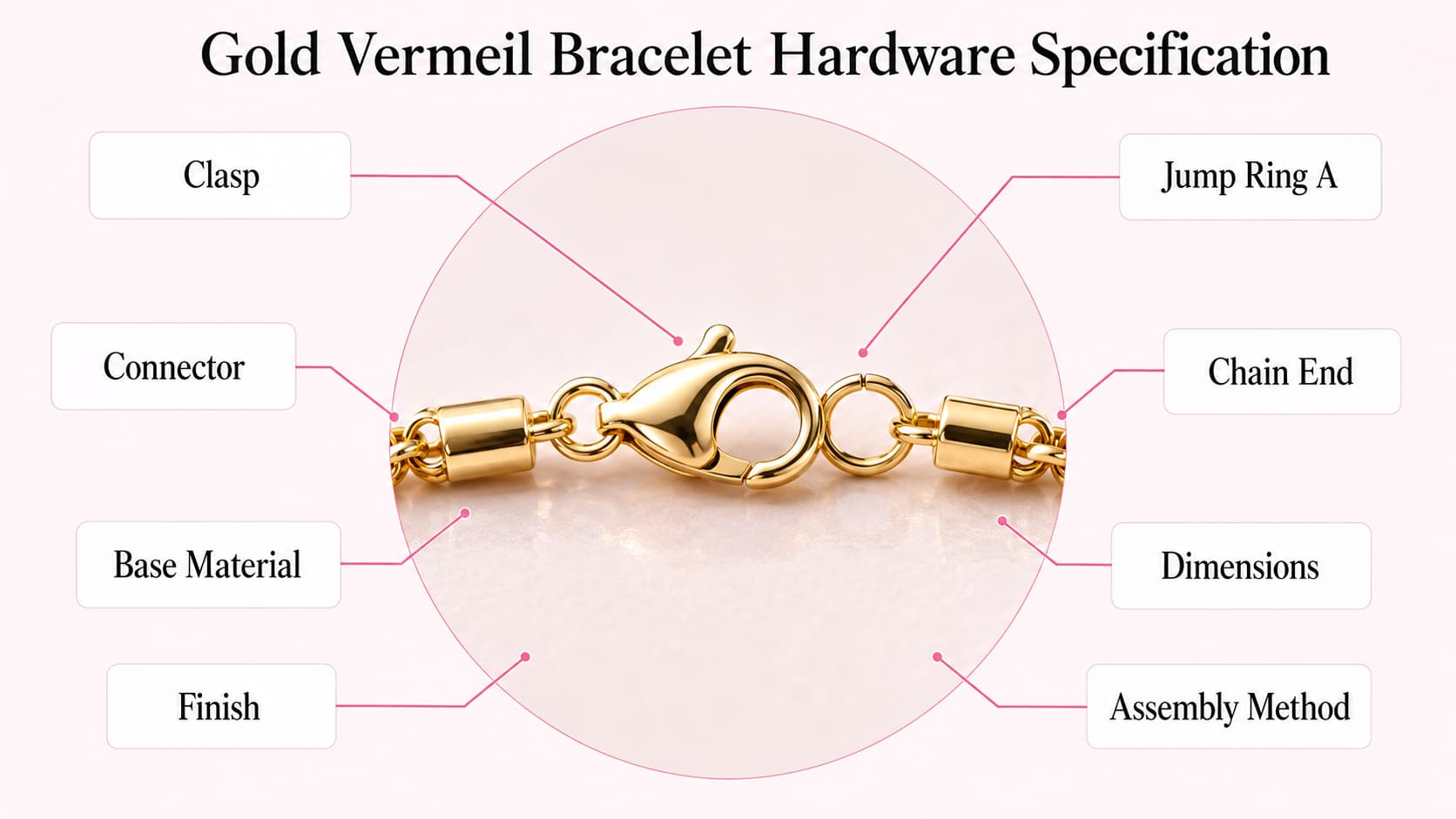
| Specification Field | What to Define |
|---|---|
| Component ID | Clasp, jump ring A, jump ring B, connector |
| Component type | Required hardware type |
| Function | Closure, chain connection, extender connection or other role |
| Base material | Required material for the component |
| Dimensions | Relevant measurable dimensions |
| Finish | Required gold tone, surface appearance or finish reference |
| Location | Where the component is used on the bracelet |
| Interface | Which other component it connects to |
| Assembly requirement | Required connection method where applicable |
| Drawing reference | Applicable controlled drawing or hardware diagram |
Not every bracelet needs the same level of documentation.
A simple chain bracelet may use only a clasp and one or two connection rings. A more complex bracelet can include an extender, branded end tag, charm connectors or several visually similar rings with different functions.
The objective is to document enough information that each important component can be identified, positioned and connected correctly. For the broader product framework, brands can refer to the existing guide on gold vermeil bracelet specifications.
What Should Be Specified for a Gold Vermeil Bracelet Clasp?
The clasp specification should begin once the closure concept has already been selected.
This article does not assume that one clasp style is universally better than another. Its purpose is to make the selected clasp measurable and unambiguous for production.
For a separate discussion of clasp and hardware selection considerations for silver bracelets, see Zhefan Jewelry's guide to clasp and hardware selection for silver bracelets.
Clasp Type
The specification should state the required clasp type.
Depending on the design, examples may include:
- lobster clasp;
- spring-ring clasp;
- toggle clasp;
- another confirmed closure type.
The type name alone, however, may not fully identify the intended component.
Different clasps within the same general category can vary in:
- proportions;
- attachment points;
- profile;
- size;
- operating mechanism;
- decorative details.
A controlled drawing or approved component reference can therefore be useful when the exact construction matters.
Clasp Dimensions
Relevant clasp dimensions should be documented when they affect proportion, operation or compatibility with surrounding hardware.
Depending on the design, these may include:
- overall length;
- overall width;
- attachment-loop dimensions;
- relevant opening dimensions;
- connector dimensions;
- other critical measurements.
The goal is not to measure every possible surface.
It is to define the dimensions necessary to distinguish the intended clasp from alternatives that could change the bracelet's appearance or connection geometry.
Orientation and Operation
Orientation can matter when a clasp has:
- an asymmetric shape;
- a branded face;
- a directional logo;
- a defined attachment side;
- a specific opening direction.
If the clasp must face a particular direction relative to the bracelet, that requirement should be shown in the product documentation rather than left to assumption.
This is particularly useful where the clasp connects to a branded tag, decorative component or another directional element.
Material and Finish
A clasp specification should identify the required base material and finish independently.
Avoid using only phrases such as:
gold clasp
matching gold hardware
These descriptions communicate appearance but may not fully define the production requirement.
Where relevant, document:
- base material;
- gold tone or finish reference;
- polished, satin or other surface appearance;
- whether the clasp should visually match other bracelet hardware.
If different hardware components use different materials or finish systems, those differences should be written explicitly.
What Should Be Specified for Bracelet Jump Rings?
Jump rings are visually small, but they can perform several different functions within one bracelet.
For that reason, a specification should avoid treating every ring as interchangeable.
Function and Location
Identify each important jump ring by what it does.
Examples can include:
- clasp-side jump ring;
- opposite-end connection ring;
- extender connection ring;
- end-component ring;
- decorative connector;
- charm connection ring where relevant.
A useful component name should tell the reader both which ring it is and where it belongs.
Jump Ring A — Clasp Connection
This is clearer than a generic description such as “Gold Ring.”
If multiple rings have different dimensions or assembly requirements, assign separate component IDs.
Jump Ring Dimensions
A reference photograph alone cannot reliably communicate the intended ring dimensions.
Depending on the product, useful fields may include:
- inner diameter;
- outer diameter where relevant;
- wire diameter;
- wire or profile shape where relevant.
The specification should define enough dimensions to identify the intended ring rather than relying on visual scale.
| Jump Ring Field | Requirement |
|---|---|
| Component ID | |
| Function | |
| Location | |
| Inner diameter | |
| Outer diameter, if required | |
| Wire diameter | |
| Profile | |
| Material | |
| Finish | |
| Assembly method |
Specific numerical values should come from the actual product requirement rather than from a generic bracelet assumption.
Closure or Assembly Method
Not every jump-ring connection is assembled in the same way.
Depending on the bracelet design and production requirement, the specification may need to identify whether the connection is:
- an open connection;
- soldered;
- welded;
- completed using another confirmed assembly method.
There is no need to assume that one method is correct for every bracelet.
If the assembly method matters to the intended construction, document it rather than leaving it undefined.
The required method may depend on the component function, product construction and agreed production requirement.
How Should the Clasp and Jump Ring Fit Together?
A clasp should not be specified in isolation.
The connection should be considered as a small system:
Clasp → Jump Ring → Chain End
The same principle applies on the opposite side of the bracelet, where the chain may connect to:
- another jump ring;
- an extender;
- a terminal ring;
- a branded component;
- another connector.
The key question is not simply:
Is the clasp correct?
It is:
Do the clasp, jump ring and chain end work together as the intended connection?
| Interface | What to Check |
|---|---|
| Clasp to jump ring | Connection geometry and usable clearance |
| Jump ring to chain end | Ring suitability for the chain-end structure |
| Clasp movement | Whether connected components allow the intended movement |
| Connector orientation | Whether hardware sits in the intended direction |
| Visible proportion | Whether hardware remains appropriate to the bracelet design |
| Finish relationship | Whether visible hardware follows the specified finish system |
This does not require one universal clearance value.
Different component constructions can require different geometry. The product specification should instead make the intended relationship clear through measurable dimensions, controlled drawings and component identification.
How Should Material and Gold Finish Be Documented Across Hardware?
A finished bracelet may contain several visible metal components:
- main chain;
- clasp;
- jump rings;
- connectors;
- extender;
- decorative end component.
A product name alone should not be relied on to define the material and finish of every component.
Instead, document important components explicitly.
| Component | Base Material | Finish | Reference |
|---|---|---|---|
| Main chain | ___ | ___ | ___ |
| Clasp | ___ | ___ | ___ |
| Jump ring A | ___ | ___ | ___ |
| Jump ring B | ___ | ___ | ___ |
| Connector | ___ | ___ | ___ |
| Extender hardware | ___ | ___ | ___ |
This approach is especially useful when hardware is sourced or produced separately from the main chain.
Finish Consistency
If the clasp and rings are intended to match the bracelet visually, record that requirement.
Possible specification fields may include:
- gold tone reference;
- surface appearance;
- finish reference;
- component-specific exception where required.
A buyer should not assume that the words “same gold finish” automatically communicate every visual or technical requirement.
Product Terminology and Market Requirements
Brands should also confirm whether material, finish, labeling or product terminology requirements apply in the markets where the bracelet will be sold. Those requirements can vary by market and product construction, so they should be treated as project-specific compliance checks rather than assumed universal rules.
How Should Chain Ends and Connectors Be Documented?
The clasp usually connects to the bracelet through a defined chain-end structure.
That structure may involve:
- the final chain link;
- a dedicated end loop;
- a jump ring;
- a connector;
- an extender;
- a branded tag.
The product specification should show how these components relate to each other.
Chain-End Interface
A chain-end specification may need to answer:
- Which chain link or end component receives the jump ring?
- Does the chain require a separate connector?
- Which ring connects directly to the clasp?
- Does the opposite end use the same construction?
- Is an extender connected through a separate ring?
These questions become more important when the bracelet has visually similar hardware on both ends but different functional requirements.
Connector Components
If a separate connector sits between the chain and clasp, define it as its own component.
Do not hide it inside a general “clasp hardware” note if its dimensions or orientation affect the bracelet. The more clearly the interface is documented, the less interpretation is required when reading the specification.
How to Create a Bracelet Hardware Connection Map
A hardware connection map can clarify how small components fit together.
For example, one side of a bracelet might be documented conceptually as:
Main Chain End → Jump Ring A → Clasp
The opposite side might be:
Main Chain End → Jump Ring B → End Ring
For an adjustable bracelet, a possible documentation format could be:
Main Chain → Connector Ring → Extender → End Component
These are only examples of documentation structure. They are not universal bracelet constructions. The actual map should reflect the specific product design.
Why Use a Connection Map?
A connection map can help when:
- several rings look similar;
- the bracelet uses different rings on different sides;
- an extender is involved;
- a branded end component is used;
- drawings and component lists need to reference the same hardware IDs.
It also makes component naming easier.
| Component ID | Function |
|---|---|
| C1 | Main clasp |
| JR1 | Clasp-side jump ring |
| JR2 | Opposite-end connection ring |
| CN1 | Extender connector |
| EC1 | Extender end component |
The exact naming system can vary, but it should be used consistently across the specification and related drawings.
What Changes for Adjustable Bracelets?
Adjustable bracelets introduce additional hardware relationships.
Sizing questions such as main bracelet length, extender length and maximum adjustable length should be documented separately. These are covered in the published gold vermeil bracelet sizing guide.
From a hardware perspective, an adjustable bracelet may also need to define:
- how the main bracelet connects to the extender;
- the extender-side connector;
- usable connection rings or adjustment points;
- extender-end ring;
- end tag, charm or decorative component;
- finish relationship between the extender and main bracelet hardware.
Extender-Side Jump Rings
If the extender contains multiple usable rings, the specification should distinguish between:
- the extender structure;
- functional connection positions;
- terminal hardware.
Do not assume that every visible ring performs the same function.
End Components
A branded or decorative component at the end of the extender can affect:
- orientation;
- visual balance;
- component identification;
- overall hardware documentation.
If it is part of the final design, record it as a defined component.
Common Clasp & Jump Ring Specification Mistakes
Specifying Only the Clasp Type
Writing only:
Lobster clasp
does not fully define:
- dimensions;
- material;
- finish;
- orientation;
- attachment geometry.
The clasp type should be combined with measurable and component-specific requirements.
Leaving Jump Rings Undefined
A product specification may carefully define the clasp while leaving the connecting rings unspecified.
This creates unnecessary interpretation. If ring dimensions, material, finish or assembly affect the final bracelet, document them.
Using Reference Photos Instead of Dimensions
Reference images can communicate shape and proportion.
They usually cannot replace measurable dimensions. A photo may show a “small jump ring,” but it does not necessarily establish its inner diameter or wire diameter.
Assuming All Hardware Uses the Same Material
If all relevant hardware uses the same material requirement, state it.
If one component is different, state the exception. Do not rely on visual similarity to define material construction.
Ignoring the Interface Between Components
A clasp, ring and chain end can each be individually identified while the connection between them remains unclear.
A hardware specification should define not only the components but also their interfaces.
Mixing Hardware Versions Across Drawings
A drawing may show one clasp while another document refers to a different clasp or ring dimension. Controlled component IDs and document versions help reduce this problem.
Treating Hardware as a Generic Afterthought
Clasps and jump rings may be small, but they should still be treated as controlled product specifications when they affect closure, appearance or assembly.
Gold Vermeil Bracelet Hardware Specification Template
The following template can be used as a practical starting point for a custom bracelet hardware specification.
| Specification Field | Requirement |
|---|---|
| Product / Style | |
| SKU | |
| Hardware specification version | |
| Drawing reference | |
| Clasp component ID | |
| Clasp type | |
| Clasp base material | |
| Clasp overall length | |
| Clasp overall width | |
| Clasp attachment dimensions | |
| Clasp finish | |
| Clasp orientation | |
| Jump ring A component ID | |
| Jump ring A function | |
| Jump ring A location | |
| Jump ring A inner diameter | |
| Jump ring A outer diameter, if required | |
| Jump ring A wire diameter | |
| Jump ring A profile | |
| Jump ring A material | |
| Jump ring A finish | |
| Jump ring A assembly method | |
| Jump ring B component ID | |
| Jump ring B function | |
| Jump ring B dimensions | |
| Jump ring B material | |
| Jump ring B finish | |
| Connector details | |
| Chain-end interface | |
| Extender-side hardware, if applicable | |
| Hardware finish reference | |
| Additional hardware notes |
Not every field will be necessary for every bracelet.
The purpose of the template is to make important hardware requirements explicit rather than forcing the manufacturer to infer them from a product image.
Final Gold Vermeil Bracelet Hardware Checklist
Before finalizing the bracelet hardware specification, confirm that the documentation identifies the following items where applicable:
- ☐ Clasp type defined
- ☐ Clasp component ID assigned
- ☐ Clasp dimensions defined
- ☐ Clasp base material defined
- ☐ Clasp finish defined
- ☐ Clasp orientation defined where relevant
- ☐ Important jump rings individually identified
- ☐ Jump ring functions defined
- ☐ Jump ring locations defined
- ☐ Relevant jump ring dimensions defined
- ☐ Jump ring material defined
- ☐ Jump ring finish defined
- ☐ Required assembly method documented where applicable
- ☐ Clasp-to-ring interface defined
- ☐ Jump-ring-to-chain interface defined
- ☐ Chain-end construction documented
- ☐ Adjustable-side connector defined where applicable
- ☐ Extender-end hardware documented where applicable
- ☐ Hardware drawing or connection-map reference identified
- ☐ Hardware specification version controlled
- ☐ Finish relationship across visible components documented
A good hardware specification does not need to make every small component complicated. It needs to remove ambiguity from the components and connections that affect the finished bracelet.
Frequently Asked Questions
What should I specify for a gold vermeil bracelet clasp?
Specify the clasp type, relevant dimensions, base material, finish, orientation and connection details. If the exact clasp construction matters, also reference a controlled drawing or component image rather than relying on the clasp name alone.
What dimensions should be recorded for bracelet jump rings?
Depending on the design, useful fields can include inner diameter, outer diameter where relevant, wire diameter and wire or profile shape. The specification should contain enough measurable information to identify the intended ring.
Should clasp and jump ring materials be specified separately?
Yes, when material requirements are important to the product. Each key component should have a defined material requirement rather than assuming that all hardware automatically uses the same construction.
How should the clasp and jump ring connection be documented?
Identify the components involved and show which ring connects the clasp to the chain end or connector. Relevant dimensions, orientation and assembly requirements can also be included in a drawing or hardware connection map.
Should jump rings be open, soldered or welded?
There is no single assembly method that applies to every bracelet. The required method depends on the intended construction and product requirement. If the assembly method matters, it should be explicitly documented in the specification.
Do adjustable bracelets require different hardware specifications?
They can require additional hardware details because the bracelet may include extender connectors, usable adjustment rings and an extender-end component. These parts should be identified separately where they affect construction or appearance.
Can a reference photo replace clasp and jump ring dimensions?
No. A reference photo can help communicate appearance and proportion, but it does not reliably define measurable clasp or jump-ring dimensions. Production requirements should use measurable specifications where dimensions matter.
Define Your Custom Gold Vermeil Bracelet Hardware Requirements
Clasps, jump rings and connectors may be small components, but together they form the closure system that connects the bracelet's main chain, adjustable elements and end hardware.
Brands developing custom pieces can review Zhefan Jewelry's gold vermeil bracelets and use the existing gold vermeil bracelet specification guide when organizing broader product requirements.
For adjustable designs, the gold vermeil bracelet sizing guide provides the separate framework for main length, fit and extender sizing.
If your team has already defined the intended clasp, ring configuration, hardware dimensions or connection layout, share your requirements with Zhefan Jewelry to discuss the custom production requirements for your project.
Share Your Bracelet Hardware Requirements
Recommended for you

What Is Gold Vermeil Jewelry? A Complete Guide for Brands and Retailers

Thick Gold Plated Jewelry Manufacturer for 925 Silver & Brass Jewelry

How to Choose a Gold Vermeil Jewelry Manufacturer

Gold Vermeil vs. Gold-Plated Jewelry: Which Fits Your Luxury Jewelry Brand?

Can Silver or Brass Be PVD Coated? A Professional Guide for Jewelry Brands

How to Make Bulk Jewelry Match the Approved Sample: A Production Control System for Jewelry Brands
Product Categories
Discuss Your Ideas with a Professional Custom Jewelry Manufacturer
We provide personalized jewelry customization services for clients worldwide.
Rest assured that your privacy is important to us, and all information provided will be handled with the utmost confidentiality.
By clicking 'Send Inquiry Now' I agree to ZHEFAN JEWELRY processing my personal data.
To see how to withdraw your consent, how to control your personal data and how we process it, please see our Privacy Policy and Terms of use.
From design to production, ZHEFAN JEWELRY offers a one-stop solution to help you enhance your brand value and market competitiveness.
Get A Quote
Contact
Tel: (+86) 188 1927 7817
© 2026 Zhefan Jewelry. All Rights Reserved.
Facebook
Instagram
YouTube
Whatsapp: +8618819277817