





Email: sales3@zhefanjewelry.com
Custom Gold Vermeil Bracelet Specifications: Materials, Dimensions, Finish & Components
Gold vermeil bracelet specifications detail the precise materials, dimensions, finish, and components essential for quality and durability. Zhefan Jewelry breaks down each element to guide manufacturers and designers in creating High Quality, compliant pieces.
- Quick Answer
- Key Takeaways
- What Should a Custom Gold Vermeil Bracelet Specification Include?
- How Should the Base Material Be Specified?
- Which Bracelet Dimensions Should Be Defined?
- Finished Bracelet Length
- Component Dimensions
- Adjustable Elements
- How Should the Gold Finish Be Documented?
- Gold Tone
- Surface Appearance
- Technical Finish Requirement
- How Should Chain Construction Be Specified?
- Chain Style
- Chain Dimensions
- Chain Configuration
- How Should Clasps and Jump Rings Be Specified?
- Clasp Type
- Jump Rings and Connectors
- Finish Consistency
- How Should Charms and Decorative Components Be Defined?
- What Stone Information Should Be Included?
- How Should Branding and Logo Placement Be Specified?
- Branding Method
- Logo Position
- Artwork Reference
- What Packaging Information Belongs in the Specification?
- How Can Brands Keep One Controlled Production Specification?
- What Are Common Gold Vermeil Bracelet Specification Mistakes?
- Relying Only on Reference Images
- Using Subjective Finish Language
- Leaving Small Hardware Undefined
- Mixing Document Versions
- Describing the Product but Not the Components
- Leaving Branding Undefined
- Final Gold Vermeil Bracelet Specification Checklist
- Frequently Asked Questions
- Discuss Your Custom Gold Vermeil Bracelet Requirements
Quick Answer
A custom gold vermeil bracelet specification should define the product in measurable, production-ready terms. At minimum, brands should document the sterling silver base, bracelet dimensions, chain construction, gold finish, clasp and connector details, charms or stones where applicable, branding requirements, packaging configuration, and the version of supporting drawings or artwork.
Reference images can communicate the intended look, but they should not replace measurable specifications. The goal is to give the buyer and manufacturer one consistent set of production requirements.
Key Takeaways
- Define the bracelet as a group of measurable components, not only as a finished visual design.
- Record the base material, dimensions, chain, finish, clasp, jump rings, decorative components and branding separately.
- Replace vague descriptions such as “thin chain” or “warm gold” with dimensions, controlled references or clearly agreed requirements.
- Keep drawings, artwork and specification versions consistent.
- Use one controlled specification as the main reference for production requirements and future reorders.
What Should a Custom Gold Vermeil Bracelet Specification Include?
A useful specification answers two questions:
- What exactly is being produced?
- How should each important part of the bracelet be defined?
The level of detail depends on the design. A simple chain bracelet may require fewer specification fields than a bracelet with multiple charms, stones, branded components or custom packaging.
The objective is not to create unnecessary documentation. It is to remove ambiguity from the parts of the bracelet that affect construction, fit, appearance, branding or final configuration.
| Specification Area | What to Define | Why It Matters |
|---|---|---|
| Product identification | Style name, SKU, specification version | Prevents different styles or revisions from being confused |
| Base material | Required sterling silver base and applicable material requirement | Establishes the product material |
| Overall dimensions | Bracelet length and other critical dimensions | Makes the product measurable |
| Chain | Chain type, link dimensions and configuration | Defines the bracelet structure |
| Gold finish | Gold tone, surface appearance and agreed finish requirement | Controls the intended appearance |
| Clasp | Type, size and connection | Defines bracelet closure |
| Jump rings and connectors | Dimensions, position and function | Defines component connections |
| Charms | Shape, dimensions, quantity and placement | Controls decorative layout |
| Stones | Type, shape, size, quantity and position, if applicable | Defines stone-related requirements |
| Branding | Logo method, position, size and artwork reference | Controls private-label details |
| Packaging | Unit packaging and labeling requirements | Defines the delivery configuration |
| Documentation | Drawing, artwork and specification version | Keeps project information consistent |
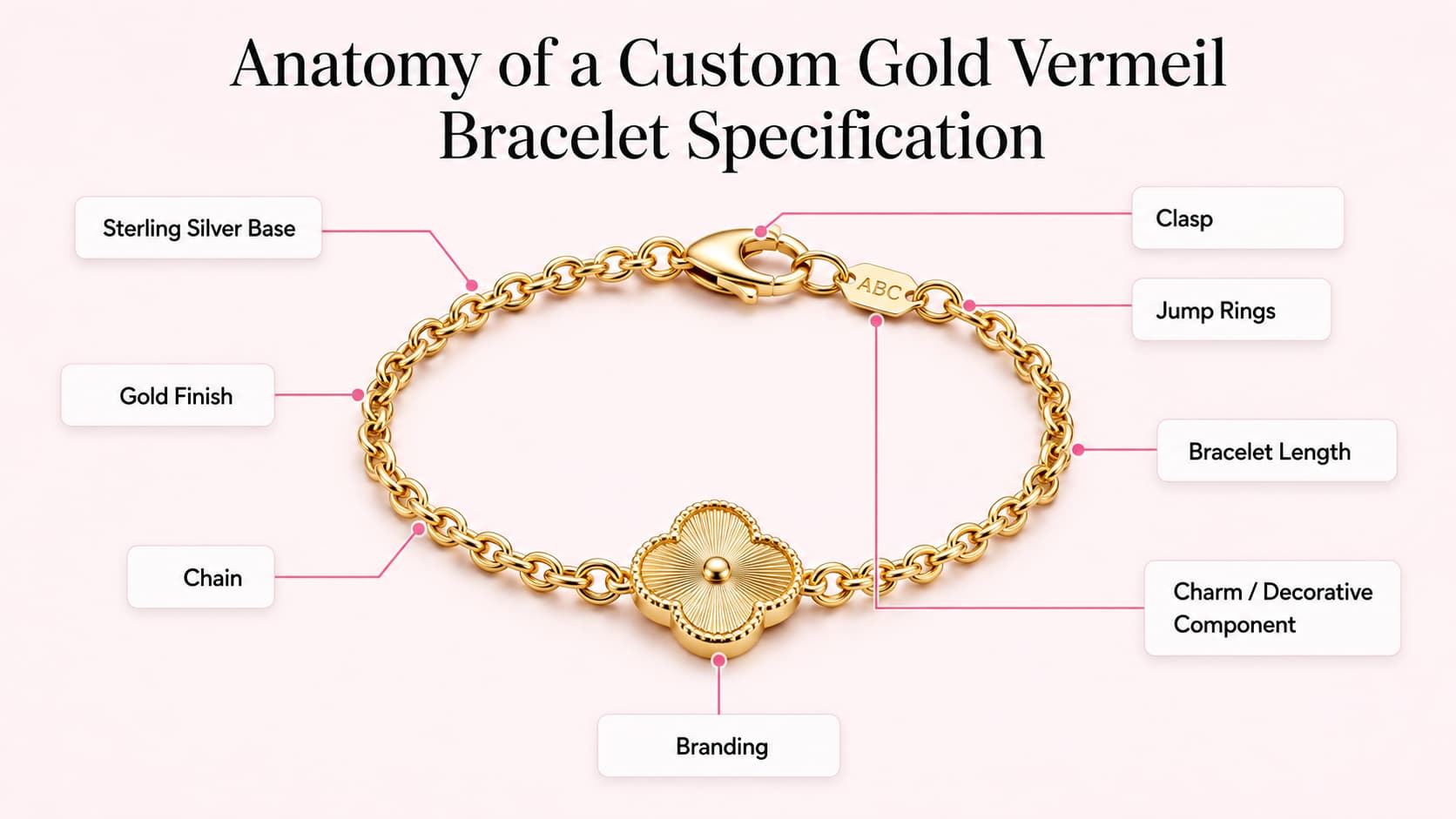
Not every bracelet requires every field. Anything that can materially change the finished product should, however, be defined rather than left to assumption.
How Should the Base Material Be Specified?
For a bracelet intended to be marketed as gold vermeil, the specification should clearly identify the sterling silver base instead of relying on the product name alone.
If the project specifically requires 925 sterling silver, that requirement should appear consistently across the main specification, relevant drawings and purchasing documents.
This becomes especially important when a brand develops visually similar bracelets in different materials or finishes. The product name may look similar while the material requirement is different.
The specification should also identify how the material requirement applies to relevant components such as:
- the main chain;
- clasps;
- jump rings;
- connectors;
- charms;
- decorative metal components.
If any component uses a different material or construction, that exception should be stated explicitly.
Brands selling into different markets should also confirm whether the intended product terminology, labeling, testing or material documentation must meet destination-market requirements. For a broader explanation of the material category, see Zhefan Jewelry's guide to how gold vermeil is defined.
Which Bracelet Dimensions Should Be Defined?
Descriptions such as “small,” “delicate,” “standard length” or “thin” communicate a visual preference, but they do not provide measurable production requirements.
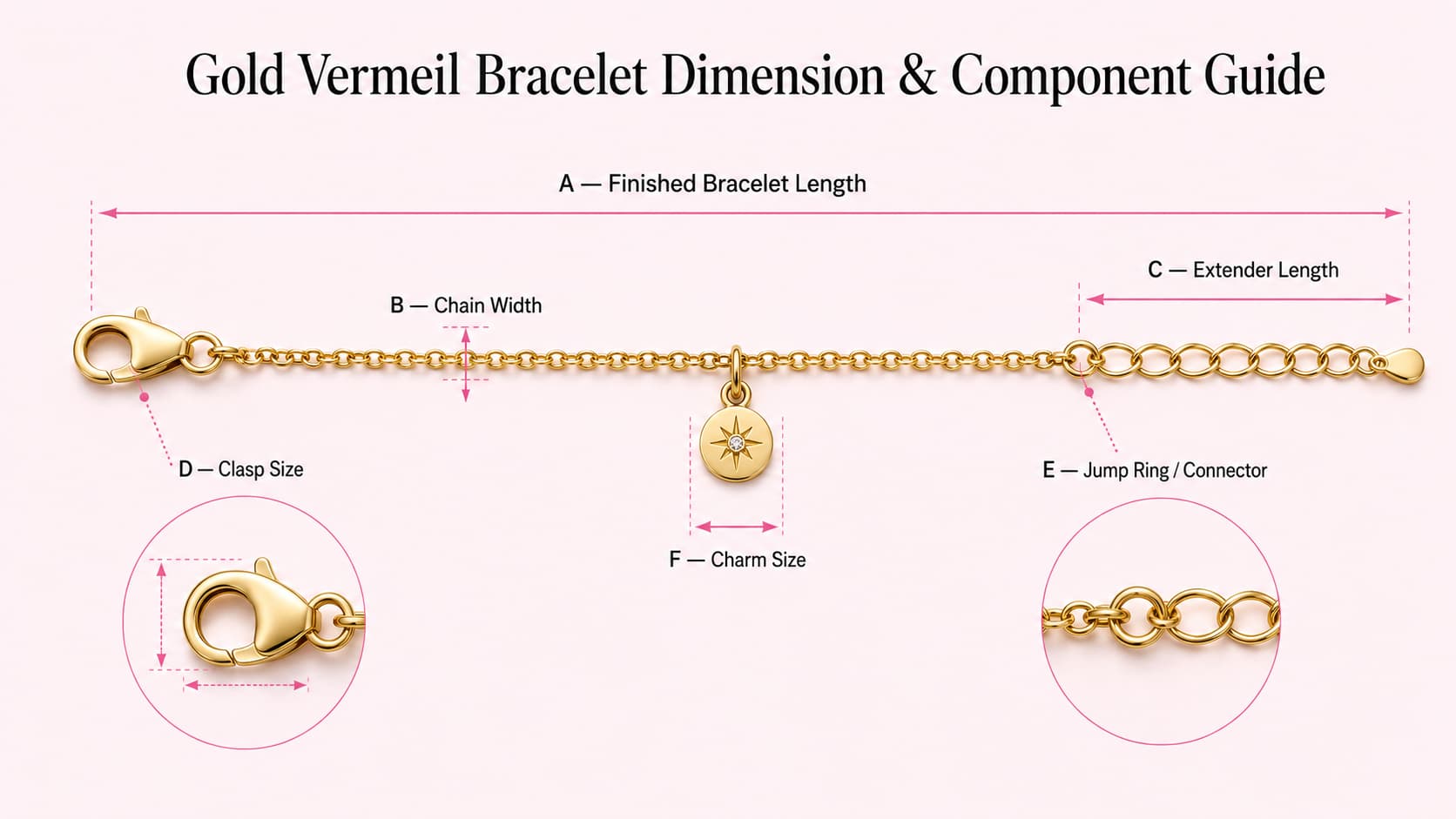
A custom bracelet specification should identify the dimensions that materially affect fit, construction and appearance.
Typical fields can include:
- finished bracelet length;
- main chain width;
- relevant chain-link dimensions;
- center-component dimensions;
- charm dimensions;
- clasp dimensions;
- connector dimensions;
- extender configuration, if used.
Finished Bracelet Length
The document should make clear what the stated bracelet length represents.
If an extender is included, distinguish the main bracelet length from the additional adjustable section. Avoid using one total figure if different teams could interpret that figure differently.
Component Dimensions
Dimensions should also be assigned to components whose proportions affect the overall design.
For example, a bracelet may need separate measurements for:
- a center element;
- decorative bars;
- charms;
- connectors;
- stone settings;
- clasp hardware.
If changing a component's size would noticeably change the finished bracelet, that dimension belongs in the specification.
Adjustable Elements
Where an extender or another adjustable element is used, document:
- its length;
- where it begins;
- how it connects;
- whether it forms part of the stated overall bracelet length.
For finished length, fit, adjustable range and extender definitions, see the gold vermeil bracelet sizing guide. This article only establishes the specification fields that should be documented.
How Should the Gold Finish Be Documented?
The finish section should record the appearance and any agreed technical requirements of the gold surface without relying on subjective marketing descriptions.
Terms such as:
- “luxury gold”;
- “premium gold”;
- “beautiful warm gold”;
are not precise production instructions. A bracelet specification should instead document the finish through controlled requirements.
Gold Tone
If gold color is important to the collection, identify an agreed reference whenever possible. A general phrase such as “yellow gold” may still allow more than one visual interpretation. A controlled product reference, finish reference or other agreed standard provides clearer direction.
Surface Appearance
Gold tone and surface texture are separate fields. A bracelet may require:
- polished surfaces;
- satin surfaces;
- defined textured areas;
- different finishes on different components.
If the surface appearance is part of the design, record it independently.
Technical Finish Requirement
Where the project has an agreed technical finish specification, reference that requirement directly. The purpose of this section is not to repeat a complete explanation of gold vermeil terminology or plating standards. It is to make clear which finish requirement applies to this bracelet.
How Should Chain Construction Be Specified?
The chain is often the structural foundation of a bracelet, so naming only the general chain style may not be enough.
Terms such as “curb chain,” “cable chain” or “fine chain” describe a category, but a custom bracelet may also require specific link proportions and configuration.
Chain Style
Identify the chain type consistently across the specification, drawings, component lists and related production documents. A reference image can help communicate appearance, but measurable information should be used where dimensions affect the design.
Chain Dimensions
Depending on the bracelet structure, relevant measurements may include:
- link width;
- link length;
- link thickness;
- wire or profile dimensions;
- other dimensions that distinguish the intended chain structure.
The purpose is not to measure every feature. Record the dimensions that are necessary to distinguish the intended chain from alternatives.
Chain Configuration
The specification should also show how the chain functions in the complete bracelet. For example:
- plain chain bracelet;
- charm bracelet;
- station bracelet;
- bracelet with a central decorative component;
- bracelet with an extender.
The same basic chain style can produce very different products depending on where connectors, charms and decorative components are positioned.
For curb-link geometry, finished chain width, usable link opening and charm attachment interfaces, see the gold vermeil curb chain bracelet specifications.
How Should Clasps and Jump Rings Be Specified?
Clasps and jump rings are small components, but they influence bracelet closure, assembly, proportions and visual consistency. They should therefore be treated as defined components rather than unspecified hardware.
Clasp Type
Record the required clasp type. If its dimensions materially affect the design, document those dimensions as well.
The specification may also need to identify:
- finish;
- branded detail;
- connection orientation;
- relevant connector components.
Jump Rings and Connectors
A bracelet may use several rings or connectors in different functions. Relevant specification fields can include:
- ring dimensions;
- connection location;
- connection purpose;
- relationship to the clasp;
- relationship to charms or decorative components.
Where several similar connectors appear in one bracelet, a drawing or component diagram can clarify their locations.
Finish Consistency
If the chain, clasp, jump rings and other visible components are intended to share the same finish, state that requirement rather than assuming it.
For a dedicated hardware specification framework, see the gold vermeil bracelet clasp and jump ring specifications.
How Should Charms and Decorative Components Be Defined?
A custom charm bracelet should define each decorative element individually. A description such as “three small charms” is too broad if the finished product depends on the relative size, position and orientation of those charms.
| Charm Requirement | What the Specification Should Answer |
|---|---|
| Shape | What is the intended charm design? |
| Dimensions | What width, height or other measurements matter? |
| Quantity | How many of each charm are used? |
| Placement | Where is each charm positioned? |
| Spacing | Is spacing equal, alternating or intentionally asymmetrical? |
| Orientation | Does the charm need to face a specific direction? |
| Attachment | Where and how is it connected to the bracelet? |
| Finish | Does it match or contrast with the rest of the bracelet? |
For a dedicated framework covering charm dimensions, spacing, placement and orientation, see the gold vermeil charm bracelet design guide.
These fields are especially useful for multi-charm designs such as floral, symbolic or celestial bracelets.
For example, a bracelet using star, moon and sun elements can change visually even when the chain itself stays the same. Differences in charm dimensions, sequence and spacing can alter the balance of the entire design. For motif-specific guidance, see the gold vermeil celestial charm bracelet sizing and spacing guide.
What Stone Information Should Be Included?
Stone specifications are only necessary where stones are part of the actual bracelet design.
When applicable, define relevant fields such as:
- stone type;
- shape;
- size;
- quantity;
- position;
- setting style;
- layout reference.
Where appearance matching matters, the relevant acceptance requirement or visual reference should be documented.
If a natural material or another decorative component can legitimately vary in appearance, the acceptable range should be confirmed between buyer and manufacturer rather than assumed.
How Should Branding and Logo Placement Be Specified?
Private-label branding is often applied to small bracelet components, so the production requirement should clearly identify the branding method and artwork.
Branding Method
The specification should state whether the design requires:
- engraving;
- stamping;
- a branded tag;
- another confirmed branding method.
Do not leave the method undefined if it affects component shape, available surface area or positioning.
Logo Position
A phrase such as “logo near clasp” can still be ambiguous. A stronger specification identifies:
- which component carries the logo;
- exact position;
- orientation;
- relevant logo dimensions.
Artwork Reference
If several logo files or artwork revisions exist, identify the applicable file or version. The manufacturer should not need to decide which email attachment is the current logo.
What Packaging Information Belongs in the Specification?
Packaging should remain a supporting part of this article rather than becoming a separate packaging guide.
If packaging or labeling is part of the order, the product specification should at least identify the applicable configuration. Relevant fields may include:
- individual pouch or box requirement;
- product label;
- SKU identification;
- barcode requirement;
- care card or insert, where applicable;
- separate packaging artwork reference.
If the packaging itself requires extensive technical detail, a separate controlled packaging document can be referenced instead of adding all packaging instructions to the bracelet specification.
How Can Brands Keep One Controlled Production Specification?
A bracelet project becomes harder to manage when important information is spread across different messages, drawings and spreadsheets. A controlled specification gives purchasing, product-development and manufacturing teams a common reference.
| Specification Field | Buyer Requirement |
|---|---|
| Product name | |
| Style / SKU | |
| Specification version | |
| Sterling silver base requirement | |
| Finished bracelet length | |
| Main chain style | |
| Chain width / relevant dimensions | |
| Extender configuration | |
| Gold tone / finish reference | |
| Surface appearance | |
| Clasp type | |
| Clasp dimensions | |
| Jump rings / connectors | |
| Charm details | |
| Stone details, if applicable | |
| Logo method | |
| Logo position | |
| Packaging configuration | |
| Label / SKU requirement | |
| Drawing reference | |
| Artwork reference | |
| Additional production requirements |
The specification table does not have to contain every drawing or artwork detail directly. It can point to controlled files, provided those files are identified clearly.
Instead of writing only “See drawing”, use a reference that clearly identifies the applicable drawing or document version. This makes the specification easier to interpret and easier to reuse when the same bracelet is reordered.
What Are Common Gold Vermeil Bracelet Specification Mistakes?
Relying Only on Reference Images
Reference images are useful for style and appearance, but they usually cannot define finished bracelet length, exact chain dimensions, hidden connectors, clasp size, logo orientation or component dimensions. Use images as supporting references rather than as the complete production specification.
Using Subjective Finish Language
Descriptions such as “premium gold” or “luxury gold finish” are subjective. Use an agreed visual or technical reference where finish appearance matters.
Leaving Small Hardware Undefined
A design may focus heavily on charms or a center element while leaving clasp and connector details unspecified. Small components still affect assembly, proportions, closure and appearance. Define them where they affect the finished product.
Mixing Document Versions
One drawing may contain an older chain width while another document contains a newer value. A controlled specification should identify which version applies.
Describing the Product but Not the Components
A commercial description such as gold vermeil celestial charm bracelet may accurately describe the product category, but it does not fully define the product for production. Break the design down into:
- dimensions;
- chain;
- connectors;
- clasp;
- charms;
- finish;
- branding;
- packaging.
Leaving Branding Undefined
If logo placement or a branded component is required, record it as part of the product specification. Do not assume the branding detail can be added later without affecting the design.
Final Gold Vermeil Bracelet Specification Checklist
Before sending a bracelet specification to a manufacturer, confirm that the document defines the following fields where applicable:
- ☐ Product name and SKU
- ☐ Specification version
- ☐ Sterling silver base requirement
- ☐ Finished bracelet length
- ☐ Chain style
- ☐ Relevant chain dimensions
- ☐ Extender configuration
- ☐ Gold tone or finish reference
- ☐ Surface appearance
- ☐ Clasp type
- ☐ Clasp dimensions
- ☐ Jump rings and connectors
- ☐ Charm dimensions
- ☐ Charm placement
- ☐ Stone details
- ☐ Logo method
- ☐ Logo position
- ☐ Packaging configuration
- ☐ Label or SKU requirement
- ☐ Drawing reference
- ☐ Artwork reference
A complete specification does not mean documenting every possible measurement. It means clearly defining the information that controls the bracelet's construction, fit, appearance, branding and final configuration.
Preparing these specifications for an OEM manufacturer? Use the gold vermeil bracelet RFQ checklist to organize the technical files, confirmed requirements, open questions, variants and commercial information before requesting a quotation.
Frequently Asked Questions
What specifications should I provide for a custom gold vermeil bracelet?
A custom gold vermeil bracelet specification should define the sterling silver base, bracelet dimensions, chain construction, gold finish, clasp, jump rings or connectors, charms or stones where applicable, branding requirements, packaging configuration, and the relevant drawing or artwork references.
Which dimensions should be included in a gold vermeil bracelet specification?
Include dimensions that materially affect the product, such as finished bracelet length, chain width or link dimensions, extender length, clasp dimensions, connector dimensions, charm dimensions and stone dimensions where applicable.
How should gold finish requirements be documented?
Document the intended gold tone, surface appearance and any agreed technical finish requirement. Where appearance is important, use a controlled visual or product reference instead of subjective descriptions such as “premium gold.”
Do I need to specify the clasp and jump rings separately?
Yes, when their type, dimensions, finish or connection affect the bracelet. Clasps and jump rings are functional components and should not automatically be treated as unspecified generic hardware.
What charm information should be included in a bracelet specification?
Define the charm shape, dimensions, quantity, placement, spacing, orientation, attachment point and relevant finish. For multi-charm designs, a layout drawing can clarify the intended arrangement.
Should packaging be included in a jewelry production specification?
If packaging or labeling is part of the order, the bracelet specification should identify the required configuration or reference a separate controlled packaging document.
Can a reference image replace a bracelet specification sheet?
No. A reference image can communicate visual direction, but it generally cannot define all dimensions, materials, connections, branding details, finish requirements or packaging information needed for production.
Discuss Your Custom Gold Vermeil Bracelet Requirements
Brands developing custom pieces can explore Zhefan Jewelry's gold vermeil bracelets for relevant product references.
If your team already has a bracelet concept, drawing or production specification, share the key material, dimension, finish and component requirements so the project can be discussed using a clear production reference.
Share Your Bracelet Requirements
Recommended for you

What Is Gold Vermeil Jewelry? A Complete Guide for Brands and Retailers

Thick Gold Plated Jewelry Manufacturer for 925 Silver & Brass Jewelry

How to Choose a Gold Vermeil Jewelry Manufacturer

Gold Vermeil vs. Gold-Plated Jewelry: Which Fits Your Luxury Jewelry Brand?

Can Silver or Brass Be PVD Coated? A Professional Guide for Jewelry Brands

How to Make Bulk Jewelry Match the Approved Sample: A Production Control System for Jewelry Brands
Product Categories
Discuss Your Ideas with a Professional Custom Jewelry Manufacturer
We provide personalized jewelry customization services for clients worldwide.
Rest assured that your privacy is important to us, and all information provided will be handled with the utmost confidentiality.
By clicking 'Send Inquiry Now' I agree to ZHEFAN JEWELRY processing my personal data.
To see how to withdraw your consent, how to control your personal data and how we process it, please see our Privacy Policy and Terms of use.
From design to production, ZHEFAN JEWELRY offers a one-stop solution to help you enhance your brand value and market competitiveness.
Get A Quote
Contact
Tel: (+86) 188 1927 7817
© 2026 Zhefan Jewelry. All Rights Reserved.
Facebook
Instagram
YouTube
Whatsapp: +8618819277817