






Email: sales3@zhefanjewelry.com
Gold Vermeil Bracelet Sizing Guide: Length, Fit & Extender Chains
Find your perfect fit with Zhefan Jewelry’s technical breakdown of gold vermeil bracelet sizing. Learn how to measure wrist circumference, calculate the ideal drape for different link styles, and utilize extender chains for versatility. This guide provides the precise measurements needed to ensure comfort and security, preventing common sizing errors before you purchase your next piece.
- Quick Answer
- Key Takeaways
- What Does Bracelet Sizing Actually Mean?
- How Should Gold Vermeil Bracelet Length Be Measured?
- Define the Start and End Points
- Main Bracelet Length vs Total Adjustable Length
- Wrist Size vs Finished Bracelet Length
- Why This Matters in Custom Production
- How Should Brands Define Bracelet Fit?
- Close Fit
- Regular Fit
- Relaxed Fit
- How Should Extender Chains Be Specified?
- Extender Length
- Adjustment Points
- Extender End Components
- Should the Listed Bracelet Length Include the Extender?
- Fixed-Length vs Adjustable Gold Vermeil Bracelets
- Fixed-Length Bracelets
- Adjustable Bracelets
- How Does Chain Width Affect Bracelet Fit?
- Chain Flexibility
- Link Width
- How Do Charms and Center Components Affect Sizing?
- Large Center Components
- Multiple Charms
- Rigid Stations
- Do Charms Affect Bracelet Sizing?
- Should Jewelry Brands Offer One Size or Multiple Bracelet Sizes?
- How to Build a Bracelet Size Specification Table
- Size Code
- Consumer-Facing Size Label
- Common Gold Vermeil Bracelet Sizing Mistakes
- Using S, M or L Without Measurements
- Mixing Wrist Size and Bracelet Length
- Combining Main Length and Extender Into One Unclear Number
- Measuring Only the Chain
- Assuming One Fit Allowance Works for Every Bracelet
- Ignoring Decorative Component Bulk
- Using Different Measurement Methods Across SKUs
- Final Gold Vermeil Bracelet Sizing Checklist
- Frequently Asked Questions
- Define the Right Size for Your Custom Gold Vermeil Bracelet
Quick Answer
Gold vermeil bracelet sizing should distinguish between wrist measurement, finished bracelet length and extender length. For custom production, jewelry brands should define exactly how the bracelet is measured, whether the extender is included in the stated length, the intended fit, and the size or adjustment range assigned to each SKU.
Sizing should also consider the complete bracelet construction. Chain width, clasp structure, charms, center components and other rigid or bulky elements can affect how a bracelet sits on the wrist. For that reason, bracelet sizing should be treated as a measurable product specification rather than a simple label such as small, medium or large.
Key Takeaways
- Wrist size and finished bracelet length are different measurements.
- Define exactly where the finished bracelet measurement starts and ends.
- Record the main bracelet length and extender length separately.
- Fit should reflect the bracelet structure and intended wearing style rather than one universal allowance.
- Chain width, clasps, charms and center components can influence how a bracelet feels on the wrist.
- Use measurable size specifications for each SKU instead of relying only on labels such as S, M or L.
- Keep the sizing method consistent across a bracelet collection.
What Does Bracelet Sizing Actually Mean?
Bracelet sizing sounds simple until several different measurements are treated as though they mean the same thing.
For product development and custom production, a jewelry brand should separate at least five concepts:
| Sizing Term | What It Means |
|---|---|
| Wrist measurement | Circumference of the intended wearer's wrist |
| Finished bracelet length | Defined measurement of the completed bracelet |
| Effective / wearable length | The usable length around the wrist once the bracelet construction, closure and components are considered |
| Extender length | Additional adjustable chain or links |
| Size range | Minimum-to-maximum adjustment available where the design is adjustable |
These measurements are related, but they are not interchangeable.
The term effective / wearable length is useful as a practical product-development concept rather than as a universal industry measurement standard. It describes how much usable length the completed bracelet provides once its construction is taken into account.
A customer's wrist circumference does not automatically equal the correct finished bracelet length. Likewise, two bracelets with the same stated length may not fit exactly the same way if they use different chain widths, center components, clasps or decorative structures.
For production purposes, sizing should therefore begin with a clearly defined measurement method. Jewelry brands developing a complete product specification can also refer to the existing guide on gold vermeil bracelet specifications for the broader material, component and documentation framework.
How Should Gold Vermeil Bracelet Length Be Measured?
The first requirement is consistency.
A bracelet specification should define where the measurement starts, where it ends and which components are included in the stated length.
Without that definition, the same number can be interpreted differently by designers, buyers, manufacturers and customers.
Define the Start and End Points
Do not assume that “bracelet length” automatically means the same measurement method for every construction.
A bracelet may include:
- a lobster clasp;
- a spring-ring clasp;
- several jump rings;
- an extender;
- a center element;
- decorative connectors;
- charms or stations.
The specification should establish which of these components are included in the finished length.
For example, if the product is measured from one functional end of the closure to the opposite end of the main bracelet, that method should be applied consistently to all relevant SKUs.
The objective is not to impose one universal measurement rule. It is to make sure that everyone involved in the product uses the same documented method.
Main Bracelet Length vs Total Adjustable Length
Adjustable bracelets create an additional source of confusion.
Main Bracelet Length
The defined base length before additional extender adjustment is used.
Extender Length
The additional adjustable section.
Maximum Adjustable Length
The longest configuration available when the extender is fully used.
| Size Field | Buyer Requirement |
|---|---|
| Main bracelet length | ___ |
| Extender length | ___ |
| Maximum adjustable length | ___ |
| Measurement method | ___ |
Wrist Size vs Finished Bracelet Length
One of the most common sizing mistakes is treating wrist measurement and bracelet length as the same value.
They are not.
Wrist Measurement + Intended Fit Allowance = Target Bracelet Length
The important point is that fit allowance is not one universal number.
The additional space required can depend on:
- bracelet structure;
- chain width;
- component thickness;
- intended wearing style;
- charm or center-element size;
- target customer;
- brand fit preference.
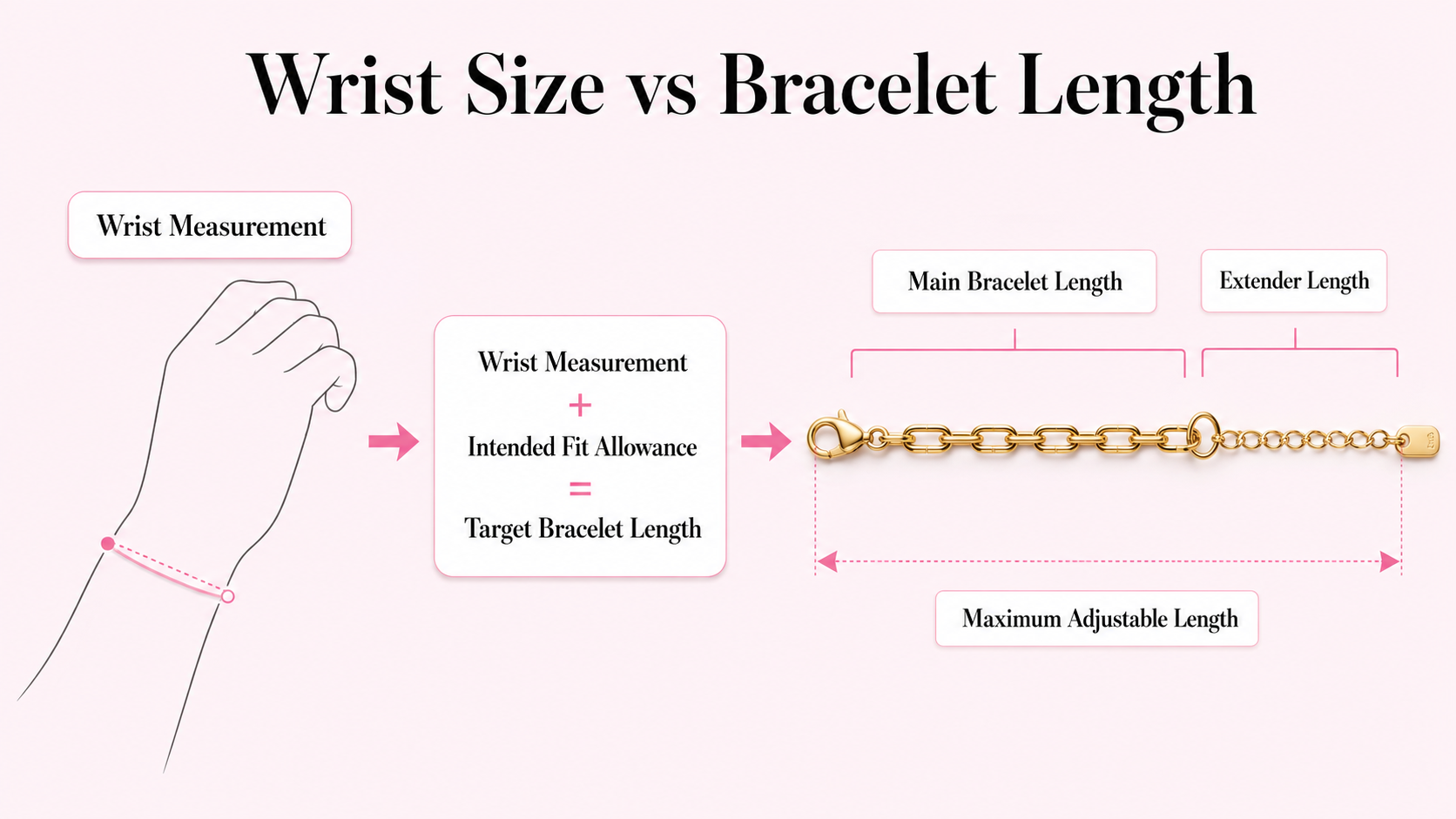
A very fine chain bracelet and a wider structured bracelet may therefore require different sizing decisions even when they are intended for the same wrist measurement.
For this reason, brands should treat wrist measurement as an input and finished bracelet length as a product decision.
Why This Matters in Custom Production
If a product specification only says:
Fits a 16 cm wrist
the manufacturer still does not necessarily know the intended finished bracelet length.
A clearer product specification states separately:
- target wrist range;
- finished bracelet length;
- adjustment range;
- intended fit.
How Should Brands Define Bracelet Fit?
Length is measurable, while fit describes how the bracelet is intended to sit and move on the wrist.
Brands can use internal fit categories to make product decisions clearer.
Close Fit
A close-fit bracelet sits relatively near the wrist with limited movement. For this type of fit, component dimensions can become especially important because thicker chain links, clasps or decorative elements occupy more space around the wrist.
Regular Fit
A regular fit allows moderate movement while keeping the bracelet relatively controlled. For many designs, this can represent a balance between movement and stability, but the actual dimensions should still be defined for the specific product.
Relaxed Fit
A relaxed-fit bracelet intentionally allows more movement. This may suit some charm bracelets or styling concepts, but additional movement can also change how charms, connectors and center components behave.
| Fit Intent | Main Design Consideration |
|---|---|
| Close | Limited movement; component bulk becomes more important |
| Regular | Balanced movement and comfort |
| Relaxed | More movement; charm and chain behavior should be considered |
These categories should not replace measurements. Instead of defining a product only as “Regular fit,” the specification should connect the intended fit to measurable bracelet dimensions.
How Should Extender Chains Be Specified?
An extender chain adds adjustment, but it should not be treated as an undefined accessory attached to the end of the bracelet. For sizing purposes, the extender is part of the product architecture.
Extender Length
Record the extender length separately from the main bracelet length.
This allows the brand to understand both:
- the base length;
- the additional adjustment available.
If multiple bracelet sizes use different extender configurations, each SKU should identify the correct extender requirement.
Adjustment Points
Some extender designs allow the clasp to connect at several usable positions. Other structures may provide more clearly defined adjustment points.
If the available adjustment positions matter to the intended fit, the product specification should identify them. Do not assume that nominal extender length always equals the full practical adjustment range.
Extender End Components
The end of an extender may include another component, such as:
- a branded tag;
- a small charm;
- a decorative bead;
- a logo component;
- another finishing element.
If that component affects the appearance, balance or stated overall length, it should be included in the product documentation.
Should the Listed Bracelet Length Include the Extender?
Do not leave this ambiguous.
A brand can decide how it presents bracelet sizing to customers, but internal production documentation should distinguish:
- main bracelet length;
- extender length;
- maximum adjustable length.
This prevents one stated number from being interpreted differently by product-development, purchasing, manufacturing and sales teams.
Fixed-Length vs Adjustable Gold Vermeil Bracelets
Fixed and adjustable bracelets require different sizing strategies.
| Feature | Fixed-Length Bracelet | Adjustable Bracelet |
|---|---|---|
| Size definition | One defined wearable length | Defined adjustment range |
| Size variants | May require more than one size | Can potentially cover a wider fit range |
| Extender | Usually not part of the design | Often included |
| Product labeling | Exact size should be clear | Main size and/or adjustment range should be clear |
| Main design issue | Correct size selection | Balance between adjustment and appearance |
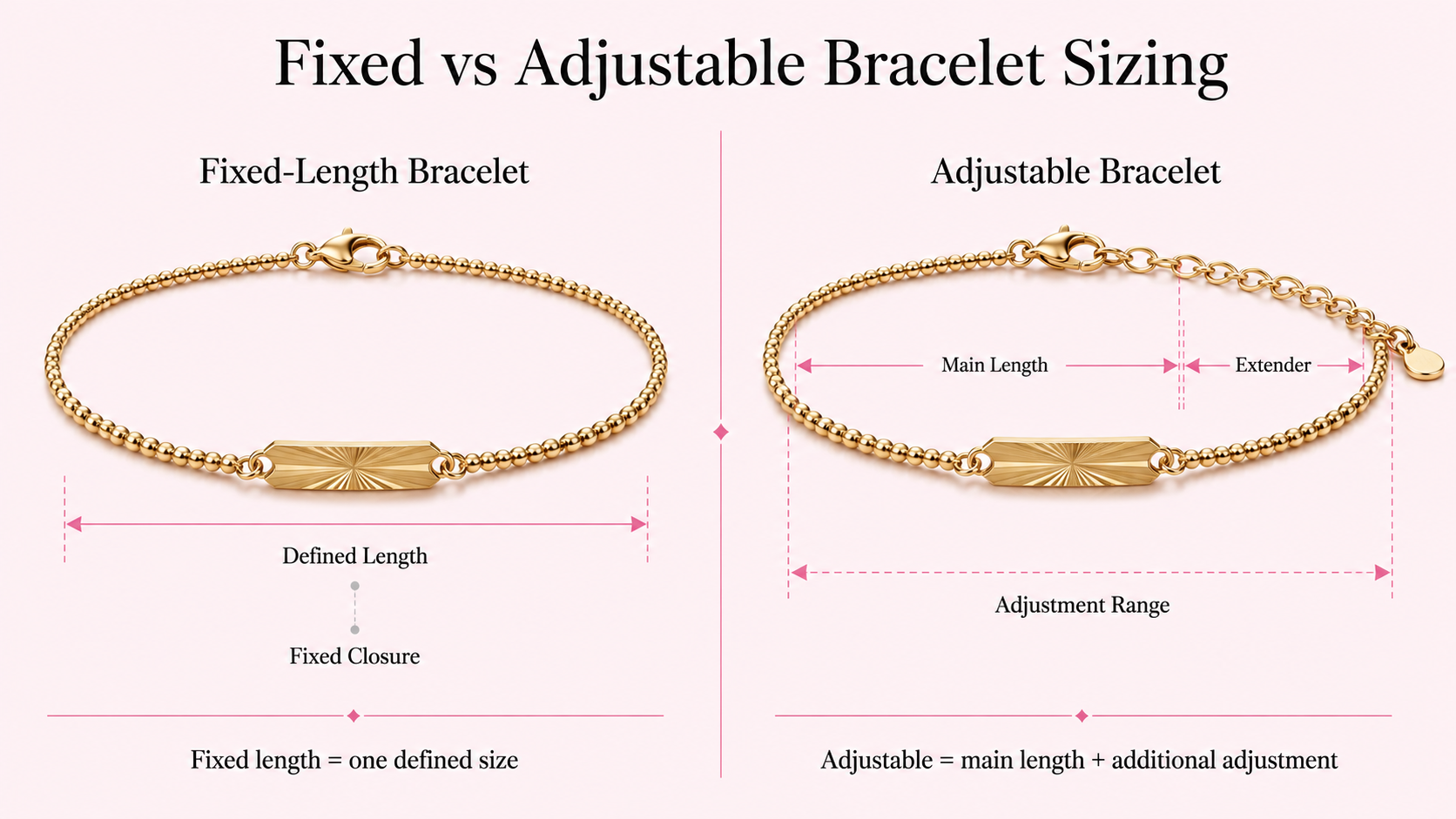
Fixed-Length Bracelets
A fixed-length bracelet provides less flexibility after production.
That means size selection becomes more important, especially when a target customer group includes a broad range of wrist measurements. Brands may choose to offer several sizes where appropriate, but that decision should be based on product construction and available customer data rather than a generic sizing rule.
Adjustable Bracelets
An adjustable design may allow one SKU to cover a wider fit range.
However, adjustability should not automatically be treated as preferable. The extender can affect:
- appearance;
- balance;
- total length;
- movement;
- branding opportunities;
- product labeling.
A brand should therefore decide whether the adjustment structure suits both the design and the sizing objective. For broader product references, Zhefan Jewelry's gold vermeil bracelets category can be used to review relevant bracelet styles.
How Does Chain Width Affect Bracelet Fit?
Two bracelets with the same nominal length may not feel exactly the same if their chain construction differs.
A fine chain takes up relatively little space around the wrist. A wider or heavier chain can create a different wearing experience because of factors such as:
- link width;
- link thickness;
- link profile;
- flexibility;
- articulation between links.
This does not mean every chain requires a different size system. It means that the finished bracelet should be considered as a complete structure rather than only as a length number.
Chain Flexibility
Highly flexible chains can follow the wrist closely. More structured links may create a different effective shape around the wrist.
Link Width
Wider links can increase both visual and physical presence.
When developing several bracelet collections, brands should therefore avoid assuming that sizing logic from a very delicate chain automatically applies to a much wider chain construction. The detailed relationship between link size, chain width and charm attachment belongs in a separate product-specific guide.
How Do Charms and Center Components Affect Sizing?
Decorative elements can change the way a bracelet fits even when the measured overall length remains the same.
Examples include:
- large center charms;
- multiple hanging charms;
- rigid bars;
- station elements;
- stone-set center pieces;
- larger decorative connectors.
Large Center Components
A rigid center element does not curve around the wrist in the same way as a flexible chain. Its dimensions can therefore affect the bracelet's effective wearable geometry.
Multiple Charms
Several charms can add weight and movement. They may also cause the bracelet to rotate or sit differently depending on their placement.
Rigid Stations
Bracelets containing rigid bars or multiple stations should be considered as complete assemblies. Sizing only the flexible chain sections can give an incomplete picture of how the finished product fits.
Do Charms Affect Bracelet Sizing?
They can. Large, rigid or closely spaced decorative components may change how a bracelet sits around the wrist. Brands should therefore define size based on the complete bracelet design rather than relying only on bare chain length.
Should Jewelry Brands Offer One Size or Multiple Bracelet Sizes?
There is no single sizing strategy that is appropriate for every bracelet design.
The decision can depend on:
- bracelet construction;
- available adjustment;
- target customer;
- collection positioning;
- existing sales data;
- customer fit feedback;
- return or exchange data, where available.
| Product Situation | Possible Sizing Approach |
|---|---|
| Highly adjustable bracelet | One adjustable SKU may be considered |
| Limited adjustment | Multiple size options may be useful |
| Rigid or structured design | More precise size segmentation may be needed |
| Brand has reliable customer sizing data | Use actual customer data to define the size mix |
| New product with limited data | Start with clearly documented assumptions and review future customer data |
The strongest size strategy comes from actual business data.
If a brand already has customer measurements, return reasons, fit complaints or sales-by-size data, that information should take priority over generic sizing assumptions.
Without that data, the brand should clearly document its sizing logic so future performance can be evaluated against a consistent starting point.
How to Build a Bracelet Size Specification Table
A sizing specification should give buyers, designers and manufacturers one common reference.
| Size Field | Requirement |
|---|---|
| Style / SKU | |
| Size code | |
| Target wrist range | |
| Main bracelet length | |
| Extender length | |
| Maximum adjustable length | |
| Chain width | |
| Clasp type | |
| Center component length | |
| Charm considerations | |
| Measurement start point | |
| Measurement end point | |
| Measurement method | |
| Intended fit | |
| Consumer-facing size label |
This table can sit inside the broader gold vermeil bracelet specification instead of being managed as an unrelated set of sizing notes.
Size Code
If the product uses:
- XS;
- S;
- M;
- L;
- numeric sizing;
- one-size adjustable;
the size code should still connect to defined measurements. For example, an internal SKU labeled “M” should have a defined finished bracelet length and, where relevant, a defined extender configuration.
Consumer-Facing Size Label
The size shown to customers does not necessarily need to duplicate the complete technical specification.
However, the brand should know exactly how the consumer-facing size maps to the production measurement. This helps maintain consistency across:
- website listings;
- catalogs;
- packaging;
- wholesale line sheets;
- purchase documents.
Common Gold Vermeil Bracelet Sizing Mistakes
Using S, M or L Without Measurements
Size labels are convenient, but they are not technical specifications. If “Small” and “Medium” do not correspond to defined bracelet lengths or adjustment ranges, different teams may interpret them differently.
Mixing Wrist Size and Bracelet Length
A wrist measurement describes the wearer. Bracelet length describes the product. Keep the two fields separate.
Combining Main Length and Extender Into One Unclear Number
If a product is described only as a “20 cm bracelet” without explaining whether the measurement includes the extender, the number may be misunderstood. Record the main length and extender separately.
Measuring Only the Chain
A bracelet can also contain:
- a clasp;
- connectors;
- a center element;
- rigid components.
The specification should define the measurement method for the completed product rather than only the raw chain.
Assuming One Fit Allowance Works for Every Bracelet
Different constructions can create different wearing experiences. Avoid turning one internal fit allowance into a universal rule for every bracelet category.
Ignoring Decorative Component Bulk
Large or rigid components can affect effective fit. This is especially relevant for charm bracelets and designs with center pieces.
Using Different Measurement Methods Across SKUs
If one bracelet is measured clasp-to-ring while another excludes certain hardware without clear documentation, size comparisons become unreliable. A collection should use a consistent method or clearly document justified exceptions.
Final Gold Vermeil Bracelet Sizing Checklist
Before finalizing sizing requirements for a custom bracelet, confirm that the product documentation defines:
- ☐ Target wrist measurement or wrist range
- ☐ Finished bracelet length
- ☐ Measurement start point
- ☐ Measurement end point
- ☐ Main bracelet length
- ☐ Extender length, if used
- ☐ Maximum adjustable length
- ☐ Intended fit
- ☐ Chain width
- ☐ Relevant link dimensions
- ☐ Clasp and connector contribution
- ☐ Center-component dimensions
- ☐ Charm or decorative-component considerations
- ☐ Size code or SKU
- ☐ Consumer-facing size label
- ☐ Consistent measurement method
A good sizing specification does not require unnecessary complexity. It requires clear definitions so every team involved in the product understands what each size actually means.
Frequently Asked Questions
How is gold vermeil bracelet length measured?
The measurement method should be defined consistently for the specific bracelet construction. Brands should document the start point, end point and which components are included in the finished length rather than assuming every bracelet is measured in exactly the same way.
Is bracelet length the same as wrist size?
No. Wrist size measures the wearer, while bracelet length measures the product. The finished bracelet length reflects the target wrist measurement, intended fit and bracelet construction.
Should an extender chain be included in bracelet length?
The main bracelet length and extender length should be documented separately. Brands can choose how they present the consumer-facing size, but production specifications should clearly distinguish the base length, extender length and maximum adjustable length.
How should an adjustable gold vermeil bracelet be sized?
Define the main bracelet length, extender length, maximum adjustment range and intended fit. If the design has specific adjustment points or an end charm or tag, those details should also be documented.
Does chain width affect bracelet fit?
It can. Wider, thicker or more structured chains may sit differently from fine, flexible chains even when their nominal lengths are the same. Sizing should therefore consider the complete bracelet construction.
Do charms affect bracelet sizing?
They can. Large, rigid or closely spaced charms and center components may change how the bracelet sits and moves around the wrist, so sizing should consider the complete design rather than chain length alone.
Should jewelry brands offer one bracelet size or multiple sizes?
It depends on the bracelet construction, adjustment range, target customer and available customer data. Highly adjustable designs may cover a wider fit range, while structured or fixed-length bracelets may require more precise size segmentation.
Define the Right Size for Your Custom Gold Vermeil Bracelet
A clear bracelet size specification should connect the wearer's wrist measurement to the actual product construction. Main bracelet length, extender range, chain width, clasp structure, charms and center components should all be considered before a size is assigned to a SKU.
Brands developing custom designs can review Zhefan Jewelry's gold vermeil bracelets and use the published gold vermeil bracelet specification guide as a broader reference for materials, finish and component documentation.
If your team has defined the intended bracelet length, adjustment range, chain structure and target fit, share those requirements with Zhefan Jewelry to discuss the custom production requirements for your project.
Share Your Bracelet Requirements
Recommended for you

What Is Gold Vermeil Jewelry? A Complete Guide for Brands and Retailers

Thick Gold Plated Jewelry Manufacturer for 925 Silver & Brass Jewelry

How to Choose a Gold Vermeil Jewelry Manufacturer

Gold Vermeil vs. Gold-Plated Jewelry: Which Fits Your Luxury Jewelry Brand?

Can Silver or Brass Be PVD Coated? A Professional Guide for Jewelry Brands

How to Make Bulk Jewelry Match the Approved Sample: A Production Control System for Jewelry Brands
Product Categories
Discuss Your Ideas with a Professional Custom Jewelry Manufacturer
We provide personalized jewelry customization services for clients worldwide.
Rest assured that your privacy is important to us, and all information provided will be handled with the utmost confidentiality.
By clicking 'Send Inquiry Now' I agree to ZHEFAN JEWELRY processing my personal data.
To see how to withdraw your consent, how to control your personal data and how we process it, please see our Privacy Policy and Terms of use.
From design to production, ZHEFAN JEWELRY offers a one-stop solution to help you enhance your brand value and market competitiveness.
Get A Quote
Contact
Tel: (+86) 188 1927 7817
© 2026 Zhefan Jewelry. All Rights Reserved.
Facebook
Instagram
YouTube
Whatsapp: +8618819277817