






Email: sales3@zhefanjewelry.com
Gold Vermeil Jewelry Specification Checklist: Materials, Dimensions, Finish & Components
Master production quality with Zhefan Jewelry’s gold vermeil jewelry specification checklist. This technical breakdown covers essential standards for sterling silver bases, precise micron thickness, and finishing requirements. Use these professional benchmarks to eliminate manufacturing errors and ensure every piece meets high-end market expectations for durability and aesthetic consistency.
- Quick Answer
- Key Takeaways
- What Should a Gold Vermeil Jewelry Specification Include?
- How Should the Base Material Be Specified?
- Separate the Main Product Material From Exceptions
- Which Dimensions Should Be Included in a Jewelry Specification?
- Finished Dimensions vs Component Dimensions
- Use One Defined Measurement Method
- How Should Jewelry Components Be Documented?
- Component Name Is Not Enough
- Define the Interface
- How Should Gold Vermeil Finish Requirements Be Recorded?
- Gold Tone
- Surface Appearance
- Technical Finish Requirement
- How Should Stones and Decorative Elements Be Specified?
- Position and Orientation Can Matter
- How Should Branding Be Included in the Specification?
- Branding Method
- Artwork Should Have a Controlled Reference
- How Should Product Variants Be Controlled?
- One Product Family Does Not Mean One Specification
- How Should Drawings, CAD Files and Artwork Be Controlled?
- Connect Files to the Product Revision
- How Should Confirmed, Manufacturer-to-Confirm and TBD Fields Be Used?
- Confirmed
- Manufacturer to Confirm
- TBD
- A Blank Cell Is Not the Same as TBD
- How Do Specifications Change by Jewelry Category?
- Gold Vermeil Earrings
- Gold Vermeil Necklaces
- Gold Vermeil Rings
- Gold Vermeil Bracelets
- How Does a Specification Connect to the Manufacturing Process?
- What Information Belongs in the Specification vs the RFQ?
- Common Gold Vermeil Jewelry Specification Mistakes
- Using a Reference Image as the Full Specification
- Using the Product Name as the Material Specification
- Leaving Critical Dimensions Undefined
- Naming Components Without Defining Interfaces
- Using Subjective Finish Terms
- Mixing Multiple Variants in One Undefined Requirement
- Mixing File Revisions
- Guessing Unresolved Technical Values
- Final Gold Vermeil Jewelry Specification Checklist
- Frequently Asked Questions
- Discuss Your Gold Vermeil Jewelry Specification
Quick Answer
A gold vermeil jewelry specification checklist should define the product in measurable and controlled terms before production decisions depend on it.
Typical specification fields include product identification, product category, silver base requirement, finished dimensions, component dimensions and interfaces, stones or decorative elements where applicable, gold finish requirements, branding, variants, packaging requirements, technical-file references and the current document revision.
Not every product needs every field. The objective is to define the information that can materially change the product rather than leaving those decisions to visual interpretation or assumption.
Earrings, necklaces, rings and bracelets can share the same specification structure, but the dimensions, components and interfaces that matter differ by jewelry category.
Key Takeaways
- A product specification should describe measurable product requirements rather than rely only on visual references.
- For gold vermeil projects, base material and gold finish should be recorded as separate controlled fields.
- Dimensions should focus on features that affect fit, construction, interfaces or visible proportion.
- Component names alone are not always enough; the specification should also define how components connect and where they are positioned.
- Variants should be controlled by SKU, version or another clear reference rather than mixed into one undefined specification.
- Technical drawings, CAD files, artwork and finish references should be connected to the correct revision.
- Unknown fields should be marked as Manufacturer to Confirm or TBD rather than completed with guessed values.
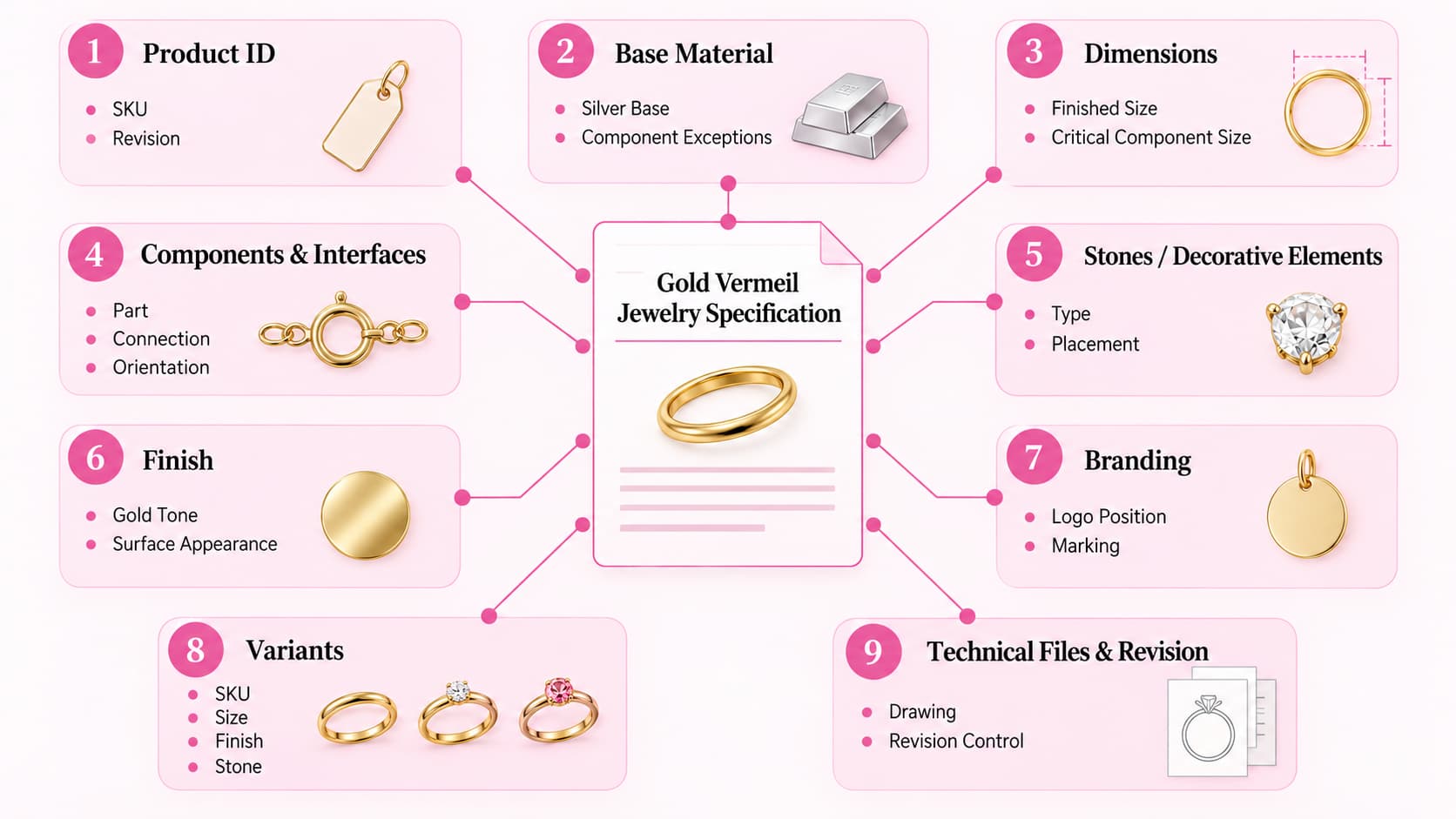
What Should a Gold Vermeil Jewelry Specification Include?
A production-ready specification should answer a basic question:
What exactly is the product that the manufacturer is being asked to make?
For B2B jewelry development, the specification should translate a visual concept into controlled product requirements.
| Specification Area | What to Define | Why It Matters |
|---|---|---|
| Product identification | Product name, SKU, style reference, revision | Prevents product and version confusion |
| Product category | Earrings, necklace, ring, bracelet or other category | Determines category-specific controls |
| Base material | Required silver base and relevant component materials | Defines product construction |
| Finished dimensions | Overall measurable dimensions | Controls size and proportion |
| Component dimensions | Chain, clasp, post, bail, band or other relevant dimensions | Controls fit and interfaces |
| Components | Clasps, posts, backs, chains, settings, connectors, charms | Defines construction |
| Component interfaces | How components connect and where | Controls assembly relationships |
| Stones or decorative elements | Type, dimensions, quantity, position and orientation | Defines decorative structure |
| Finish | Gold tone, surface appearance and technical reference | Controls surface requirements |
| Branding | Logo method, position and artwork | Controls private-label details |
| Variants | Size, color, finish or component differences | Separates SKU requirements |
| Packaging | Configuration where applicable | Controls delivered product format |
| Technical files | Drawing, CAD, component map, artwork | Controls technical reference |
| Revision | Current specification and related file versions | Prevents obsolete instructions |
This is a master structure rather than a universal form.
A simple chain necklace may require fewer fields than a stone-set ring or a multi-charm bracelet.
The purpose of the checklist is not to make every specification longer. It is to make every important product decision visible.
How Should the Base Material Be Specified?
The material field should state the intended base material clearly enough that the production team does not need to infer it from the product name or reference image.
For a product intended to be developed as gold vermeil jewelry, the specification should identify the required silver base and any relevant component-material differences.
Depending on the design, useful fields can include:
- main body material;
- chain material;
- clasp material;
- post or back material;
- pendant or charm material;
- connector material;
- component-material exceptions;
- applicable market requirement where relevant.
A phrase such as “gold vermeil necklace” is a product description. It is not a complete material specification.
Separate the Main Product Material From Exceptions
A design may contain components that need separate material review, such as:
- earring posts;
- earring backs;
- clasps;
- jump rings;
- stone settings;
- branded tags;
- connectors.
If a component is subject to a different requirement, that exception should be recorded rather than hidden inside a general note.
For background on the category itself, buyers can review what is gold vermeil jewelry. Exact legal, labeling or market-specific requirements should be confirmed for the intended destination market rather than assumed to be identical everywhere.
Which Dimensions Should Be Included in a Jewelry Specification?
The most useful dimensions are the ones that can materially change fit, construction, component compatibility, visible proportion, assembly or product identity.
The goal is not to measure every visible feature. The goal is to define the dimensions that matter to the product.
| Category | Typical Dimensions to Define |
|---|---|
| Earrings | Overall size, post position, post dimensions, hoop geometry, charm size |
| Necklaces | Finished chain length, pendant dimensions, bail dimensions, extender length |
| Rings | Ring size, band width, band thickness, setting dimensions |
| Bracelets | Finished length, chain width, clasp dimensions, extender length, charm size |
Finished Dimensions vs Component Dimensions
These should not be treated as the same thing.
A necklace can have a finished chain length while also containing pendant dimensions, bail dimensions, clasp dimensions and extender dimensions.
A bracelet can have a finished length while also containing chain width, clasp size, jump-ring dimensions and charm dimensions.
A ring can have a finished ring size while also requiring band width, band thickness, stone dimensions and setting dimensions.
Use One Defined Measurement Method
A number is only useful if the measurement method is clear. A specification may need to clarify whether a dimension refers to:
- total finished length;
- usable length;
- body length excluding a clasp;
- outer diameter;
- inner diameter;
- overall component height;
- visible face width.
When the measurement method matters, record it. Do not assume all teams interpret the same dimension in the same way.
How Should Jewelry Components Be Documented?
Component lists help define how the product is constructed. Depending on the jewelry category, components can include:
- chains;
- clasps;
- jump rings;
- connectors;
- posts;
- backs;
- bails;
- pendants;
- charms;
- stone settings;
- branded tags;
- extenders;
- decorative elements.
Component Name Is Not Enough
For example, “lobster clasp” does not necessarily define clasp size, material, finish, connector, orientation or attachment relationship.
Likewise, “jump ring” does not define which connection it belongs to, its relevant dimensions, whether it is decorative or structural, or how it connects adjacent components.
Define the Interface
For B2B jewelry production, component interfaces are often as important as the components themselves.
- What connects to what?
- Where does the connection occur?
- Which side or direction applies?
- Does the component rotate freely or remain oriented?
- Which drawing defines the connection?
- Does the component differ by variant?
A pendant and a chain may both be correct while the finished necklace is still wrong if the bail or connector relationship has not been defined.
How Should Gold Vermeil Finish Requirements Be Recorded?
Gold finish requirements should be recorded as controlled product fields rather than subjective marketing descriptions.
“Premium gold” is a marketing description, not a production specification.
Depending on the project, the finish section can include:
- gold tone or color direction;
- surface appearance;
- controlled visual reference;
- technical finish requirement where already confirmed;
- finish reference number or document where applicable;
- verification requirement where applicable;
- destination-market requirement where relevant.
Gold Tone
If the intended gold color matters, the specification should identify how the production team should interpret it.
This may be through:
- an approved product reference;
- an approved visual reference;
- another controlled finish reference.
Surface Appearance
The specification may need to identify appearance requirements such as:
- polished;
- matte;
- brushed;
- textured;
- mixed surface treatment where applicable.
Technical Finish Requirement
Technical finish values should only be written into the specification when they have been confirmed for the project.
Do not invent:
- plating thickness;
- process sequence;
- testing method;
- tolerance;
- verification criteria.
If one of these fields is not yet confirmed, mark it Manufacturer to Confirm or TBD as appropriate.
How Should Stones and Decorative Elements Be Specified?
Stones and decorative elements can change geometry, appearance, assembly and product cost structure. Where applicable, the specification should identify the fields that materially affect the design.
| Field | Question to Define |
|---|---|
| Type | What stone or decorative material is required? |
| Shape | What shape applies? |
| Size | What dimensions matter? |
| Quantity | How many are used? |
| Position | Where is each element located? |
| Orientation | Does direction matter? |
| Setting | What setting requirement applies? |
| Visual reference | Is an approved reference available? |
Position and Orientation Can Matter
For some designs, the production team may also need to know:
- exact placement;
- spacing;
- symmetry;
- directional orientation;
- relationship to a logo or charm;
- whether the design differs on the left and right side.
Descriptions such as “luxury look,” “more sparkle” or “balanced appearance” may communicate direction, but they do not replace a controlled layout or reference.
How Should Branding Be Included in the Specification?
Branding should be treated as part of the product definition when it is required on the jewelry or packaging.
Useful branding fields can include:
- branding method;
- logo position;
- logo dimensions;
- logo orientation;
- artwork file;
- artwork revision;
- branded tag or component;
- packaging artwork where applicable.
Branding Method
Depending on the project, branding can involve methods such as:
- engraving;
- stamping;
- branded tags;
- branded components;
- another confirmed method.
The specification should not assume one branding method for every project.
Artwork Should Have a Controlled Reference
Avoid instructions such as “use our latest logo.”
Instead, identify the relevant artwork file or revision so the production team can distinguish between old and new artwork, different market versions and separate product or packaging graphics.
How Should Product Variants Be Controlled?
Product variants are a common source of specification confusion.
A single design may have variations in:
- size;
- chain length;
- ring size;
- gold tone;
- stone color;
- charm;
- pendant;
- clasp;
- packaging;
- branding.
If the variation changes a production requirement, it should be represented as a controlled variant rather than hidden inside a general note.
| SKU / Variant | Size | Finish | Stone | Component Difference |
|---|---|---|---|---|
| Variant A | Confirmed | Confirmed | — | Standard configuration |
| Variant B | Confirmed | Confirmed | Confirmed | Different pendant |
| Variant C | TBD | Confirmed | Confirmed | Same base construction |
This table is a documentation example only and does not represent actual Zhefan Jewelry product values.
One Product Family Does Not Mean One Specification
Two variants may look similar but still require different production information.
If the difference affects production, it should be visible in the specification and connected to a controlled SKU, style number, product code, variant ID or specification revision.
How Should Drawings, CAD Files and Artwork Be Controlled?
Technical files are useful only when the specification identifies which version applies.
A specification should not simply say “see drawing.” It should make clear which drawing and which revision.
| Document | What the Specification Should Record |
|---|---|
| CAD file | File name or controlled revision |
| Dimensional drawing | Drawing number or version |
| Component map | Applicable revision |
| Branding artwork | File and revision |
| Packaging artwork | File and revision |
| Finish reference | Controlled reference |
| Product image | Reference status where applicable |
Connect Files to the Product Revision
If the main specification is Revision C but the drawing is still Revision A, the project may contain conflicting requirements.
The specification should therefore record:
- current specification version;
- relevant drawing version;
- current CAD version where applicable;
- applicable artwork version;
- current component reference;
- obsolete files where relevant.
For the broader production workflow behind these documents, see the gold vermeil jewelry manufacturing process.
How Should Confirmed, Manufacturer-to-Confirm and TBD Fields Be Used?
Not every specification is complete when a project first enters technical discussion. What matters is distinguishing a confirmed requirement from an unresolved one.
| Status | Meaning |
|---|---|
| Confirmed | The buyer requirement is fixed |
| Manufacturer to Confirm | Technical or production review is required |
| TBD | The buyer decision remains open |
Confirmed
Use Confirmed when the buyer has already defined the requirement, such as an approved dimension, selected stone, approved branding artwork or confirmed finish direction.
Manufacturer to Confirm
Use this when technical input is required before the value or method can be finalized, such as production feasibility, tolerance, component compatibility, assembly method or a process-dependent detail.
TBD
Use TBD when the buyer has not yet made the decision, such as an optional charm, final stone color, packaging artwork or unresolved variant.
A Blank Cell Is Not the Same as TBD
A blank cell can mean forgotten, not applicable, unknown or not yet reviewed. A TBD field clearly states that the requirement is intentionally unresolved and still requires a decision.
How Do Specifications Change by Jewelry Category?
The overall specification framework can remain consistent across a collection, but category-specific controls change.
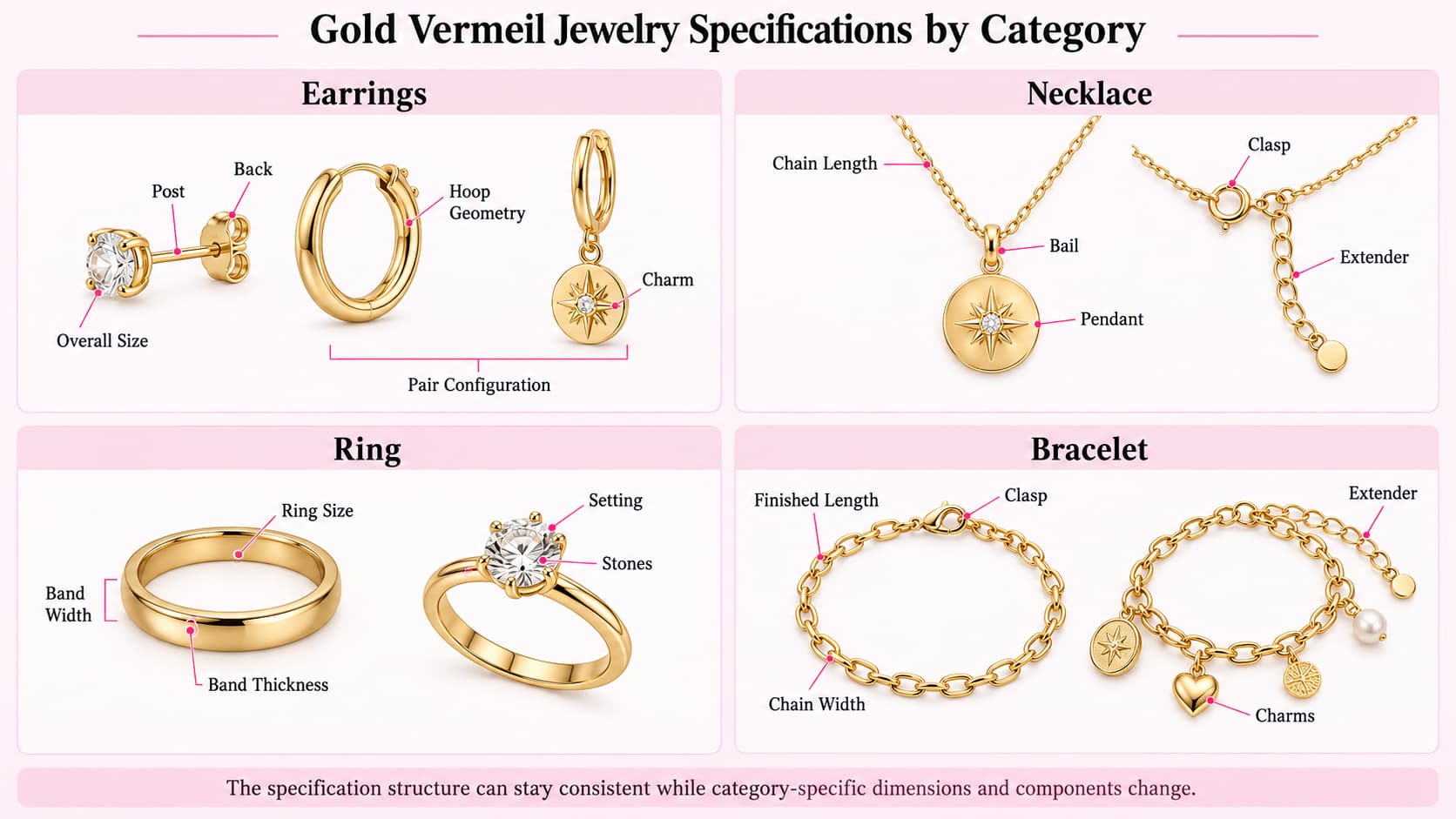
| Category | Category-Specific Controls |
|---|---|
| Earrings | Posts, backs, hoop dimensions, pair configuration, charms |
| Necklaces | Chain length, pendant, bail, clasp, extender |
| Rings | Ring size, band geometry, setting dimensions, stones |
| Bracelets | Finished length, chain, clasp, extender, charms |
Gold Vermeil Earrings
Earring specifications may need to define:
- overall dimensions;
- post dimensions;
- post position;
- earring backs;
- hoop geometry;
- charm dimensions;
- pair configuration;
- left/right orientation where applicable.
Gold Vermeil Necklaces
Necklace specifications may need to define:
- finished chain length;
- chain dimensions;
- pendant dimensions;
- bail geometry;
- clasp;
- extender;
- pendant position;
- component connections.
Gold Vermeil Rings
Ring specifications may need to define:
- ring size;
- band width;
- band thickness;
- setting geometry;
- stone configuration;
- face dimensions;
- orientation;
- finish.
Gold Vermeil Bracelets
Bracelet specifications may need to define:
- finished length;
- chain width;
- clasp;
- extender;
- jump rings;
- charms;
- component attachment points.
For a deeper bracelet-specific breakdown, see the existing gold vermeil bracelet specifications guide.
How Does a Specification Connect to the Manufacturing Process?
A specification and a manufacturing process solve different problems.
| Specification | Manufacturing Process |
|---|---|
| What must be produced? | How do those requirements move through production? |
The specification can define material, dimensions, components, finish, branding and product revision.
The manufacturing workflow then uses those controlled requirements across relevant stages such as technical definition, component preparation, surface preparation, finishing, assembly, quality review and production handoff.
For a stage-by-stage view, read Gold Vermeil Jewelry Manufacturing Process: From Design to Production.
What Information Belongs in the Specification vs the RFQ?
A product specification and an RFQ are related, but they are not the same document.
A specification defines the product. An RFQ combines that product definition with the information needed for quotation and commercial discussion.
| Product Specification | RFQ / Commercial Request |
|---|---|
| Product identity | Requested quantity |
| Base material | Quote scope |
| Dimensions | Order structure |
| Components | Commercial request |
| Finish | Pricing basis |
| Stones | Requested variants |
| Branding | Packaging / commercial context |
| Technical drawings | Timeline questions |
| Variant definition | Commercial terms |
| Revision | Additional sourcing requirements |
This separation helps prevent commercial information from replacing technical product definition.
Common Gold Vermeil Jewelry Specification Mistakes
Using a Reference Image as the Full Specification
A reference image can communicate visual direction, but it usually cannot fully define dimensions, materials, hidden interfaces, finish requirements or variant differences.
Using the Product Name as the Material Specification
A phrase such as “gold vermeil earrings” does not replace the material field. Record the required base material and relevant component-material requirements explicitly.
Leaving Critical Dimensions Undefined
Undefined dimensions can lead to different interpretations of size, proportion, fit and component compatibility.
Naming Components Without Defining Interfaces
A component can be correct while the finished construction is wrong. Where an interface matters, define what connects, where it connects and how it is oriented.
Using Subjective Finish Terms
Terms such as “premium gold,” “luxury finish” or “perfect polish” are not complete production specifications.
Mixing Multiple Variants in One Undefined Requirement
If one size, finish, charm or stone configuration differs from another, the difference should be connected to a controlled variant.
Mixing File Revisions
Old drawings, new CAD files and revised artwork can define different versions of the product. Use one current requirement package.
Guessing Unresolved Technical Values
Do not invent:
- plating values;
- tolerances;
- testing requirements;
- production methods;
- component dimensions.
Use Manufacturer to Confirm or TBD instead.
Final Gold Vermeil Jewelry Specification Checklist
Before a specification is used for production discussion, review the following fields:
| Specification Field | Review Question |
|---|---|
| Product name | Is the product clearly identified? |
| SKU / style reference | Is there a controlled product identifier? |
| Specification revision | Is the current version clear? |
| Product category | Is the jewelry category defined? |
| Base material | Is the required silver base documented? |
| Component materials | Are relevant exceptions identified? |
| Finished dimensions | Are overall dimensions defined? |
| Critical component dimensions | Are production-relevant component dimensions included? |
| Components | Are required parts listed? |
| Component interfaces | Is it clear how critical components connect? |
| Stones / decorative elements | Are type, size, quantity and position defined where applicable? |
| Finish | Is gold tone and surface appearance defined? |
| Technical finish fields | Are confirmed fields separated from open technical questions? |
| Branding | Are method, position and artwork defined where applicable? |
| Variants | Are size, finish, stone or component differences controlled? |
| Packaging | Is the relevant configuration defined or marked open? |
| CAD file | Is the correct revision identified where applicable? |
| Drawing | Is the correct drawing version identified? |
| Artwork | Is the correct artwork revision identified? |
| Finish reference | Is the controlled reference identified where applicable? |
| Manufacturer-to-confirm fields | Are technical review items clearly marked? |
| TBD fields | Are buyer decisions still open clearly marked? |
A strong specification does not need to contain every possible field. It needs to contain the fields that materially define the product.
Frequently Asked Questions
What should a gold vermeil jewelry specification include?
A gold vermeil jewelry specification can include product identification, silver base requirements, finished and component dimensions, components and interfaces, stones or decorative elements, finish requirements, branding, variants, packaging requirements, technical-file references and the current document revision. Only fields relevant to the specific product need to be included.
Is a reference image enough for custom gold vermeil jewelry production?
Usually not. A reference image can show visual direction but may not define dimensions, base material, component interfaces, finish requirements, hidden construction or variant differences. Where these details affect production, they should be recorded separately in controlled technical documents.
Which dimensions should be included in a jewelry specification?
Include dimensions that materially affect fit, construction, component compatibility or visible proportion. Depending on the product, this may include overall size, chain length, pendant dimensions, ring size, band dimensions, post position, clasp dimensions, extender length or charm size.
How should gold vermeil finish requirements be documented?
The specification can identify the intended gold tone, surface appearance, controlled visual reference and any confirmed project-specific technical or verification requirements. Values that have not been confirmed should be marked Manufacturer to Confirm or TBD rather than guessed.
Should every component be listed in the specification?
Components that materially affect product construction, function, appearance or interfaces should be identified. The required level of detail depends on the jewelry design. Critical interfaces should also be defined where the component name alone is not enough.
How should different sizes or finish variants be controlled?
Use a clear SKU, variant code or other controlled identifier to separate requirements. If a variant changes a dimension, finish, stone, component or another production field, that difference should be visible in the specification rather than hidden in an informal note.
What is the difference between a product specification and an RFQ?
A product specification defines what is being made, including materials, dimensions, components, finish, variants and technical references. An RFQ uses that product definition together with commercial information such as requested quantities, quote scope and other quotation requirements.
What should be marked Manufacturer to Confirm or TBD?
Use Manufacturer to Confirm for fields that require technical or production review. Use TBD for buyer decisions that remain open. These statuses are preferable to guessing unresolved values or leaving unclear blank cells.
Discuss Your Gold Vermeil Jewelry Specification
If your team is preparing a custom gold vermeil jewelry project, organize the product identity, base material, dimensions, components, finish direction, variants and available technical files before production discussion.
A clear specification gives both the buyer and manufacturer a controlled reference for reviewing the product.
For broader commercial product options, review Zhefan Jewelry's gold vermeil jewelry range.
Discuss Your Jewelry Specification
Recommended for you

What Is Gold Vermeil Jewelry? A Complete Guide for Brands and Retailers

Thick Gold Plated Jewelry Manufacturer for 925 Silver & Brass Jewelry

How to Choose a Gold Vermeil Jewelry Manufacturer

Gold Vermeil vs. Gold-Plated Jewelry: Which Fits Your Luxury Jewelry Brand?

Can Silver or Brass Be PVD Coated? A Professional Guide for Jewelry Brands

How to Make Bulk Jewelry Match the Approved Sample: A Production Control System for Jewelry Brands
Product Categories
Discuss Your Ideas with a Professional Custom Jewelry Manufacturer
We provide personalized jewelry customization services for clients worldwide.
Rest assured that your privacy is important to us, and all information provided will be handled with the utmost confidentiality.
By clicking 'Send Inquiry Now' I agree to ZHEFAN JEWELRY processing my personal data.
To see how to withdraw your consent, how to control your personal data and how we process it, please see our Privacy Policy and Terms of use.
From design to production, ZHEFAN JEWELRY offers a one-stop solution to help you enhance your brand value and market competitiveness.
Get A Quote
Contact
Tel: (+86) 188 1927 7817
© 2026 Zhefan Jewelry. All Rights Reserved.
Facebook
Instagram
YouTube
Whatsapp: +8618819277817