






Email: sales3@zhefanjewelry.com
Gold Vermeil Finish Specifications: What Jewelry Brands Should Define for Production
A practical guide to defining gold vermeil finish requirements for custom production, including gold direction, surface appearance, thickness, coverage, components, references and verification scope.
- Quick Answer
- Key Takeaways
- What Should Gold Vermeil Finish Specifications Define?
- What Is the Difference Between Gold Fineness, Gold Tone and Surface Finish?
- Gold Fineness or Karat Direction
- Gold Tone
- Surface Finish
- How Should Gold Tone Be Specified?
- Use a Controlled Color Reference
- Do Not Rely Only on Words
- Control Finish Variants
- How Should Surface Appearance Be Defined?
- Mixed Surface Designs
- Surface References and Finish Maps
- How Should Gold Vermeil Thickness Be Specified?
- Define the Technical Value
- Define the Thickness Basis
- Do Not Separate the Number From Its Scope
- Which Surfaces Should the Finish Requirement Cover?
- Significant and Difficult Geometry
- Avoid “All Surfaces” Unless It Is Truly Defined
- How Should Component Finish Requirements Be Defined?
- When Should an Underlayer or Barrier Layer Be Specified?
- When Should a Topcoat Be Included in the Specification?
- How Should Measurement Locations Be Defined?
- Measurement Location and Acceptance Criteria Work Together
- How Should Finish Verification Be Specified?
- Evidence Should Match the Requirement
- How Should Finish Variants Be Controlled?
- How Should Finish Revisions Be Managed?
- Avoid Mixing Old and New Finish References
- How Does Finish Specification Connect to Quality Control?
- How Does Finish Specification Fit Into the Manufacturing Process?
- Common Gold Vermeil Finish Specification Mistakes
- Writing Only “18K Gold”
- Treating Karat and Exact Color as the Same Thing
- Using Subjective Terms Such as “Premium Gold”
- Defining Thickness Without Scope
- Defining Thickness Without Measurement Locations
- Assuming Every Component Follows the Main Body
- Mixing Polished, Matte and Textured Areas Without a Finish Map
- Adding a Topcoat Without Defining Its Role
- Using an Outdated Finish Reference
- Final Gold Vermeil Finish Specification Checklist
- Frequently Asked Questions
- Discuss Your Gold Vermeil Finish Requirements
Quick Answer
A gold vermeil finish specification should define more than a phrase such as “gold plated” or “18K gold.”
Depending on the product and project, the specification can identify the intended gold fineness or karat direction, gold tone, surface appearance, thickness requirement, coverage scope, component scope, measurement locations, controlled visual reference, any underlayer or topcoat requirement, verification method and current revision.
Not every project needs every field. Technical values should only be written when they have been confirmed for the product and target market. Unresolved requirements should remain Manufacturer to Confirm, Project-specific or TBD rather than being replaced with guessed values.
A finish specification should define the requirement, the scope and the reference used to verify it.
Key Takeaways
- A finish specification is more than a color name.
- Gold fineness, gold tone and surface appearance should be treated as separate specification fields.
- A technical thickness value is incomplete without clear scope and measurement context.
- Coverage should identify which surfaces and components the finish requirement applies to.
- Component finish requirements should not automatically be assumed from the main jewelry body.
- Measurement locations and verification scope should be defined before technical review begins.
- Unknown values should remain Manufacturer to Confirm or TBD rather than being invented during production.
What Should Gold Vermeil Finish Specifications Define?
Useful gold vermeil finish specifications should answer three questions:
- What finish is required?
- Where does that requirement apply?
- How will the requirement be referenced or verified?
The exact fields depend on the product, construction, target market and technical requirement.
| Finish Field | What to Define | Why It Matters |
|---|---|---|
| Gold direction | Karat or fineness direction | Identifies the intended finish family |
| Gold tone | Intended visible color | Controls appearance |
| Surface appearance | Polished, matte, brushed, textured or mixed | Separates texture from color |
| Thickness | Confirmed technical requirement where applicable | Defines coating requirement |
| Thickness basis | How the stated value should be interpreted | Reduces ambiguity |
| Coverage | Which surfaces are included | Defines finish scope |
| Component scope | Main body, chain, clasp, posts, findings and other parts | Prevents hidden assumptions |
| Measurement locations | Named verification points | Makes technical verification meaningful |
| Underlayer | Requirement where applicable | Defines part of the layer structure |
| Topcoat | Requirement where applicable | Defines an additional finish-system element |
| Visual reference | Approved finish reference | Controls appearance |
| Verification method | Confirmed project-specific method | Defines how evidence is obtained |
| Acceptance reference | Confirmed criterion | Supports quality review |
| Variant | Finish-specific SKU differences | Prevents variant mixing |
| Revision | Current finish-specification version | Controls changes |
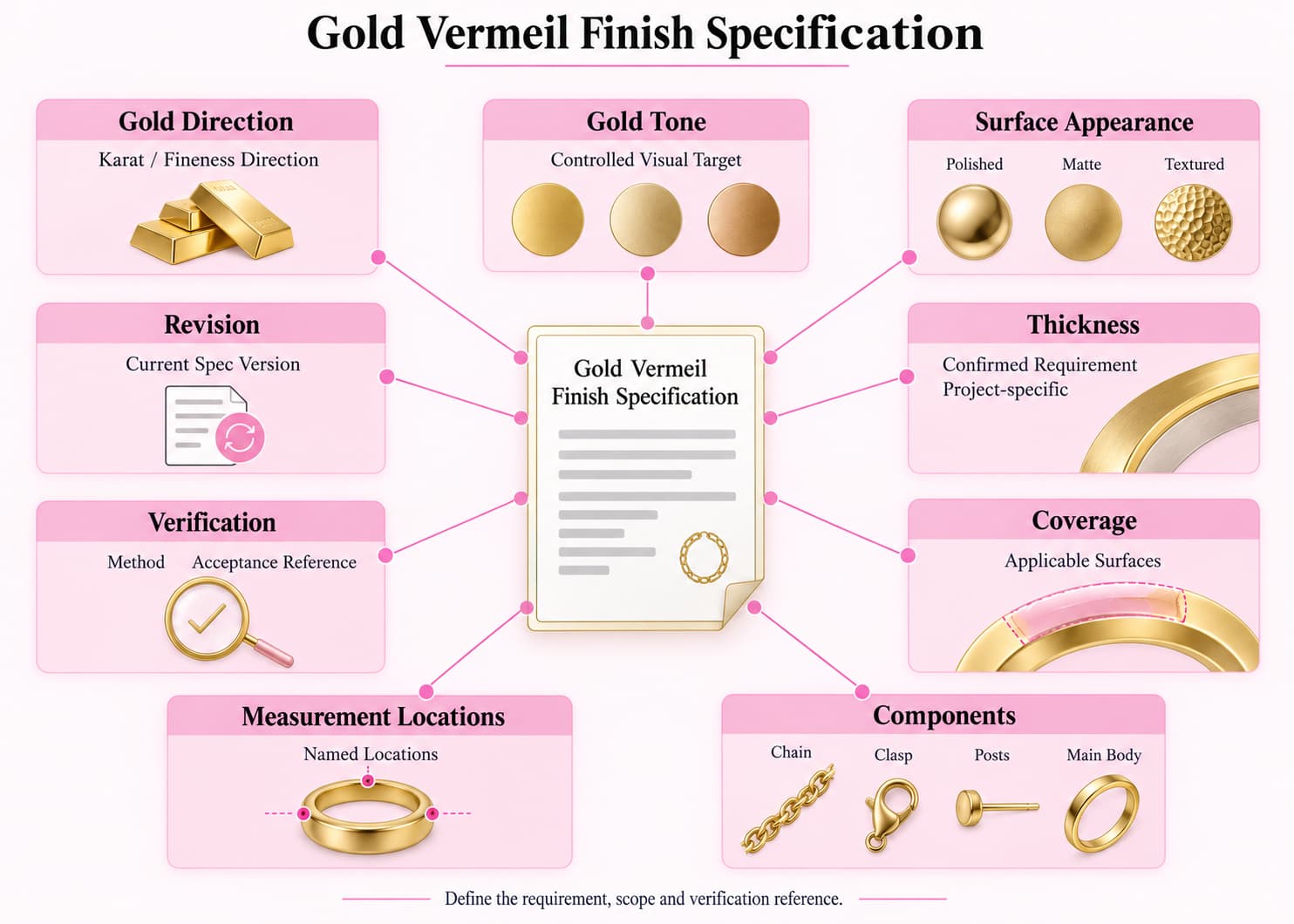
This is not a universal manufacturing standard. It is a structure for turning a broad finish request into a clearer production requirement.
For the broader product-level framework that includes materials, dimensions, components, finish and technical files, see the gold vermeil jewelry specification checklist.
What Is the Difference Between Gold Fineness, Gold Tone and Surface Finish?
These fields are related, but they do not describe the same thing.
| Field | Main Question |
|---|---|
| Gold fineness / karat direction | What gold-alloy direction is intended? |
| Gold tone | What visible color should the product have? |
| Surface finish | How should the surface reflect or diffuse light? |
Gold Fineness or Karat Direction
A project may identify a gold direction such as a particular karat designation where applicable.
That field helps define the intended finish family, but it should not be treated as a complete color specification by itself.
Two finishes described using the same general karat direction can still appear different depending on:
- alloy composition;
- supplier formulation;
- surface preparation;
- polished or matte appearance;
- visual reference;
- other project-specific variables.
Gold Tone
Gold tone describes the intended visible color.
A color direction may be described using terms such as:
- warm gold;
- yellow gold;
- pale gold;
- richer yellow;
- another project-specific description.
However, words alone can be subjective. A controlled reference is usually more useful than a general descriptive term.
Surface Finish
Surface finish describes the visual texture or reflection of the surface.
- polished;
- matte;
- brushed;
- satin;
- textured;
- mixed finish.
A polished surface and a matte surface can show the same gold-tone direction differently.
Gold tone and surface appearance should be specified separately.
If you are deciding between different karat directions for a collection, the existing guide on 14K vs. 18K gold vermeil addresses that comparison in more detail.
How Should Gold Tone Be Specified?
A finish specification should avoid relying only on subjective color language.
Use a Controlled Color Reference
Depending on the project, a controlled visual reference may be:
- an approved physical reference;
- an identified retained product;
- a finish reference card;
- an approved product image used under controlled conditions;
- another project-specific visual standard.
The purpose is to reduce ambiguity.
A phrase such as “make it a rich luxury gold” can be interpreted differently by different people.
A better specification identifies a reference that the production and review teams can use consistently.
Do Not Rely Only on Words
Terms such as:
- warm gold;
- champagne gold;
- classic yellow;
- soft gold;
- deep gold
can help communicate direction, but they do not necessarily define the final target precisely.
A color name describes direction; a controlled reference defines the target more clearly.
Control Finish Variants
If one collection contains more than one finish direction, each should be controlled as a distinct variant.
For example:
- Finish Variant A;
- Finish Variant B;
- Polished Variant;
- Matte Variant;
- another identified finish code.
The actual technical details should be project-specific. The important point is that different finish requirements should not be hidden in one general note.
How Should Surface Appearance Be Defined?
Surface appearance should be defined independently from gold tone.
Useful surface categories can include:
- polished;
- matte;
- brushed;
- satin;
- textured;
- mixed finish.
The specification should explain which appearance applies to which area.
Mixed Surface Designs
Some jewelry designs intentionally combine more than one surface appearance.
For example, a product may contain:
- a polished front surface;
- a matte recessed area;
- textured side details;
- another controlled combination.
If the product uses mixed surfaces, a general instruction such as “polished finish” may be incomplete.
The specification can instead identify:
- the applicable area;
- the intended surface appearance;
- any transition between different finishes;
- the visual reference.
Surface References and Finish Maps
For a more complex product, surface requirements can be shown using:
- annotated drawings;
- marked product images;
- technical drawings;
- finish maps;
- numbered surface zones.
Which finish applies to this exact surface?
How Should Gold Vermeil Thickness Be Specified?
Thickness can be an important technical finish field, but it should not be written as an isolated number.
The correct value depends on confirmed project requirements and applicable market terminology.
Define the Technical Value
Where a project requires a technical thickness value, the value should be documented clearly.
If the requirement has not yet been confirmed, use Manufacturer to Confirm or Project-specific rather than inventing a number.
A specification should not copy a thickness value from another product simply because both products are described as gold vermeil. Different projects can have different requirements.
Define the Thickness Basis
A number can still be ambiguous if its basis is unclear.
Depending on the project and verification method, the specification may need to clarify:
- how the reported thickness is interpreted;
- whether the value applies to a particular layer;
- how the test report describes the result;
- whether market-specific terminology affects the requirement.
The correct wording should come from the confirmed technical requirement.
Do Not Separate the Number From Its Scope
A technical thickness value should be connected to:
- the product;
- the applicable component;
- the applicable surface;
- the measurement location;
- the verification method where applicable.
A thickness number without scope and measurement location is an incomplete production requirement.
For example, a thickness requirement written only in the product title may leave unanswered questions about:
- clasp;
- chain;
- jump rings;
- posts;
- backs;
- pendant;
- recessed surfaces;
- other components.
Which Surfaces Should the Finish Requirement Cover?
Coverage scope defines where the finish requirement applies.
Depending on the product, areas may include:
- broad visible surfaces;
- edges;
- recessed areas;
- interior surfaces;
- contact areas;
- moving joints;
- decorative relief;
- small connected components.
The specification should not assume that every area is automatically governed by the same technical requirement.
Instead, it should identify:
- included areas;
- excluded areas where applicable;
- component-specific requirements;
- areas requiring separate technical review.
Significant and Difficult Geometry
Small or complex surfaces can behave differently during finishing and measurement.
Examples can include:
- sharp edges;
- narrow recessed areas;
- small chain links;
- thin posts;
- internal clasp surfaces;
- detailed decorative relief.
That does not mean one universal rule should be applied to all of them. It means the specification should clearly state which locations matter for the project.
Avoid “All Surfaces” Unless It Is Truly Defined
A note such as “same plating on all surfaces” can sound clear while still leaving technical ambiguity.
Questions may remain:
- Does it include purchased findings?
- Does it include hidden interior areas?
- Does it include posts and backs?
- Does it include moving components?
- Does it include chain links?
How Should Component Finish Requirements Be Defined?
A jewelry product is often made from multiple components.
The main body finish should not automatically be assumed to apply identically to every component.
Relevant components can include:
- chain;
- clasp;
- jump rings;
- connectors;
- posts;
- backs;
- bail;
- pendant;
- charms;
- branded tags;
- purchased findings.
| Component | Finish Requirement to Define |
|---|---|
| Main body | Gold direction, surface and technical requirement |
| Chain | Gold tone, finish consistency and technical scope |
| Clasp | Material and finish requirement |
| Jump ring / connector | Finish and interface requirement |
| Post | Component-specific material and finish |
| Earring back | Component-specific requirement |
| Bail | Finish and relationship to pendant |
| Pendant / charm | Tone, surface and coverage |
| Branded tag | Finish and branding requirement |
Do not assume every component automatically follows the main-body finish specification.
If a component intentionally differs, that difference should be documented rather than discovered during final inspection.
When Should an Underlayer or Barrier Layer Be Specified?
Some projects may include an intermediate layer between the silver base and the visible gold finish.
Whether such a layer is required depends on the confirmed product and project requirements.
If an underlayer is part of the finish system, the specification may need to identify:
- whether it is required;
- the component scope;
- the relevant technical requirement;
- any target-market considerations;
- the verification scope where applicable.
The specification should not assume a particular underlayer material unless it has been confirmed.
The safer approach is Underlayer: Manufacturer to Confirm / Project-specific until the technical requirement is defined.
When Should a Topcoat Be Included in the Specification?
A topcoat can be another project-specific finish-system element.
If the product uses one, the specification can identify:
- whether a topcoat is required;
- which components it applies to;
- any visual considerations;
- compatibility requirements;
- verification requirements;
- project-specific acceptance criteria.
A topcoat should not be described as a universal durability guarantee.
A topcoat is one layer in a finish system, not a stand-alone guarantee of wear life or durability.
If a topcoat is important to the project, its role should be defined clearly enough that production and quality review know what requirement applies.
How Should Measurement Locations Be Defined?
Technical verification becomes more meaningful when the measurement location is identified.
Different locations can have different geometry and accessibility.
| Location Type | Why It May Matter |
|---|---|
| Broad surface | Accessible reference area |
| Edge | Geometry differs from a flat surface |
| Recess | Coverage behavior can differ |
| Chain link | Small and moving geometry |
| Clasp | Separate component |
| Post | Small component with its own requirement |
| Soldered area | Construction differs from the main surface |
| Pendant face | May be a primary visible reference area |
The specification does not need to invent a fixed number of measurement points.
Instead, it should define:
- which locations are important;
- which component is being measured;
- which SKU or variant applies;
- which technical requirement the location represents.
Measurement Location and Acceptance Criteria Work Together
A thickness value without a test location may be incomplete.
A test location without a defined requirement may also be incomplete.
Requirement + Location + Method + Acceptance Reference
How Should Finish Verification Be Specified?
A finish specification should define the verification requirement when technical evidence is needed.
| Verification Field | What to Define |
|---|---|
| Method | Project-specific verification method |
| Product / SKU | Which item is being checked |
| Component | Which part applies |
| Location | Named verification point |
| Sample scope | Project-specific |
| Report scope | What the evidence represents |
| Acceptance criterion | Confirmed technical requirement |
| Revision | Which specification version applies |
A technical method should only be named where it is suitable and confirmed for the project.
For example, an instrumental method may be used in some cases, but it should not automatically be described as the universal requirement for every jewelry product.
Evidence Should Match the Requirement
A report is only useful when it answers the correct question.
If the product specification defines one component but the report represents another component, the evidence may not resolve the requirement.
Similarly, if a report was created for an earlier revision, it should not automatically be assumed to apply to a revised product.
Verification should therefore be connected to the current product, current finish requirement and current revision.
How Should Finish Variants Be Controlled?
Finish differences should be treated as controlled product differences when they affect production.
Examples can include:
- one gold-tone direction versus another;
- polished versus matte;
- different component finishes;
- different finish-system requirements;
- different technical verification requirements.
| Variant Field | Example Structure |
|---|---|
| SKU | Identified product code |
| Gold direction | Variant-specific |
| Gold tone | Controlled reference |
| Surface | Polished / matte / other |
| Component exception | Defined where applicable |
| Technical requirement | Project-specific |
| Revision | Current version |
If a finish difference changes production, it should be controlled as a variant rather than hidden in a general note.
How Should Finish Revisions Be Managed?
Finish requirements can change during product development.
Possible changes include:
- gold-tone reference;
- karat direction;
- surface appearance;
- technical thickness requirement;
- component scope;
- underlayer;
- topcoat;
- measurement location;
- verification method.
A finish revision should identify:
- what changed;
- which SKU or variant is affected;
- which previous requirement is replaced;
- which reference is now current.
A note such as “Use the new gold” is not sufficient revision control.
Avoid Mixing Old and New Finish References
A common risk occurs when:
- the specification is updated;
- the finish card is not updated;
- the drawing still contains an old note;
- the quality-control team receives a different revision.
Revision control should therefore apply to both written requirements and visual references.
How Does Finish Specification Connect to Quality Control?
Finish specification and quality control perform different roles.
| Finish Specification Defines | Quality Control Checks |
|---|---|
| Gold direction | Correct finish family |
| Gold tone | Product against visual reference |
| Surface appearance | Polished, matte or textured requirement |
| Thickness requirement | Technical verification where applicable |
| Coverage scope | Correct applicable surfaces |
| Component scope | Correct finished components |
| Measurement locations | Correct verification points |
| Verification method | Correct evidence approach |
| Variant | Correct finish-specific SKU |
| Revision | Current reference set |
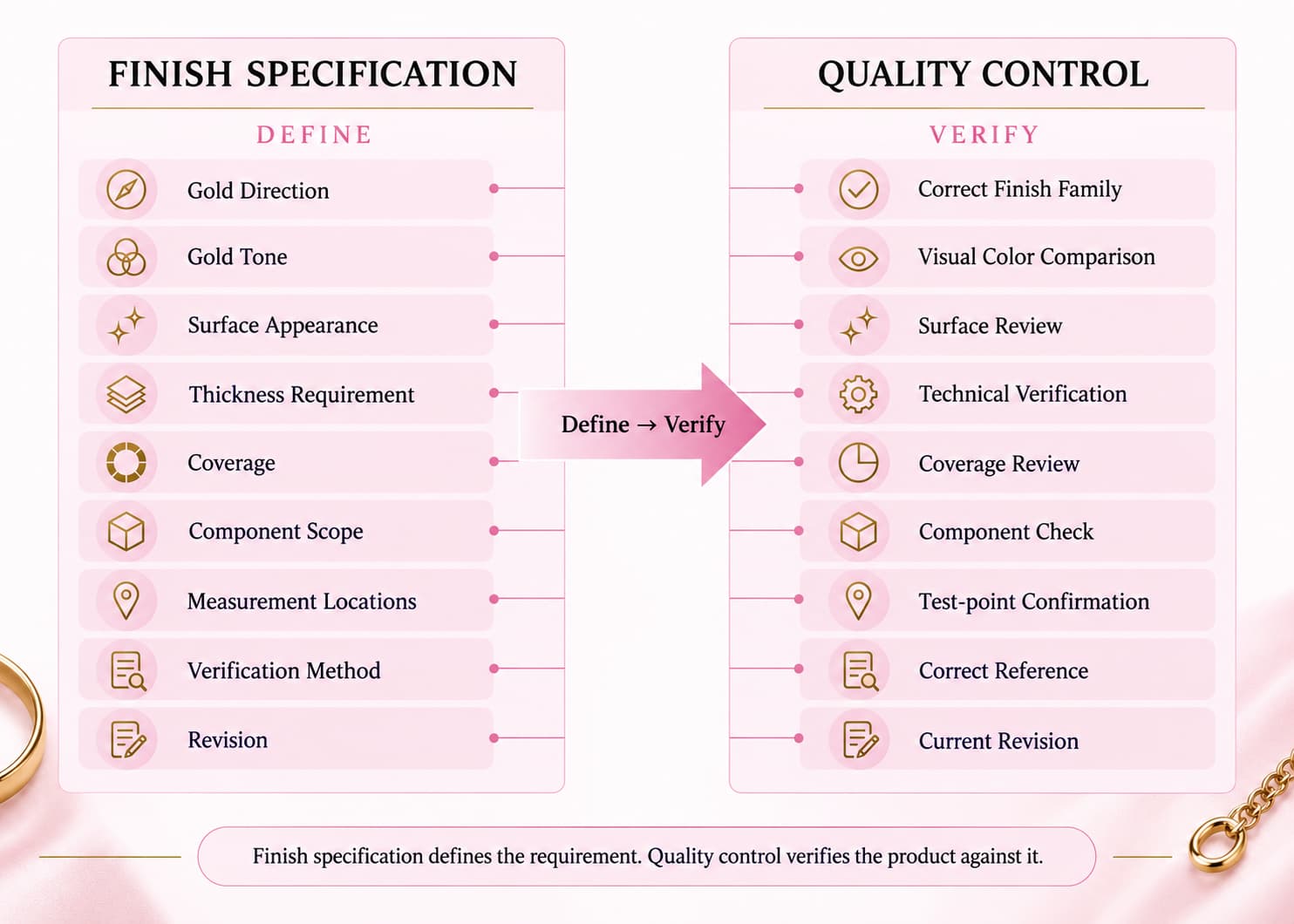
Finish specification defines the requirement; quality control verifies the product against it.
For the inspection framework used after requirements are defined, see the gold vermeil jewelry quality control checklist.
How Does Finish Specification Fit Into the Manufacturing Process?
The finish specification does not replace the overall product specification or manufacturing process.
It is one controlled technical layer within them.
Product Specification
Defines the complete product.
Finish Specification
Defines the finish in greater detail.
Manufacturing Process
Carries the confirmed requirement through production.
Quality Control
Checks the resulting product against those requirements.
For the broader workflow, see the gold vermeil jewelry manufacturing process.
Common Gold Vermeil Finish Specification Mistakes
Writing Only “18K Gold”
A karat direction does not automatically define exact visible color, surface appearance, thickness, coverage, component scope or verification.
Treating Karat and Exact Color as the Same Thing
Karat direction and visible gold tone are related but separate. Use a controlled color reference when appearance matters.
Using Subjective Terms Such as “Premium Gold”
Words such as “premium,” “luxury,” “rich” and “high-end” do not create measurable finish criteria. Use a controlled reference instead.
Defining Thickness Without Scope
A technical value should identify which product, component and surface it applies to.
Defining Thickness Without Measurement Locations
A value without a named verification location can be difficult to interpret consistently.
Assuming Every Component Follows the Main Body
Chains, clasps, posts, backs and purchased findings may need separate requirements. Do not leave them implicit.
Mixing Polished, Matte and Textured Areas Without a Finish Map
A mixed-finish product needs area-specific instructions.
Adding a Topcoat Without Defining Its Role
If a topcoat is required, document where it applies and how it relates to the project requirement.
Using an Outdated Finish Reference
An old visual sample or technical note can create the wrong production target. Always identify the current revision.
Final Gold Vermeil Finish Specification Checklist
Use the following framework before releasing the finish requirement for production.
| Specification Field | What to Confirm | Status Example |
|---|---|---|
| Product / SKU | Correct product identity | Confirmed / Review / TBD |
| Finish revision | Current version | Confirmed / Review / TBD |
| Base material reference | Correct product-material requirement | Confirmed / Review / TBD |
| Gold fineness / karat direction | Intended finish family | Confirmed / Review / TBD |
| Gold tone | Intended visible color | Confirmed / Review / TBD |
| Visual reference | Approved controlled reference | Confirmed / Review / TBD |
| Surface appearance | Polished, matte, textured or other | Confirmed / Review / TBD |
| Mixed surface map | Area-specific finish where applicable | Confirmed / Review / N/A |
| Thickness requirement | Project-specific technical value | Confirmed / Manufacturer to Confirm |
| Thickness basis | Interpretation of stated value | Confirmed / Manufacturer to Confirm |
| Coverage scope | Applicable surfaces | Confirmed / Review / TBD |
| Component scope | Main body, chain, clasp, posts, findings | Confirmed / Review / TBD |
| Underlayer | Requirement where applicable | Confirmed / Manufacturer to Confirm / N/A |
| Topcoat | Requirement where applicable | Confirmed / Manufacturer to Confirm / N/A |
| Measurement locations | Named technical review points | Confirmed / Manufacturer to Confirm |
| Verification method | Project-specific method | Confirmed / Manufacturer to Confirm |
| Sample scope | Applicable SKU or sample set | Project-specific |
| Acceptance criterion | Controlled requirement | Confirmed / Review |
| Variant differences | Finish-specific SKU changes | Confirmed / N/A |
| Market-specific requirement | Destination-market terminology or rule | Confirmed / Review |
| Outstanding fields | Unresolved technical items | TBD / Manufacturer to Confirm |
A specification does not need every field in every project. It does need the fields that materially affect the product to be clear before production and verification.
Frequently Asked Questions
What should a gold vermeil finish specification include?
A gold vermeil finish specification can include gold fineness or karat direction, gold tone, surface appearance, thickness requirement where applicable, coverage scope, component scope, measurement locations, visual references, any underlayer or topcoat requirement, verification method, variant information and revision control. The exact fields should follow the confirmed product and project requirements.
Is gold karat the same as gold color?
No. Karat direction identifies a gold-alloy or fineness direction, while gold color describes the intended visible appearance. Products using the same general karat direction can still show different tones depending on formulation, surface appearance and other project-specific factors. A controlled visual reference can help define the target color more clearly.
How should gold vermeil color be specified for production?
Define the intended gold-tone direction and connect it to a controlled visual reference where appearance matters. Avoid relying only on subjective phrases such as “rich gold” or “premium gold.” If the collection has multiple finish colors, control them as separate variants.
How should gold vermeil thickness be documented?
Where a technical thickness requirement has been confirmed, document the value together with its scope, applicable components or surfaces, measurement locations and verification requirement. If the value or basis has not been confirmed, mark it Manufacturer to Confirm or Project-specific rather than guessing.
Should chains, clasps and other components have separate finish requirements?
They can. The main-body finish should not automatically be assumed to apply identically to chains, clasps, jump rings, posts, backs, branded tags or other findings. Component-specific requirements should be defined where they materially affect the product.
Why should measurement locations be included in a finish specification?
Measurement location provides context for a technical requirement. Broad surfaces, edges, recesses, chain links and separate components can have different geometry, so the specification should identify which locations are intended to represent the requirement rather than leaving the test point undefined.
What is the difference between a finish specification and quality control?
The finish specification defines what finish is required, where it applies and how it should be referenced. Quality control checks the product against those defined requirements. Quality control should not create an undefined finish requirement during inspection.
What should be marked Manufacturer to Confirm or TBD in a finish specification?
Any unresolved technical item can remain Manufacturer to Confirm or TBD, including thickness, tolerance, underlayer, topcoat, measurement locations, verification method or market-specific technical requirements. These fields should be confirmed before they become acceptance criteria.
Discuss Your Gold Vermeil Finish Requirements
When preparing a custom gold vermeil jewelry project, define the finish as a controlled technical requirement rather than a general color description.
Useful information for finish discussion can include:
- product or SKU;
- gold-tone direction;
- surface appearance;
- controlled visual reference;
- component-specific requirements;
- coverage scope;
- confirmed technical requirements;
- finish variants;
- current revision.
For the wider product-definition framework, review the gold vermeil jewelry specification checklist.
For finish inspection after the requirement has been defined, use the gold vermeil jewelry quality control checklist.
For commercial product references, explore gold vermeil jewelry.
Discuss Your Gold Vermeil Finish Requirements
Recommended for you

What Is Gold Vermeil Jewelry? A Complete Guide for Brands and Retailers

Thick Gold Plated Jewelry Manufacturer for 925 Silver & Brass Jewelry

How to Choose a Gold Vermeil Jewelry Manufacturer

Gold Vermeil vs. Gold-Plated Jewelry: Which Fits Your Luxury Jewelry Brand?

Can Silver or Brass Be PVD Coated? A Professional Guide for Jewelry Brands

How to Make Bulk Jewelry Match the Approved Sample: A Production Control System for Jewelry Brands
Product Categories
Discuss Your Ideas with a Professional Custom Jewelry Manufacturer
We provide personalized jewelry customization services for clients worldwide.
Rest assured that your privacy is important to us, and all information provided will be handled with the utmost confidentiality.
By clicking 'Send Inquiry Now' I agree to ZHEFAN JEWELRY processing my personal data.
To see how to withdraw your consent, how to control your personal data and how we process it, please see our Privacy Policy and Terms of use.
From design to production, ZHEFAN JEWELRY offers a one-stop solution to help you enhance your brand value and market competitiveness.
Get A Quote
Contact
Tel: (+86) 188 1927 7817
© 2026 Zhefan Jewelry. All Rights Reserved.
Facebook
Instagram
YouTube
Whatsapp: +8618819277817