






Email: sales3@zhefanjewelry.com
Gold Vermeil Celestial Charm Bracelet Sizing & Spacing Guide: Star, Moon & Sun
Getting the perfect fit for your gold vermeil celestial charm bracelet matters—wrong sizing ruins the whole look. Zhefan Jewelry breaks down exactly how to measure, space star and moon charms, and adjust your bracelet so it sits just right on your wrist. Skip the guesswork and get it right the first time.
- Quick Answer
- Key Takeaways
- What Makes Gold Vermeil Celestial Charm Bracelet Sizing Different?
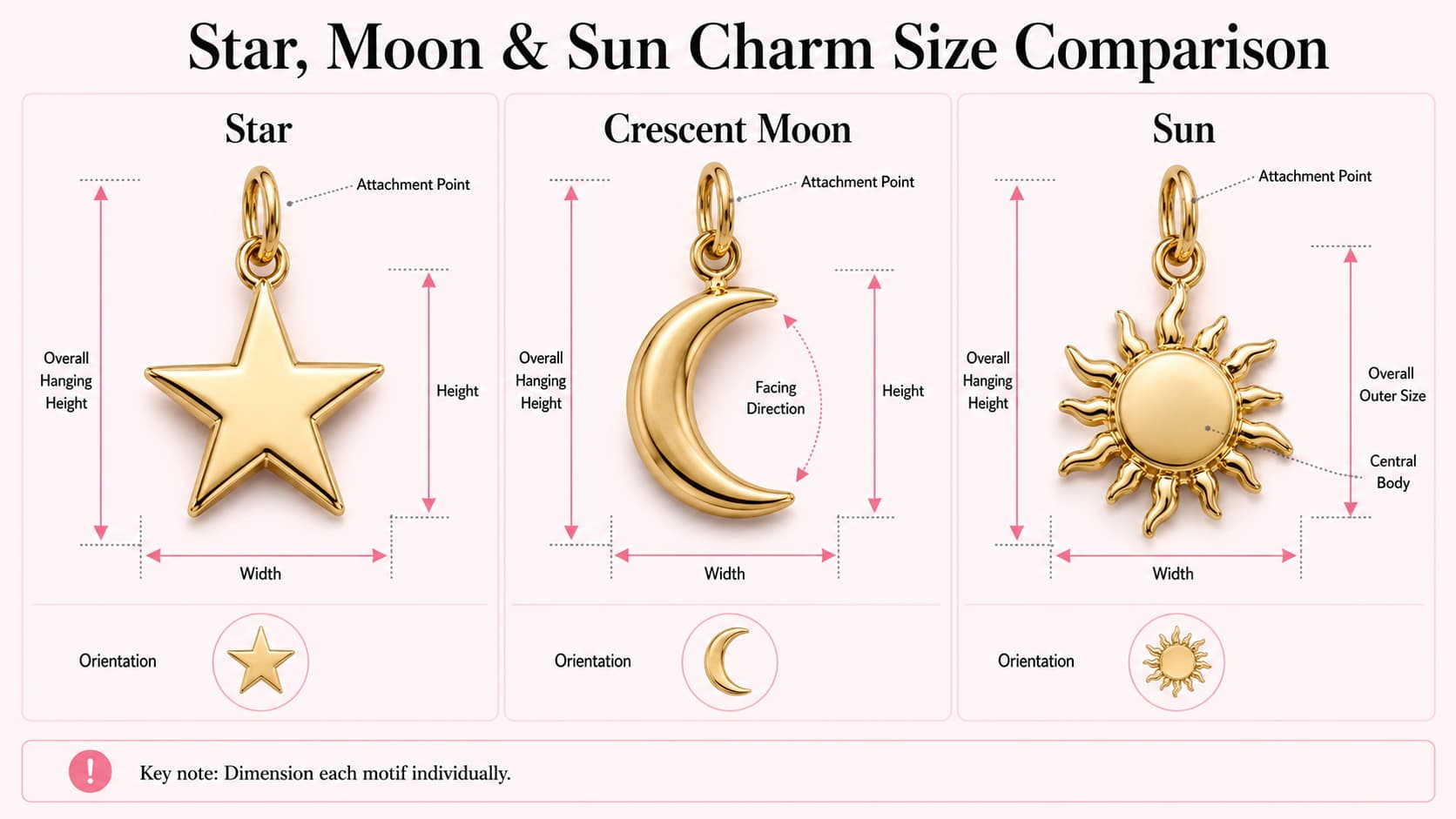
- How Should Star Charm Size Be Specified?
- Overall Width and Height
- Point-to-Point Dimensions
- Star Attachment Point
- Star Body Size vs Overall Hanging Height
- How Should Moon Charm Size Be Specified?
- Bounding Width and Height
- Crescent Direction
- Moon Attachment Point
- How Should Sun Charm Size Be Specified?
- Central Body vs Full Outer Motif
- Ray-to-Ray Extent
- Sun Attachment Point
- Should Star, Moon and Sun Charms Be the Same Size?
- Equal-Scale Layout
- Dominant-Motif Layout
- Graduated Layout
- What Is Visual Weight in a Celestial Charm Layout?
- How Should Star, Moon and Sun Spacing Be Measured?
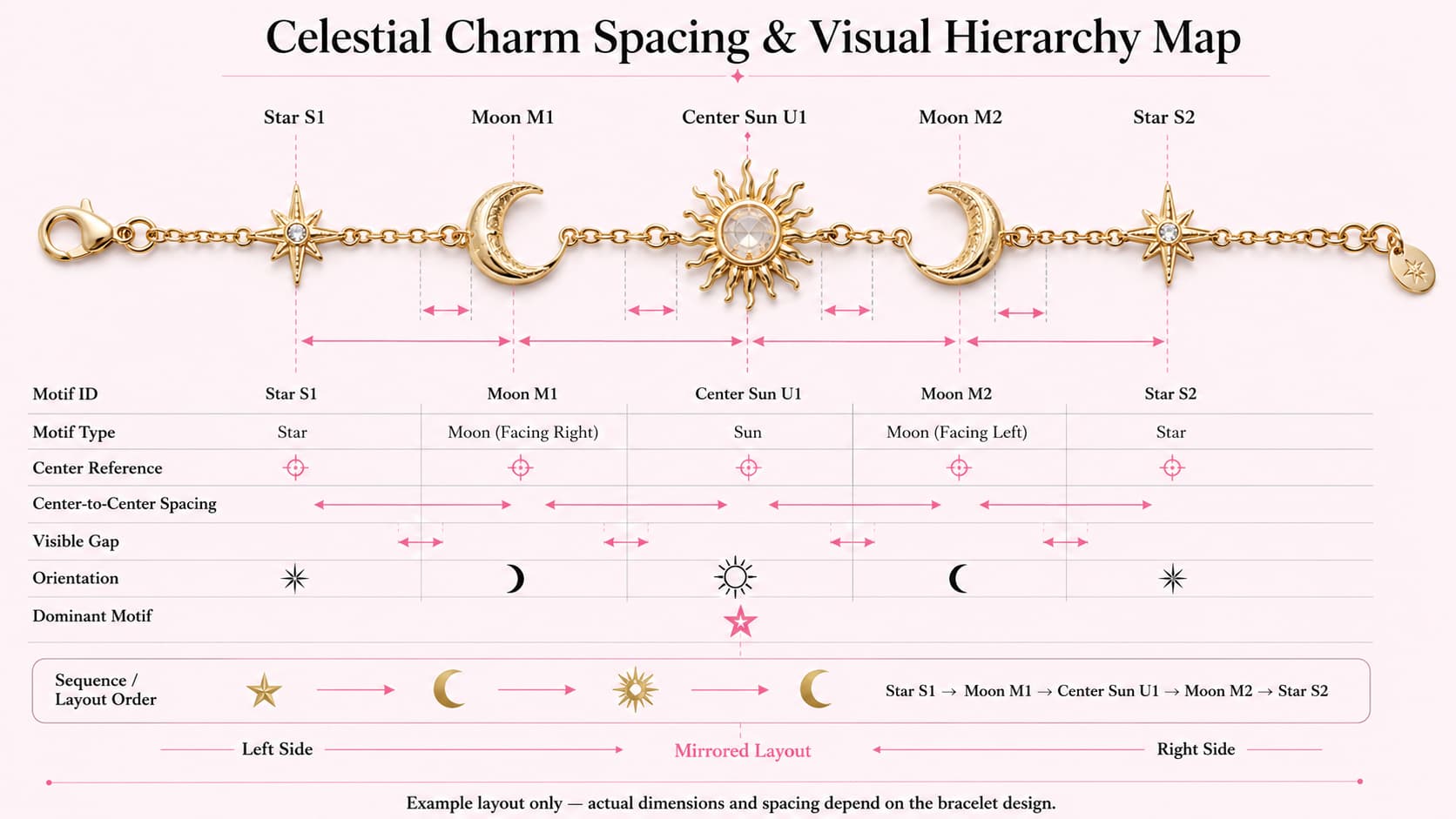
- Center-to-Center Spacing
- Edge-to-Edge Spacing
- Designated Chain Position
- Keep the Spacing Method Clear
- How Should Visual Gap Be Defined Between Different Motifs?
- How Should a Center Celestial Motif Be Chosen?
- Symmetrical Celestial Layouts
- Alternating Celestial Layouts
- Asymmetrical Celestial Layouts
- How Should Charm Orientation Be Defined?
- Crescent Moon Orientation
- Star Orientation
- Sun Orientation
- How to Create a Celestial Charm Layout Map
- Celestial Charm Layout Map Template
- Example Motif IDs
- How Should Celestial Sizing Coordinate With Curb Chain Width?
- Common Celestial Charm Bracelet Design Mistakes
- Using One Size Label for All Three Motifs
- Assuming Equal Dimensions Mean Equal Visual Weight
- Using Equal Center Spacing Without Checking Visible Gaps
- Leaving Crescent Moon Orientation Undefined
- Defining a Center Motif Without a Center Reference
- Mixing Motif Body Size and Overall Hanging Size
- Using a Rendering Without a Measurable Layout Map
- Changing the Motif Sequence Without Updating the Drawing
- Applying Generic Charm Rules Without Considering Motif Geometry
- Gold Vermeil Celestial Charm Bracelet Specification Template
- Final Gold Vermeil Celestial Charm Bracelet Checklist
- Frequently Asked Questions
- Define Your Custom Celestial Charm Bracelet Layout
Quick Answer
Gold vermeil celestial charm bracelet sizing should define star, moon and sun dimensions individually rather than treating all celestial motifs as equal-size components.
Because stars, crescent moons and suns can differ in width, height, outline, visual weight and hanging profile, their spacing should be based on the actual motif geometry and intended design hierarchy. A controlled layout should identify each motif, its dimensions, attachment point, orientation, sequence, center or position reference and the spacing method used between neighboring charms.
Equal measurements do not automatically create equal visual balance, and equal center-to-center spacing does not always create equal visible gaps when the motif widths differ.
This guide focuses specifically on sizing and spacing relationships among star, moon and sun motifs rather than general charm-bracelet layout rules or curb-chain attachment engineering.
Key Takeaways
- Star, moon and sun charms should be dimensioned individually.
- Charm body size and overall hanging size may need separate measurements.
- Equal spacing does not necessarily create equal visual balance when motif widths differ.
- Define whether each celestial motif is dominant, supporting, repeated or part of a symmetrical sequence.
- Use one controlled spacing method and declare the measurement reference points.
- Review motif dimensions and neighboring visible gaps together.
- A celestial layout map should identify motif IDs, sequence, dimensions, orientation and spacing.
What Makes Gold Vermeil Celestial Charm Bracelet Sizing Different?
A celestial bracelet may use several motifs that belong to the same design theme but have very different geometry.
A star, crescent moon and sun can all be described as celestial charms, yet the motif name alone does not define the component.
For custom product development, the specification may need to distinguish:
- overall width;
- overall height;
- thickness where relevant;
- attachment point;
- orientation;
- overall hanging height;
- position within the bracelet;
- neighboring motif;
- spacing method.
| Motif | Possible Geometry Considerations |
|---|---|
| Star | Overall width, overall height, point-to-point extent, attachment point |
| Crescent moon | Outer width, outer height, crescent direction, attachment point |
| Sun | Overall width or diameter, ray-to-ray extent, central body where relevant |
| Any celestial motif | Thickness, orientation, hanging height, position and spacing |
These fields depend on the actual design. They are not fixed measurement rules for every celestial charm.
A celestial motif name identifies the shape concept, not the production dimensions.
A product brief should therefore avoid instructions such as “Small star, medium moon and large sun.” Those descriptions may communicate visual intent, but they do not provide measurable specifications.
For the wider bracelet framework, these motif-level requirements can be incorporated into the broader gold vermeil bracelet specifications.
How Should Star Charm Size Be Specified?
A star charm may appear visually simple, but the measurement reference should still be clear.
Depending on the design, useful dimensions can include:
- overall width;
- overall height;
- thickness where relevant;
- point-to-point extent;
- attachment point;
- orientation;
- overall hanging height.
Overall Width and Height
A star often has projecting points, which means its visible outer dimensions may be defined by the furthest points of the motif.
The drawing should therefore make clear whether the stated width and height refer to:
- the full outer outline;
- an internal central body;
- another defined reference.
For many designs, the full outer dimensions are the most useful way to understand how much visual and physical space the star occupies. However, the exact measurement method should follow the actual drawing.
Point-to-Point Dimensions
If the star shape has several prominent points, a technical drawing may use point-to-point dimensions to clarify the outer geometry.
This can be useful when:
- the star is not perfectly symmetrical;
- one point is elongated;
- the attachment loop changes the top profile;
- orientation matters.
A dimensional note should identify which points form the measurement reference.
Star Attachment Point
The attachment point can affect both hanging height and orientation. The specification may therefore need to show:
- attachment loop position;
- top reference;
- intended hanging direction;
- front and back where relevant.
Star Body Size vs Overall Hanging Height
A star charm body may be smaller than the complete hanging component if the assembly includes an attachment loop, a jump ring or another connector.
For that reason, it can be useful to distinguish Star Body Height from Overall Hanging Height. The actual inclusion or exclusion of attachment hardware should be stated in the specification.
How Should Moon Charm Size Be Specified?
A crescent moon is directionally asymmetrical, so orientation can be as important as width and height.
Useful dimensions can include:
- overall width;
- overall height;
- thickness where relevant;
- outer crescent profile;
- attachment point;
- crescent-facing direction;
- overall hanging height.
Bounding Width and Height
The technical drawing can define the full outer dimensions of the crescent. These dimensions should describe the overall motif envelope rather than relying on an informal phrase such as “Medium moon.”
Crescent Direction
A crescent may visually open toward the left, the right or another defined orientation. These directions are examples of design documentation, not fixed product rules.
If the moon is directional, the orientation should be shown explicitly in the drawing.
For a crescent moon, orientation can be as important as width and height because the motif is directionally asymmetrical.
Moon Attachment Point
The attachment point may influence:
- hanging angle;
- visual balance;
- orientation;
- relationship to the neighboring charm.
If the moon must face a particular direction, the attachment point and orientation should be documented together.
How Should Sun Charm Size Be Specified?
A sun motif can have a central body with rays extending beyond it.
That creates an important measurement question:
Does the stated size refer to the center only, or to the full outer motif?
Depending on the design, useful fields can include:
- overall outer width or diameter;
- overall height;
- ray-to-ray extent;
- central body dimensions where relevant;
- thickness;
- attachment point;
- orientation;
- overall hanging height.
Central Body vs Full Outer Motif
If the sun contains a clearly defined central disc with projecting rays, those can be treated as separate reference concepts.
Central Body Size may describe the core design element, while Full Outer Size may describe the maximum extent including the rays.
The drawing should state which dimension is being used.
Ray-to-Ray Extent
When rays materially affect the outer profile, the full motif dimension may need to include them.
A sun with narrow projecting rays can occupy more visual space than its central body suggests. This matters when comparing:
- the sun with neighboring stars;
- the sun with a crescent moon;
- available visual gaps;
- overall charm density.
Sun Attachment Point
As with other celestial charms, the attachment point can affect:
- hanging orientation;
- total hanging height;
- visual alignment;
- relationship to surrounding motifs.
The specification should not assume that all sun motifs use the same attachment geometry.
Should Star, Moon and Sun Charms Be the Same Size?
They do not need to be the same size.
Equal dimensions and equal visual balance are different design goals.
Equal-Scale Layout
A design may use star, moon and sun motifs with broadly similar outer dimensions. This can support a relatively uniform visual rhythm. However, equal dimensions do not guarantee equal visual weight because the motifs have different shapes.
Dominant-Motif Layout
One celestial charm may act as the visual anchor.
The dominant motif might be a:
- star;
- moon;
- sun;
- another defined celestial component.
No motif should be assumed to be dominant simply because of its theme.
Graduated Layout
A design may intentionally use multiple charm sizes in a controlled progression.
Smaller Motif → Medium Motif → Dominant Motif → Medium Motif → Smaller Motif
This is an example layout structure rather than a fixed celestial bracelet rule. The exact dimensions should be documented for the specific design.
Star, moon and sun charms do not need identical dimensions; their sizes should follow the intended visual hierarchy and measurable bracelet layout.
What Is Visual Weight in a Celestial Charm Layout?
Visual weight describes how prominent a motif appears within the design.
It is not the same as physical weight, and it is not determined by width alone.
Two charms with similar outer dimensions may appear different because of:
- solid surface area;
- open or negative space;
- pointed outlines;
- curved outlines;
- projecting rays;
- internal cutouts;
- overall hanging profile.
A star may have a wide outer span but relatively open visual space between its points.
A crescent moon may occupy a narrower area but appear visually strong because of its solid curved body.
A sun may have projecting rays that increase its apparent presence beyond the central body.
Equal dimensions do not always create equal visual weight.
When visual balance matters, useful questions include:
- Which motif should attract attention first?
- Which motifs are supporting elements?
- Does one charm appear visually heavier despite similar dimensions?
- Does the spacing need adjustment because of the motif outline?
- Does the center motif need a different scale from repeated motifs?
How Should Star, Moon and Sun Spacing Be Measured?
Celestial charm spacing can be documented using several methods. The selected method should be defined clearly and applied consistently.
Center-to-Center Spacing
Center-to-center spacing measures from the defined position center of one motif to the defined center of the next.
This can be useful for:
- repeated layouts;
- symmetrical sequences;
- controlled station systems;
- layouts where charm widths differ.
Star Center → Moon Center
Moon Center → Sun Center
Edge-to-Edge Spacing
Edge-to-edge spacing describes the visible or physical gap between neighboring motif outlines.
This can be particularly useful when star, moon and sun charms have different widths. A large sun and a narrow crescent can have the same center-to-center distance as two stars while producing a very different visible gap.
Designated Chain Position
Some designs may identify charm positions using controlled chain stations or receiving links.
Star S1 — Station L2
Moon M1 — Station C1
Sun U1 — Station R2
The technical relationship between receiving links and connectors belongs in the gold vermeil curb chain bracelet specifications. This article focuses on the celestial motif sizing and spacing relationship.
Keep the Spacing Method Clear
Do not use center-to-center spacing in one part of the layout and visible edge spacing in another without identifying the change. If more than one method is required, label each measurement.
When celestial motifs have different widths, equal center-to-center spacing does not necessarily create equal visible gaps.
How Should Visual Gap Be Defined Between Different Motifs?
Visible spacing deserves separate attention when motifs have very different outlines.
Consider two relationships:
Star → Moon
Moon → Sun
Even if both pairs use the same center-to-center distance, the nearest visible edges may not be equally separated.
A visual-gap specification can define:
- nearest-edge gap;
- outer-outline gap;
- another controlled motif-to-motif reference.
| Motif Pair | Spacing Method | Requirement |
|---|---|---|
| Star → Moon | Center-to-center | |
| Moon → Sun | Center-to-center | |
| Star → Moon | Visible edge gap, if relevant | |
| Moon → Sun | Visible edge gap, if relevant |
Not every layout needs both measurement methods. The objective is to document the design accurately enough that “even spacing” does not depend entirely on visual judgment.
Geometric spacing and perceived spacing can be different when the neighboring celestial motifs have different silhouettes.
How Should a Center Celestial Motif Be Chosen?
A center motif can act as a visual anchor, but the design should define what “center” means.
The center reference may be based on:
- the main bracelet length;
- a designated chain position;
- a controlled layout station;
- another defined product reference.
For bracelet length and extender definitions, refer to the gold vermeil bracelet sizing guide.
The center charm itself can be:
- a star;
- a moon;
- a sun;
- another defined motif.
There is no universal rule that the sun must be central or that the moon must be the largest charm.
Instead, the specification should identify the center reference, center motif ID, motif dimensions, attachment point, orientation and spacing to neighboring motifs.
Center Reference C1 — Motif U1 — Sun
Symmetrical Celestial Layouts
A symmetrical design mirrors motif positions around a declared center.
Star → Moon → Sun → Moon → Star
S1 → M1 → U1 → M2 → S2
This is an example layout, not a fixed product configuration.
A symmetrical specification should define:
- center motif;
- center reference;
- mirrored motif IDs;
- left and right positions;
- spacing method;
- dimensions;
- orientation.
| Position | Motif ID | Motif Type | Relationship |
|---|---|---|---|
| L2 | S1 | Star | Mirrors S2 |
| L1 | M1 | Moon | Mirrors M2 |
| C1 | U1 | Sun | Center |
| R1 | M2 | Moon | Mirrors M1 |
| R2 | S2 | Star | Mirrors S1 |
Symmetry should be measurable rather than assumed from a rendering.
Alternating Celestial Layouts
An alternating design repeats different celestial motifs in a controlled sequence.
Star → Moon → Star → Moon
Moon → Star → Sun → Star → Moon
These examples illustrate sequence logic only.
The specification should define:
- motif IDs;
- order;
- starting position;
- ending position;
- spacing method;
- motif dimensions;
- orientation;
- intentional exceptions.
If the sequence changes between SKUs, the drawing or specification version should also change.
Asymmetrical Celestial Layouts
Celestial designs do not need to be symmetrical.
An intentional asymmetrical sequence might use different motifs or distances on either side of the bracelet.
Moon → Star → Sun → Star
This is a documentation example rather than a recommended production layout.
In an asymmetrical design, each important position should be defined independently. Useful fields include:
- motif ID;
- motif type;
- position;
- dimensions;
- orientation;
- neighboring motif;
- spacing method.
Celestial asymmetry should be documented as an intentional sequence rather than left to visual interpretation.
How Should Charm Orientation Be Defined?
Orientation is especially important for directional celestial motifs.
A crescent moon may clearly face one direction. A sun may include asymmetrical rays or design details. Some stars may also have a defined top point or directional decorative face.
| Field | Requirement |
|---|---|
| Motif ID | |
| Front / back | |
| Top reference | |
| Attachment point | |
| Facing direction | |
| Drawing reference |
Crescent Moon Orientation
For a crescent moon, define whether the open side faces a particular direction where that matters to the design. Do not rely solely on the product rendering.
Star Orientation
If one star point must face upward or another direction, show it in the drawing.
Sun Orientation
If the sun is rotationally symmetrical, orientation may be less important. If the rays, face, logo or internal details create a directional motif, document that direction.
Orientation should be specified whenever rotating the charm would materially change the intended appearance.
How to Create a Celestial Charm Layout Map
A celestial layout map connects motif identity, size, sequence and spacing.
Star S1 → Moon M1 → Center Sun U1 → Moon M2 → Star S2
This structure can identify:
- which motif appears at each position;
- which motif is central;
- which motifs mirror one another;
- how spacing is measured;
- which dimensions belong to each component.
Celestial Charm Layout Map Template
| Field | Requirement |
|---|---|
| Product / SKU | |
| Layout version | |
| Drawing reference | |
| Bracelet length reference | |
| Chain specification reference | |
| Motif ID | |
| Motif type | |
| Body width | |
| Body height | |
| Thickness, if relevant | |
| Overall hanging height, if relevant | |
| Attachment point | |
| Orientation | |
| Position | |
| Center reference | |
| Spacing method | |
| Center-to-center spacing, if relevant | |
| Visible / edge gap, if relevant | |
| Neighboring motif | |
| Sequence | |
| Chain attachment reference | |
| Additional notes |
Example Motif IDs
| ID | Motif |
|---|---|
| S1 | Star 1 |
| S2 | Star 2 |
| M1 | Moon 1 |
| M2 | Moon 2 |
| U1 | Sun 1 |
The letters are only example identifiers. Any consistent component-ID system can be used. For broader rules about generic charm placement maps, refer to the gold vermeil charm bracelet design guide.
How Should Celestial Sizing Coordinate With Curb Chain Width?
Celestial charm dimensions should also be reviewed against the bracelet chain.
Potentially relevant factors include:
- finished chain width;
- charm width;
- charm hanging height;
- connector dimensions;
- receiving link;
- visual proportion;
- movement.
A wider curb chain does not automatically require larger celestial charms. Likewise, a larger sun or moon does not automatically require a particular chain width.
There is no universal celestial-charm-to-chain width ratio.
The relationship should be reviewed for the actual design. For chain-link dimensions, internal opening, finished chain width and the charm-to-chain attachment interface, refer to the gold vermeil curb chain bracelet specifications.
Celestial Layout Guide
How large are the motifs, and how are they arranged?
Curb Chain Specification Guide
How does the selected motif connect to the chain structure?
Common Celestial Charm Bracelet Design Mistakes
Using One Size Label for All Three Motifs
Writing “Medium star, medium moon, medium sun” does not establish measurable dimensions. Each important motif should have its own specification.
Assuming Equal Dimensions Mean Equal Visual Weight
A star, crescent moon and sun can have similar outer dimensions while appearing visually different. Review the silhouettes together.
Using Equal Center Spacing Without Checking Visible Gaps
Equal center-to-center spacing can create different visible gaps when neighboring motif widths differ. Review the actual edge relationship where visual spacing matters.
Leaving Crescent Moon Orientation Undefined
A crescent is directional. If the intended opening direction matters, show it in the drawing.
Defining a Center Motif Without a Center Reference
“Sun in center” can remain ambiguous if the bracelet's center reference is undefined. Identify the controlled center position.
Mixing Motif Body Size and Overall Hanging Size
An attachment loop or connector can increase the total hanging dimension. Distinguish the charm body from the full assembled hanging size when necessary.
Using a Rendering Without a Measurable Layout Map
A rendering communicates visual intention, but it may not define:
- motif dimensions;
- spacing method;
- center reference;
- orientation;
- exact sequence.
Use the rendering together with measurable specifications.
Changing the Motif Sequence Without Updating the Drawing
If:
Star → Moon → Sun
changes to:
Moon → Star → Sun
the controlled layout reference should also be updated.
Applying Generic Charm Rules Without Considering Motif Geometry
General charm-layout principles remain useful, but celestial motifs introduce specific geometric differences. Star points, crescent direction and sun rays may affect visible space differently. The celestial specification should account for the actual motif silhouettes.
Gold Vermeil Celestial Charm Bracelet Specification Template
The following template can be used as a starting point for a custom celestial charm bracelet design specification.
| Specification Field | Requirement |
|---|---|
| Product / Style | |
| SKU | |
| Layout version | |
| Drawing reference | |
| Bracelet length reference | |
| Chain specification reference | |
| Motif ID | |
| Motif type | |
| Motif role: dominant / supporting / repeated | |
| Body width | |
| Body height | |
| Thickness, if relevant | |
| Overall hanging height, if relevant | |
| Outer profile reference | |
| Attachment point | |
| Front / back, if relevant | |
| Orientation | |
| Position | |
| Center reference | |
| Spacing method | |
| Center-to-center spacing, if relevant | |
| Visible / edge gap, if relevant | |
| Neighboring motif | |
| Sequence | |
| Symmetry rule, if relevant | |
| Chain attachment reference | |
| Additional notes |
Not every field will be necessary for every bracelet.
The objective is to convert the celestial design concept into measurable instructions rather than rely on motif names and renderings alone.
Final Gold Vermeil Celestial Charm Bracelet Checklist
Before finalizing the celestial portion of a custom bracelet specification, confirm the following where applicable:
- Star dimensions defined
- Moon dimensions defined
- Sun dimensions defined
- Body size distinguished from overall hanging size where relevant
- Star attachment point defined
- Moon attachment point defined
- Sun attachment point defined
- Crescent moon orientation defined
- Other directional motif orientations defined
- Dominant motif identified where applicable
- Supporting motifs identified where applicable
- Center reference defined
- Center motif identified where applicable
- Motif sequence documented
- Spacing method defined
- Center-to-center spacing defined where relevant
- Visible gaps reviewed where relevant
- Symmetry rule documented where applicable
- Asymmetrical positions individually defined where applicable
- Graduated sizing documented where applicable
- Motif visual weight reviewed
- Chain-width relationship reviewed
- Chain attachment reference identified where relevant
- Drawing reference identified
- Layout version controlled
A good celestial charm bracelet specification should make it possible to understand not only which motifs are used, but also how large they are, how they relate visually and how they are positioned relative to one another.
Frequently Asked Questions
Should star, moon and sun charms be the same size on a bracelet?
For gold vermeil celestial charm bracelet sizing, star, moon and sun charms do not need identical dimensions. Their sizes should be selected according to the intended visual hierarchy and actual bracelet design. Equal dimensions and equal visual weight are not necessarily the same thing.
How should a star charm be measured?
Depending on the design, useful star dimensions can include overall width, overall height, thickness, point-to-point extent, attachment point and overall hanging height. The drawing should define the measurement reference clearly.
How should a crescent moon charm be measured and oriented?
A crescent moon can be specified using overall width, overall height, thickness where relevant, attachment point and overall hanging height. If the crescent direction matters, the drawing should also identify which way the open side faces.
How should a sun charm be sized when rays extend beyond the center?
The specification can distinguish the central body from the full outer motif. Where the rays materially affect the overall dimensions, the full ray-to-ray width or outer extent should be documented using a defined measurement method.
Should celestial charm spacing be center-to-center or edge-to-edge?
Either method can be appropriate. Center-to-center spacing helps control motif positions, while edge-to-edge spacing can define the visible gap between different shapes. The selected method should be clearly stated and used consistently.
How do different motif widths affect visible spacing?
Different motif widths can create different visible gaps even when center-to-center spacing is identical. The star, moon and sun outlines should therefore be reviewed together when visual spacing matters.
How should a star, moon and sun charm sequence be documented?
Use controlled motif IDs, positions and sequence references. A layout map can record the star, moon and sun IDs, dimensions, orientation, position, spacing method, neighboring motifs and center reference where applicable.
Define Your Custom Celestial Charm Bracelet Layout
Star, moon and sun charms should work together as one controlled visual and dimensional system rather than as three isolated decorative components.
Brands developing custom pieces can review Zhefan Jewelry's gold vermeil bracelets and use the gold vermeil bracelet specification guide to organize the wider bracelet requirements.
For generic charm size, spacing and placement documentation, refer to the gold vermeil charm bracelet design guide. For curb-chain dimensions, chain width and the charm-to-chain interface, use the gold vermeil curb chain bracelet specification guide.
Brands evaluating this motif direction can also review the celestial star, moon and sun charm curb chain bracelet as a relevant product reference.
If your team has already defined the celestial motif dimensions, visual hierarchy, sequence, spacing method and orientation, you can share those requirements with Zhefan Jewelry to discuss the custom production requirements for your project.
Share Your Celestial Charm Bracelet Requirements
Recommended for you

What Is Gold Vermeil Jewelry? A Complete Guide for Brands and Retailers

Thick Gold Plated Jewelry Manufacturer for 925 Silver & Brass Jewelry

How to Choose a Gold Vermeil Jewelry Manufacturer

Gold Vermeil vs. Gold-Plated Jewelry: Which Fits Your Luxury Jewelry Brand?

Can Silver or Brass Be PVD Coated? A Professional Guide for Jewelry Brands

How to Make Bulk Jewelry Match the Approved Sample: A Production Control System for Jewelry Brands
Product Categories
Discuss Your Ideas with a Professional Custom Jewelry Manufacturer
We provide personalized jewelry customization services for clients worldwide.
Rest assured that your privacy is important to us, and all information provided will be handled with the utmost confidentiality.
By clicking 'Send Inquiry Now' I agree to ZHEFAN JEWELRY processing my personal data.
To see how to withdraw your consent, how to control your personal data and how we process it, please see our Privacy Policy and Terms of use.
From design to production, ZHEFAN JEWELRY offers a one-stop solution to help you enhance your brand value and market competitiveness.
Get A Quote
Contact
Tel: (+86) 188 1927 7817
© 2026 Zhefan Jewelry. All Rights Reserved.
Facebook
Instagram
YouTube
Whatsapp: +8618819277817