






Email: sales3@zhefanjewelry.com
Gold Vermeil Bracelet RFQ Checklist: What to Send an OEM Manufacturer
Sending an RFQ to a gold vermeil bracelet manufacturer? Know exactly what specs, materials, and production details to include so you get accurate quotes and avoid costly revisions. Zhefan Jewelry breaks down the essential checklist every buyer needs before contacting an OEM.
- Quick Answer
- Key Takeaways
- What Should a Gold Vermeil Bracelet RFQ Checklist Include?
- Start With Product Identification and Revision Control
- Why Revision Control Matters
- What Technical Files Should Be Included?
- Identify Each File Clearly
- What Material and Finish Information Should Be Sent?
- Separate Material From Appearance
- What Bracelet Dimensions Should the RFQ Define?
- Do Not Use Undefined Measurement Labels
- How Should Chain, Clasp and Hardware Requirements Be Organized?
- Useful Hardware Fields
- What Charm Information Should Be Included?
- Example Charm Table
- Keep Charm Placement and Attachment Separate
- How Should Variants Be Listed in an RFQ?
- Why Variant IDs Matter
- What Branding and Packaging Information Should Be Included?
- Connect Artwork to the Correct Product
- What Commercial Information Helps Define the RFQ Scope?
- Quantity Should Be Connected to the Correct Variant
- What Quality or Compliance Requirements Should Be Declared?
- What Can Be Marked “Manufacturer to Confirm”?
- Confirmed
- Manufacturer to Confirm
- TBD
- How Should the RFQ File Package Be Organized?
- File Naming
- Keep One Current RFQ Package
- What Should You Ask the OEM Manufacturer to Return?
- Ask for Open Questions Separately
- Common Gold Vermeil Bracelet RFQ Mistakes
- Sending Only a Product Image
- Mixing Multiple Revisions in One RFQ
- Using “Gold Vermeil” Without Defining the Project Finish Requirements
- Leaving Bracelet Length Undefined
- Combining Link Width and Finished Chain Width
- Writing “Standard Clasp” Without a Component Reference
- Describing Charm Positions Only Visually
- Mixing Several Variants Without Variant IDs
- Omitting Requested Quantity
- Omitting Destination or Market Requirements
- Filling Unknown Fields With Guessed Specifications
- Asking for a Quote Without Defining What the Quote Should Include
- Gold Vermeil Bracelet RFQ Template
- Final Pre-Send Gold Vermeil Bracelet RFQ Checklist
- Product Identification
- Technical Requirements
- Variant Control
- Branding and Packaging
- Commercial Request
- Open Technical Fields
- Submission Control
- Frequently Asked Questions
- Share Your Gold Vermeil Bracelet RFQ Requirements
Quick Answer
A gold vermeil bracelet RFQ checklist should give an OEM manufacturer enough information to identify the product, understand its construction, review the dimensions and finish, identify the required components and variants, and understand the commercial scope of the quotation request.
Useful RFQ inputs can include a product or SKU reference, drawing revision, technical files, material and finish requirements, bracelet dimensions, chain and hardware details, charm information where applicable, branding and packaging requirements, requested quantity by variant, destination market and project-specific requirements.
The RFQ should also separate information into three categories:
- Confirmed — requirements already fixed by the buyer;
- Manufacturer to Confirm — technical or production points that require review;
- TBD — buyer decisions that are still open.
The goal of an RFQ package is not to guess every manufacturing detail. It is to make clear what is fixed, what is optional and what still needs confirmation.
This guide focuses on preparing the information package sent before quotation rather than comparing supplier prices or evaluating completed quotations.
Key Takeaways
- Every RFQ should identify the exact product, SKU and document revision being quoted.
- Separate confirmed specifications from fields that still require manufacturer confirmation.
- Include measurable dimensions instead of relying on reference images alone.
- Organize material, finish, chain, hardware, charm, branding and packaging requirements into clear sections.
- Give each commercially different variant a controlled identifier.
- Include requested quantity and other commercial information needed to define the quotation scope.
- Use one version-controlled RFQ package so design, sourcing and manufacturing teams refer to the same requirements.
What Should a Gold Vermeil Bracelet RFQ Checklist Include?
A bracelet RFQ is most useful when technical specifications and commercial requirements are organized separately.
An unstructured email may contain the same information, but important details can be difficult to identify when dimensions, finishes, quantities and open questions are mixed together.
A practical RFQ can be divided into the following information blocks:
| RFQ Block | Purpose |
|---|---|
| Product identification | Define exactly what product is being quoted |
| Technical files | Provide controlled visual and dimensional information |
| Material and finish | Define the requested construction and appearance |
| Dimensions and fit | Define measurable bracelet requirements |
| Components and layout | Define chain, clasp, hardware and charms |
| Branding and packaging | Define project-specific presentation requirements |
| Commercial request | Define variants, quantities and quotation scope |
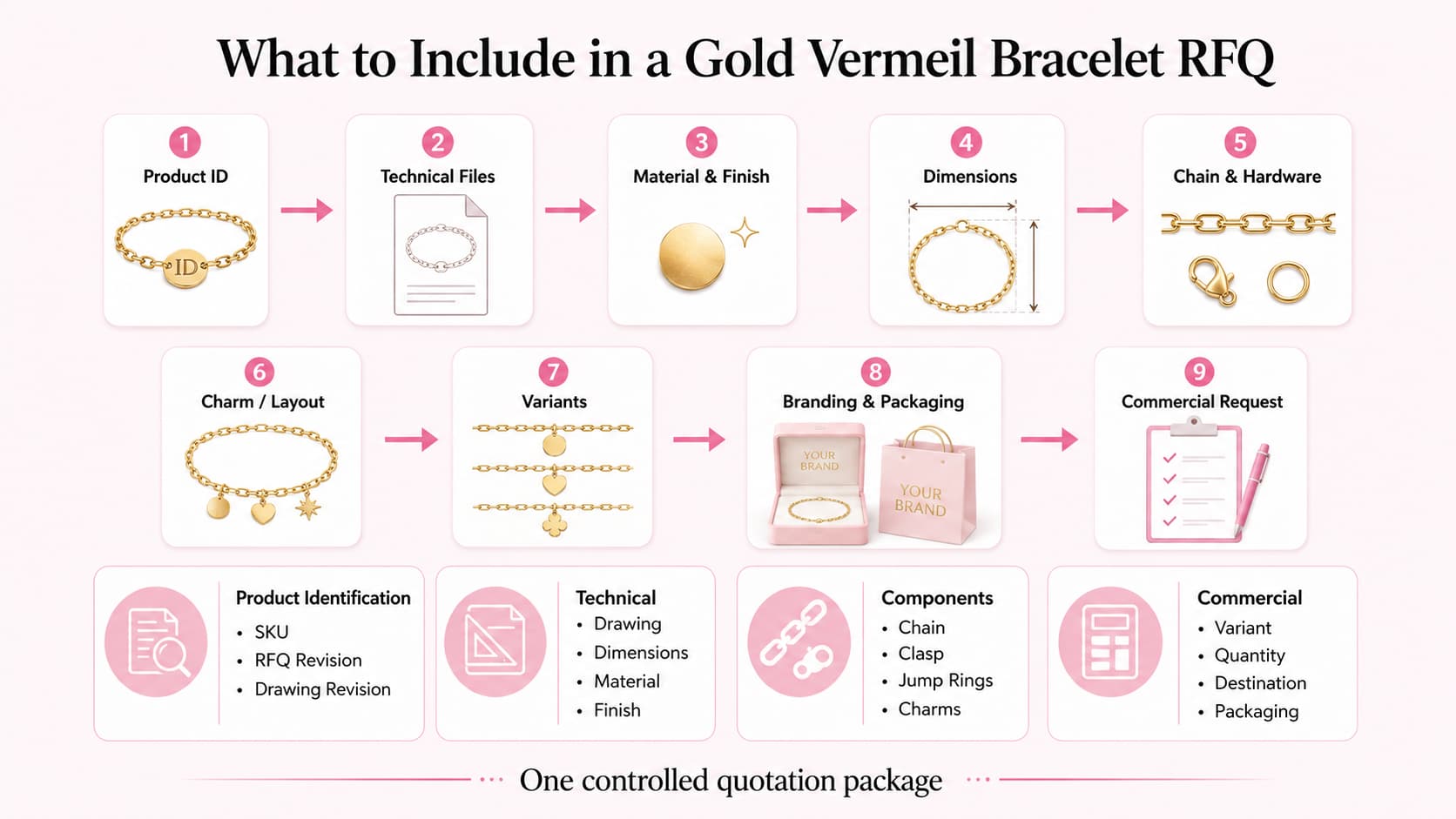
A useful RFQ separates product specifications from commercial requirements instead of mixing them into one unstructured message.
The exact amount of information required will depend on the development stage and the complexity of the bracelet.
A simple chain bracelet may need fewer fields than a multi-charm design with several finishes, lengths and packaging variants.
Start With Product Identification and Revision Control
Before listing dimensions or materials, identify which product the RFQ refers to.
Useful identification fields can include:
- project name;
- product or style name;
- SKU or internal product reference;
- RFQ version;
- revision date;
- drawing version;
- project contact;
- number of variants.
Why Revision Control Matters
A bracelet specification can change during product development.
For example:
- chain geometry may change;
- a charm layout may be revised;
- a clasp may be replaced;
- packaging requirements may change;
- one variant may be removed or added.
If different teams use different versions of the specification, a quotation may be based on outdated requirements.
Every RFQ should make it possible to identify which product and which specification revision the quotation refers to.
| Field | Example Format |
|---|---|
| Project | Project name |
| SKU | Internal product ID |
| RFQ Revision | Rev A / Rev B |
| Drawing Revision | Drawing revision ID |
| RFQ Date | Current document date |
These are example organizational fields, not required Zhefan Jewelry formats.
What Technical Files Should Be Included?
Reference images are useful for communicating design direction, but they may not define dimensions or component relationships precisely.
Depending on the development stage, an RFQ package can include:
- technical drawing;
- dimensional drawing;
- CAD file where available;
- marked reference image;
- chain or component map;
- charm layout map;
- branding artwork where applicable;
- packaging specification where applicable;
- other project-specific technical documents.
Reference images communicate appearance; controlled drawings and specification sheets communicate measurable requirements.
Not every project will have every file type.
The important point is that the documents included in the RFQ should help distinguish visual inspiration from controlled product requirements.
Identify Each File Clearly
Each file should be easy to connect to:
- the product;
- the relevant component;
- the current revision.
BR001_Drawing_RevA.pdf
This is only an example. The buyer can use another document-control system as long as it remains consistent.
What Material and Finish Information Should Be Sent?
Material and finish requirements should be stated as project requirements rather than left entirely to a product image.
Depending on the design, an RFQ can identify:
- base material requirement;
- gold finish or color requirement;
- gold color or karat reference where relevant;
- surface appearance;
- polished, matte, brushed or another controlled finish where applicable;
- project-specific coating requirements;
- finish reference;
- destination-market requirements where relevant.
If a value has not yet been decided, it should not be invented simply to complete the form.
It can instead be marked TBD or Manufacturer to Confirm.
The wider product specification can be organized using the gold vermeil bracelet specifications.
Separate Material From Appearance
A finish requirement can include several different questions:
- What is the base material?
- What gold appearance is required?
- Is the surface polished or another defined finish?
- Are there project-specific coating requirements?
- Is a visual reference being used?
What Bracelet Dimensions Should the RFQ Define?
A bracelet RFQ should identify the dimensions that materially affect the finished product.
Depending on the design, useful fields can include:
- finished bracelet length;
- adjustable range where applicable;
- extender length where applicable;
- chain width;
- component dimensions;
- charm dimensions where relevant;
- overall hanging dimensions where relevant;
- measurement reference;
- tolerance only when it has already been defined or confirmed.
For bracelet length, fit and extender definitions, refer to the gold vermeil bracelet sizing guide.
Do Not Use Undefined Measurement Labels
Instructions such as “Standard bracelet length” or “Medium chain” may be too ambiguous for a quotation request.
Instead, the RFQ should either provide the confirmed measurement or identify the field as open.
| Field | Buyer Requirement | Status |
|---|---|---|
| Finished bracelet length | Confirmed / TBD | |
| Adjustable range | Confirmed / Manufacturer to Confirm | |
| Chain width | Confirmed / TBD | |
| Tolerance | Confirmed / Manufacturer to Confirm |
The blank fields above are intentional. No project-specific values should be guessed.
How Should Chain, Clasp and Hardware Requirements Be Organized?
Chain and hardware requirements become easier to review when each important component has its own reference.
| Component ID | Component | Requirement |
|---|---|---|
| CHN1 | Main chain | |
| CL1 | Clasp | |
| JR1 | Jump ring | |
| EX1 | Extender | |
| END1 | End component |
These IDs are example naming conventions, not Zhefan Jewelry standards.
Useful Hardware Fields
Depending on the project, the RFQ may define:
- component type;
- component ID;
- dimensions;
- material requirement;
- finish requirement;
- location in the bracelet;
- connection point;
- orientation where relevant;
- drawing reference.
For detailed clasp and connector documentation, refer to the gold vermeil bracelet clasp and jump ring specifications.
For curb-chain geometry, chain width and charm-to-chain interfaces, refer to the gold vermeil curb chain bracelet specifications.
What Charm Information Should Be Included?
If the bracelet includes charms, the RFQ should identify the charms as controlled components rather than describe them only as decorative elements.
Useful charm fields can include:
- charm ID;
- motif or charm type;
- body width;
- body height;
- overall hanging dimensions where relevant;
- attachment point;
- bracelet position;
- spacing method;
- orientation;
- receiving link or attachment station where relevant;
- connector reference.
Example Charm Table
| Charm ID | Charm Type | Position | Size Reference | Orientation | Attachment Reference |
|---|---|---|---|---|---|
| CH1 | |||||
| CH2 | |||||
| CH3 |
For general charm size, spacing and placement documentation, refer to the gold vermeil charm bracelet design guide.
For celestial star, moon and sun designs, the gold vermeil celestial charm bracelet sizing and spacing guide explains how different motif dimensions, orientation and spacing can be documented.
Keep Charm Placement and Attachment Separate
Placement
Where should this charm appear?
Attachment
How does this charm connect to the bracelet?
How Should Variants Be Listed in an RFQ?
Variants should be identified clearly when they change the product or quotation scope.
Possible variant differences include:
- bracelet length;
- finish;
- chain configuration;
- charm configuration;
- branding;
- packaging;
- other project-specific options.
| Variant ID | Size / Length | Finish | Charm Layout | Packaging | Requested Quantity |
|---|---|---|---|---|---|
| V1 | |||||
| V2 | |||||
| V3 |
Every commercially different variant should have a controlled identifier rather than being described only in email text.
Why Variant IDs Matter
Without variant IDs, phrases such as “the longer gold one” or “the version with the moon charm” can become ambiguous when multiple specifications are being discussed.
A controlled variant reference allows the RFQ, drawing and quotation response to refer to the same product configuration.
What Branding and Packaging Information Should Be Included?
Branding and packaging can change the quotation scope, so relevant requirements should be identified before the quotation request where possible.
Branding information can include:
- logo position;
- engraving location;
- branding artwork;
- logo file;
- orientation;
- branding reference;
- other project-specific identification requirements.
Packaging information can include:
- packaging type;
- insert requirement;
- label requirement;
- barcode requirement;
- packaging artwork;
- packaging variant;
- other buyer-defined packaging instructions.
These are buyer specification fields. They should not be interpreted as fixed Zhefan Jewelry packaging standards.
Connect Artwork to the Correct Product
If multiple products or packaging versions are included in the RFQ, the artwork file should identify which:
- SKU;
- variant;
- packaging version;
What Commercial Information Helps Define the RFQ Scope?
Technical specifications describe the product.
Commercial information describes what the buyer is asking the manufacturer to quote.
Useful RFQ fields can include:
- requested quantity by SKU;
- requested quantity by variant;
- number of styles;
- destination country or market;
- delivery destination;
- buyer-requested commercial term where applicable;
- packaging basis;
- currency preference where relevant;
- project timing requirement;
- retailer or marketplace requirements where relevant.
These fields are buyer inputs, not statements about the manufacturer's MOQ, price, lead time, capacity or commercial terms.
Quantity Should Be Connected to the Correct Variant
Instead of writing “Total quantity: ___” when several variants are involved, it can be clearer to specify:
| Variant | Requested Quantity |
|---|---|
| V1 | |
| V2 | |
| V3 |
What Quality or Compliance Requirements Should Be Declared?
If a project has specific quality, market or compliance requirements, they should be identified in the RFQ where known.
Possible fields can include:
- destination market;
- buyer-specific material restrictions;
- retailer-specific requirements;
- required testing documentation;
- labeling requirements;
- inspection criteria if already defined;
- other project-specific compliance requirements.
A vague requirement such as “Must be compliant” may not identify what the buyer actually expects.
A better RFQ should state the relevant:
- market;
- buyer requirement;
- retailer requirement;
- standard;
- test requirement;
Do not use “compliant” as a complete specification when the applicable requirement has not been identified.
What Can Be Marked “Manufacturer to Confirm”?
An RFQ does not need to pretend that every technical field has already been solved.
Some requirements are buyer decisions. Others may require production review.
| Status | Meaning |
|---|---|
| Confirmed | Buyer requirement is fixed |
| Manufacturer to Confirm | Requires technical or production review |
| TBD | Buyer decision is still open |
Confirmed
Use this status for requirements the buyer has already decided.
Examples can include:
- selected motif;
- confirmed bracelet length;
- approved logo artwork;
- confirmed packaging concept.
Manufacturer to Confirm
Use this when the buyer needs the manufacturer to review:
- feasibility;
- component compatibility;
- production method;
- an unresolved technical interface;
- another manufacturing-dependent point.
TBD
Use TBD when the buyer has not yet made the decision.
For example:
- final packaging version;
- one optional finish;
- final quantity allocation;
- another project-level choice.
An incomplete field is safer when clearly marked as open than when filled with an invented specification.
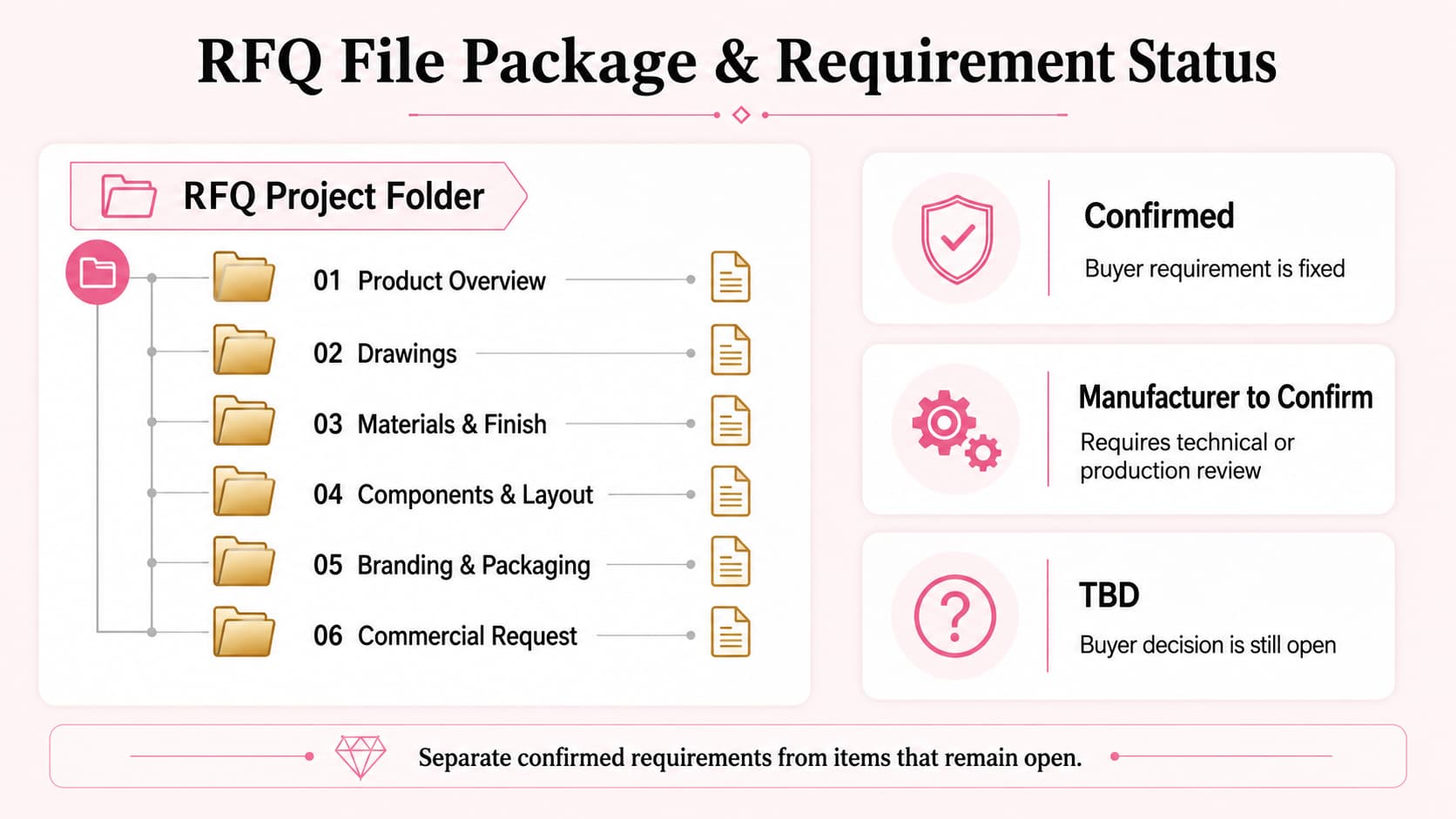
How Should the RFQ File Package Be Organized?
A structured file package helps the receiving team identify which files belong to which part of the RFQ.
One example organization is:
RFQ_Project_Name/
├── 01_Product_Overview/
├── 02_Drawings/
├── 03_Materials_Finish/
├── 04_Components_Layout/
├── 05_Branding_Packaging/
└── 06_Commercial_Request/
This is an example organizational structure, not a required Zhefan Jewelry file format.
File Naming
A practical file name can include:
SKU + Document Type + Revision
BR001_Drawing_RevA.pdf
BR001_CharmLayout_RevA.pdf
BR001_Packaging_RevB.pdf
Again, these are example naming conventions. The important requirement is consistency.
Keep One Current RFQ Package
When a new revision is issued, clearly distinguish it from older versions.
The receiving team should be able to determine:
- which RFQ is current;
- which drawing belongs to it;
- which artwork belongs to the current variant;
- which documents have been replaced.
What Should You Ask the OEM Manufacturer to Return?
The RFQ should define not only what the buyer sends, but also what the buyer expects the quotation response to identify.
Depending on the project, the buyer can request that the quotation response include or confirm:
- quoted product or SKU;
- quoted variant;
- specification revision used;
- assumptions used for unresolved fields;
- included scope;
- excluded scope;
- manufacturer-to-confirm items;
- technical questions;
- quantity basis;
- unit-price basis;
- packaging basis;
- commercial term where applicable;
- timing response;
- other unresolved requirements.
The quotation should identify the assumptions behind the price rather than present a number without a defined specification scope.
Ask for Open Questions Separately
If the manufacturer identifies unclear requirements, those questions should ideally be separated from the price response.
That makes it easier for the buyer to distinguish commercial quotation from technical clarification required before the specification is final.
This article focuses on preparing that RFQ input package rather than comparing completed supplier quotations.
Common Gold Vermeil Bracelet RFQ Mistakes
Sending Only a Product Image
A product image can communicate style, but it may not define measurable dimensions, components, attachment points or finish requirements. Include controlled specifications where available.
Mixing Multiple Revisions in One RFQ
If the drawing, charm layout and component sheet belong to different revisions, the quotation scope can become unclear. Use one current document set.
Using “Gold Vermeil” Without Defining the Project Finish Requirements
The product category alone may not define all appearance or finish requirements for the specific project. Identify the fields that are already confirmed and mark open fields clearly.
Leaving Bracelet Length Undefined
If bracelet length affects the product configuration, the RFQ should define it or mark it as open. Do not rely on the word “standard.”
Combining Link Width and Finished Chain Width
Individual link geometry and assembled chain width are different specification questions. Use separate fields where both are relevant.
Writing “Standard Clasp” Without a Component Reference
A generic phrase may not identify which clasp the buyer expects. Use a component reference, drawing or defined requirement where applicable.
Describing Charm Positions Only Visually
A rendering can show the intended appearance, but it may not define the exact charm position, spacing method or orientation. Use a controlled layout map where necessary.
Mixing Several Variants Without Variant IDs
Different lengths, finishes or charm configurations should be easy to distinguish. Assign controlled IDs.
Omitting Requested Quantity
Quantity can affect the commercial scope of the quotation request. Include quantity by product or variant where applicable.
Omitting Destination or Market Requirements
If the destination market affects labeling, testing or other buyer requirements, identify it in the RFQ.
Filling Unknown Fields With Guessed Specifications
Do not invent dimensions, tolerances, plating requirements or component details just to make the RFQ appear complete.
Mark unresolved fields as Manufacturer to Confirm or TBD.
Asking for a Quote Without Defining What the Quote Should Include
A price can be difficult to interpret if the buyer has not clarified whether the request includes:
- particular variants;
- branding;
- packaging;
- specific quantities;
- other project requirements.
Define the quotation scope before comparing the result.
Gold Vermeil Bracelet RFQ Template
The following template can be used as a starting point for organizing a bracelet quotation request.
| RFQ Field | Buyer Requirement | Status / Notes |
|---|---|---|
| Project name | ||
| Product / style | ||
| SKU | ||
| RFQ revision | ||
| RFQ date | ||
| Drawing reference | ||
| Drawing revision | ||
| Material requirement | ||
| Finish requirement | ||
| Finish reference | ||
| Bracelet length | ||
| Adjustable range | ||
| Extender requirement | ||
| Chain type | ||
| Chain width | ||
| Chain component reference | ||
| Clasp ID / requirement | ||
| Jump ring ID / requirement | ||
| Other hardware | ||
| Charm ID(s) | ||
| Charm dimensions | ||
| Charm position(s) | ||
| Charm spacing method | ||
| Attachment station(s) | ||
| Charm orientation | ||
| Branding requirement | ||
| Branding artwork reference | ||
| Packaging requirement | ||
| Packaging artwork reference | ||
| Variant IDs | ||
| Quantity by variant | ||
| Destination market | ||
| Delivery destination | ||
| Project timing requirement | ||
| Buyer-specific compliance requirements | ||
| Quote scope requested | ||
| Manufacturer-to-confirm fields | ||
| Open technical questions | ||
| Additional notes |
For the Status / Notes column, useful labels include Confirmed, Manufacturer to Confirm and TBD.
Not every field is required for every bracelet. The objective is to create a quotation request that clearly distinguishes the product requirements, commercial request and unresolved technical questions.
Final Pre-Send Gold Vermeil Bracelet RFQ Checklist
Product Identification
- Product or style name identified
- SKU identified
- RFQ revision identified
- RFQ date included
- Latest drawing version identified
- Current file package confirmed
Technical Requirements
- Base material requirement documented
- Finish requirement documented
- Bracelet dimensions included where relevant
- Measurement references identified
- Chain specification included
- Clasp and hardware identified
- Charm information included where relevant
- Charm positions and spacing documented where relevant
- Orientation defined where relevant
- No undefined “standard” component labels used
Variant Control
- Each commercial variant has an ID
- Length variants separated
- Finish variants separated
- Charm variants separated
- Packaging variants separated where relevant
- Quantity identified by variant
Branding and Packaging
- Logo requirement identified where applicable
- Artwork file linked to the correct SKU or variant
- Packaging requirement identified
- Packaging artwork linked to the correct version where applicable
- Label or barcode requirements identified where applicable
Commercial Request
- Requested quantity included
- Destination country or market identified
- Delivery destination identified where relevant
- Project timing requirement stated
- Quote scope defined
- Packaging basis identified where relevant
- Buyer-requested commercial terms identified where applicable
Open Technical Fields
- Unknown fields are not filled with guessed values
- Manufacturer-to-confirm fields are clearly marked
- TBD buyer decisions are clearly marked
- Technical questions are separated from confirmed requirements
Submission Control
- One current RFQ version is being sent
- File names are consistent
- Product IDs match across documents
- Revision IDs match across documents
- Project contact is identified
A good RFQ does not need to contain unnecessary detail. It needs to make the project understandable enough that the buyer and manufacturer can identify the same product, the same revision, the same quotation scope and the same unresolved questions.
Frequently Asked Questions
What should be included in a gold vermeil bracelet RFQ?
A gold vermeil bracelet RFQ checklist can include product identification, revision information, technical drawings, material and finish requirements, bracelet dimensions, chain and hardware details, charm requirements where relevant, branding, packaging, variants, requested quantities, destination market and open technical questions.
Can I request a quote with only a reference image?
A reference image can help communicate the visual direction, but it may not define dimensions, materials, component relationships or variant requirements clearly enough for a controlled RFQ. Where available, include measurable drawings or specification fields alongside the image.
Which bracelet dimensions should be included in an RFQ?
Relevant fields can include finished bracelet length, adjustable range, extender length, chain width, component dimensions and charm dimensions where applicable. Only include confirmed tolerances or other technical values; unresolved fields can be marked for manufacturer confirmation.
How should different bracelet variants be listed for quotation?
Assign each commercially different version a controlled variant ID and identify the attributes that change, such as length, finish, charm configuration, packaging and requested quantity. This helps connect the quotation to the correct product configuration.
What should I do if some technical details are not finalized?
Do not guess the missing values. Mark the field as TBD when the buyer still needs to make a decision, or Manufacturer to Confirm when the requirement needs technical or production review.
Should compliance and destination-market requirements be included in the RFQ?
Yes, where they are relevant and known. Identify the destination market and any buyer-specific, retailer-specific, testing, labeling or other project requirements that could affect the quotation scope.
What should an OEM manufacturer confirm in its quotation response?
The buyer can ask the manufacturer to identify the quoted SKU or variant, specification revision, assumptions, included and excluded scope, quantity basis, packaging basis, commercial terms where applicable, unresolved technical questions and manufacturer-to-confirm fields.
Share Your Gold Vermeil Bracelet RFQ Requirements
A complete bracelet RFQ should connect product specifications, technical files and commercial requirements into one controlled information package.
Before preparing the quotation request, brands can use the gold vermeil bracelet specifications, gold vermeil bracelet sizing guide, gold vermeil bracelet clasp and jump ring specifications, gold vermeil charm bracelet design guide, gold vermeil curb chain bracelet specifications and gold vermeil celestial charm bracelet sizing and spacing guide to define individual parts of the product requirement.
Brands can also review Zhefan Jewelry's gold vermeil bracelets when defining the relevant product direction.
If your team has already organized the current product revision, technical files, bracelet specifications, variant information and quotation scope, you can share those requirements with Zhefan Jewelry to discuss the OEM manufacturing requirements for your project.
Share Your Bracelet RFQ Requirements
Recommended for you

What Is Gold Vermeil Jewelry? A Complete Guide for Brands and Retailers

Thick Gold Plated Jewelry Manufacturer for 925 Silver & Brass Jewelry

How to Choose a Gold Vermeil Jewelry Manufacturer

Gold Vermeil vs. Gold-Plated Jewelry: Which Fits Your Luxury Jewelry Brand?

Can Silver or Brass Be PVD Coated? A Professional Guide for Jewelry Brands

How to Make Bulk Jewelry Match the Approved Sample: A Production Control System for Jewelry Brands
Product Categories
Discuss Your Ideas with a Professional Custom Jewelry Manufacturer
We provide personalized jewelry customization services for clients worldwide.
Rest assured that your privacy is important to us, and all information provided will be handled with the utmost confidentiality.
By clicking 'Send Inquiry Now' I agree to ZHEFAN JEWELRY processing my personal data.
To see how to withdraw your consent, how to control your personal data and how we process it, please see our Privacy Policy and Terms of use.
From design to production, ZHEFAN JEWELRY offers a one-stop solution to help you enhance your brand value and market competitiveness.
Get A Quote
Contact
Tel: (+86) 188 1927 7817
© 2026 Zhefan Jewelry. All Rights Reserved.
Facebook
Instagram
YouTube
Whatsapp: +8618819277817