






Email: sales3@zhefanjewelry.com
Gold Vermeil Curb Chain Bracelet Specifications: Link Size, Chain Width & Charm Attachment Guide
Master the technical details of the gold vermeil curb chain bracelet specifications. Zhefan Jewelry provides exact data on link dimensions, chain width ratios, and secure charm attachment methods. Use these professional standards to ensure structural integrity and aesthetic balance for high-end jewelry production or purchasing. Get the precise measurements required for quality craftsmanship.
- Quick Answer
- Key Takeaways
- What Should Gold Vermeil Curb Chain Bracelet Specifications Define?
- How Should Curb Chain Link Size Be Specified?
- Link Length and Width
- Link Thickness or Profile
- Internal Opening
- What Is the Difference Between Link Size and Chain Width?
- How Should Finished Chain Width Be Measured?
- Why Does Link Geometry Matter for Charm Attachment?
- How Can a Charm Be Attached to a Curb Chain?
- Through a Defined Chain Link
- Through a Separate Jump Ring
- Through a Defined Connector Component
- How Should the Charm Attachment Link Be Identified?
- How Do Chain Width and Charm Size Work Together?
- How Should Charm Attachment Be Coordinated With Placement?
- How Should Curb Chain Orientation Be Documented?
- How to Create a Curb Chain & Charm Attachment Map
- Curb Chain & Charm Attachment Map Template
- Example Component Identification
- Common Curb Chain Specification Mistakes
- Treating Link Size and Chain Width as the Same Measurement
- Using Only a Chain Reference Photo
- Recording Outer Link Size but Ignoring the Usable Opening
- Specifying the Charm Connector Without Checking the Receiving Link
- Writing “Attach Charm to Chain” Without a Defined Station
- Leaving Chain Orientation Undefined
- Repeating Placement Information Instead of Attachment Information
- Mixing Chain or Attachment Versions Across Drawings
- Gold Vermeil Curb Chain Bracelet Specification Template
- Final Gold Vermeil Curb Chain Bracelet Specification Checklist
- Frequently Asked Questions
- Define Your Custom Gold Vermeil Curb Chain Bracelet Requirements
Quick Answer
Gold vermeil curb chain bracelet specifications should define individual link dimensions, finished chain width and the exact charm-attachment interface as separate product requirements.
Link size describes the geometry of an individual curb-chain component, while chain width describes the assembled chain structure. Charm attachment should then be checked against the usable receiving link, connector geometry, orientation and intended movement rather than specified independently from the chain.
A reference image can help communicate the visual direction, but it should not replace measurable link dimensions, a defined chain-width method or a documented charm attachment station.
This guide focuses specifically on curb-chain geometry and the charm-to-chain interface rather than bracelet sizing, clasp selection, charm placement or general product sourcing.
Key Takeaways
- Individual curb-link dimensions and finished chain width should be documented separately.
- Define the measurement method before recording link length, width, thickness or profile.
- Chain width should describe the assembled chain rather than be assumed from one individual link dimension.
- Identify the exact link or chain station used for each important charm attachment.
- Review usable link opening and charm connector geometry as one interface.
- Attachment method and orientation should be documented where they affect the finished bracelet.
- Do not use a product photo or a phrase such as “attach charm to chain” as a substitute for measurable specifications.
What Should Gold Vermeil Curb Chain Bracelet Specifications Define?
A curb chain is made from individual links that work together as an assembled structure.
For custom bracelet development, the specification should therefore distinguish between the geometry of one link and the dimensions of the completed chain.
A useful technical brief may need to answer questions such as:
- What are the dimensions of the individual curb link?
- How is link width measured?
- What is the finished width of the assembled chain?
- Is the usable internal opening relevant to the design?
- Which link receives each charm?
- What connector sits between the chain and the charm?
- Does link orientation affect charm position or movement?
- How is the attachment shown in the controlled drawing?
| Specification Field | What It Defines |
|---|---|
| Link length | Individual link dimension |
| Link width | Individual link dimension |
| Link thickness / profile | Link cross-section or profile where relevant |
| Internal opening | Usable internal geometry where relevant |
| Finished chain width | Width of the assembled chain |
| Link orientation | How the link sits within the finished structure |
| Attachment station | Which link or position receives a charm |
| Attachment interface | How the chain link and charm connector work together |
Link size describes the component; chain width describes the assembled structure.
These fields can form one part of the broader gold vermeil bracelet specifications for the complete product.
How Should Curb Chain Link Size Be Specified?
“Link size” should not be treated as one undefined number. A curb link can have several dimensions, and the important fields depend on the actual geometry of the chain.
Link Length and Width
At minimum, a design may need to distinguish:
- link length;
- link width;
- measurement direction;
- measurement reference points.
For example, “link width” should clearly indicate what part of the individual component is being measured.
| Link Field | Requirement |
|---|---|
| Link component ID | |
| Link length | |
| Link width | |
| Measurement reference | |
| Drawing reference |
The actual values should come from the approved design or component specification.
Terms such as “small curb link,” “medium curb link” or “wide curb link” can communicate a general design direction, but they are not measurable production specifications by themselves.
Link Thickness or Profile
Depending on the chain design, the specification may also need to record:
- link thickness;
- wire or section thickness where relevant;
- flattened profile;
- rounded profile;
- other controlled cross-sectional geometry.
Not every curb chain requires the same dimensional fields.
The purpose is to document the geometry that affects the finished chain, connector fit or visual result. A profile description should therefore be tied to the actual drawing rather than assumed from the general term “curb chain.”
Internal Opening
The external dimensions of a curb link do not necessarily define the usable space inside that link.
This distinction becomes important when a charm, jump ring or connector needs to pass through or engage with the chain.
A specification may therefore need to identify the usable internal opening separately from the external link dimensions.
External link size and usable internal opening are different specification questions.
The usable opening may be relevant when checking:
- connector fit;
- jump ring fit;
- attachment access;
- intended movement;
- neighboring links.
This does not mean every curb-chain design requires one universal internal-opening measurement method. It means the measurement should be defined when it matters to the attachment design.
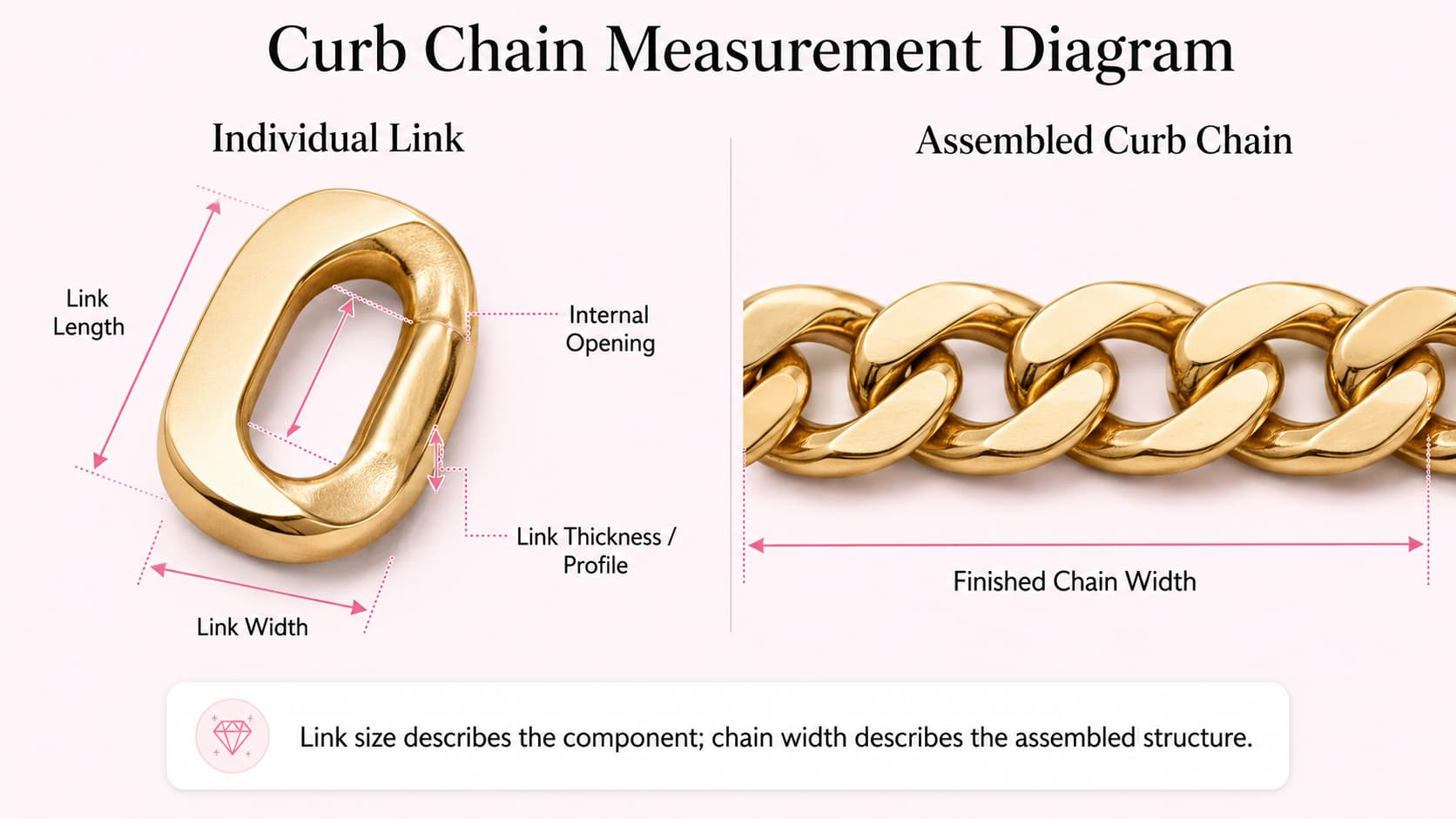
What Is the Difference Between Link Size and Chain Width?
Link size and finished chain width describe different objects.
Link size describes the dimensions of an individual chain component.
Finished chain width describes the width of the assembled curb chain in a defined condition.
| Measurement | Object Being Measured |
|---|---|
| Link length | Individual link |
| Link width | Individual link |
| Link thickness | Individual link profile |
| Internal opening | Usable space within an individual link |
| Finished chain width | Assembled chain |
| Bracelet length | Finished bracelet |
This distinction is important because curb links interact with neighboring links in the assembled structure.
The visual and physical width of that structure may therefore depend on more than a single isolated link dimension.
Bracelet length is another separate field. For finished length, fit and extender definitions, refer to the gold vermeil bracelet sizing guide.
Do not substitute one link measurement for the finished chain width unless the specification explicitly defines that relationship.
How Should Finished Chain Width Be Measured?
A chain-width value is useful only when the measurement condition is clear.
A specification may need to state:
- whether the chain is placed flat;
- the orientation of the links during measurement;
- the direction of the width measurement;
- whether connectors are excluded;
- whether charms are excluded;
- whether the measurement refers only to the chain section.
For example, a technical note might define the measurement as:
Finished chain width measured across the assembled curb chain in the specified flat orientation, excluding charms and closure hardware.
That is an example of documentation logic, not a fixed industry rule.
Different products may require different measurement conditions. The important requirement is consistency.
A chain-width value is useful only when the measurement condition is defined.
Why Does Link Geometry Matter for Charm Attachment?
Charm attachment is not only a charm-hardware decision.
It is an interface between at least two parts of the bracelet:
Receiving Chain Link → Connector → Charm
Potentially relevant factors can include:
- usable link opening;
- connector dimensions;
- link profile;
- connector profile;
- attachment direction;
- link orientation;
- neighboring chain links;
- intended movement;
- visual relationship between chain and charm.
A connector can be correctly specified as an individual component while still being unsuitable for a particular receiving link.
A charm connector should be specified against the actual receiving chain link, not as an isolated component.
How Can a Charm Be Attached to a Curb Chain?
A charm can be connected to a curb chain through different design structures. The correct method depends on the actual product specification, and no single structure should be treated as universally better.
Through a Defined Chain Link
Receiving Chain Link → Charm Attachment Component → Charm
The attachment specification may then define:
- link or station ID;
- charm ID;
- connector or attachment component;
- orientation;
- drawing reference.
Through a Separate Jump Ring
Curb Chain Link → Jump Ring → Charm
The chain-side interface may require checking:
- usable link opening;
- jump ring dimensions;
- jump ring orientation;
- charm-side connection;
- assembly method where applicable.
Detailed jump-ring specification belongs in the gold vermeil bracelet clasp and jump ring specifications. This article focuses on how that connector interfaces with the curb chain.
Through a Defined Connector Component
Curb Chain Link → Connector → Charm
The specification can then identify:
- connector geometry;
- receiving link;
- charm-side interface;
- orientation;
- attachment method where relevant.
The important point is not the naming of the connector. It is that all components in the interface are traceable in the drawing or specification.
How Should the Charm Attachment Link Be Identified?
A phrase such as “Attach charm to chain” does not identify where the charm belongs.
Even if the charm position is visually obvious in a rendering, the technical documentation should be able to identify the receiving chain position.
A simple identification system might use:
- link station numbers;
- chain position IDs;
- center reference;
- left and right station IDs;
- another controlled location system.
Center Charm CH1 — Receiving Link Station C1
Charm CH2 — Attachment Station L1
These are example documentation formats rather than fixed naming rules.
| Field | Requirement |
|---|---|
| Charm ID | |
| Receiving link / station | |
| Attachment component ID | |
| Attachment method | |
| Orientation | |
| Link opening reference | |
| Connector reference | |
| Drawing reference |
This allows the product-development team to distinguish where the charm belongs from how the charm connects.
How Do Chain Width and Charm Size Work Together?
Chain width and charm size influence the visual and physical relationship of the finished bracelet.
Important considerations may include:
- finished chain width;
- charm width;
- charm height;
- overall hanging size;
- connector size;
- charm movement;
- neighboring components;
- intended visual proportion.
A larger charm does not automatically require one specific chain width.
Likewise, a wider curb chain does not automatically require a larger charm.
Charm size and chain width should be reviewed together for the specific design, but there is no universal charm-to-chain width formula.
For the broader charm-layout specification, including charm size, spacing and exact placement, refer to the charm size, spacing and placement guide.
How Should Charm Attachment Be Coordinated With Placement?
Charm attachment and charm placement are related, but they are not the same specification question.
Charm placement asks:
Where should the charm appear within the bracelet layout?
Charm attachment asks:
How does that charm connect to the designated curb-chain position?
The placement document may identify:
Center Charm — Position C1
while the chain attachment document identifies:
Position C1 → Receiving Link L1 → Connector JR1 → Charm CH1
This makes it possible to coordinate design intent with the technical interface.
For detailed bracelet-level layout methods, use the charm size, spacing and placement guide.
How Should Curb Chain Orientation Be Documented?
Curb-chain orientation may matter when the link geometry affects:
- charm facing direction;
- connector movement;
- attachment access;
- visual plane of the bracelet;
- position of the charm relative to neighboring links.
If orientation affects the attachment, the drawing should show that orientation explicitly.
A specification might identify:
- chain face;
- top / bottom reference where relevant;
- receiving-link orientation;
- connector direction;
- charm-facing direction.
The exact terminology can vary by design.
If link orientation affects charm position or connector movement, orientation should be shown in the controlled drawing rather than left to visual interpretation.
How to Create a Curb Chain & Charm Attachment Map
A chain-and-attachment map turns the technical interface into a controlled sequence.
Curb Link L1 → Connector JR1 → Charm CH1
A bracelet with several charms might be documented as:
Link Station C1 → Center Charm CH1
Link Station L1 → Left Charm CH2
Link Station R1 → Right Charm CH3
These are example documentation structures. Actual chain geometry, attachment locations and component IDs should come from the specific bracelet design.
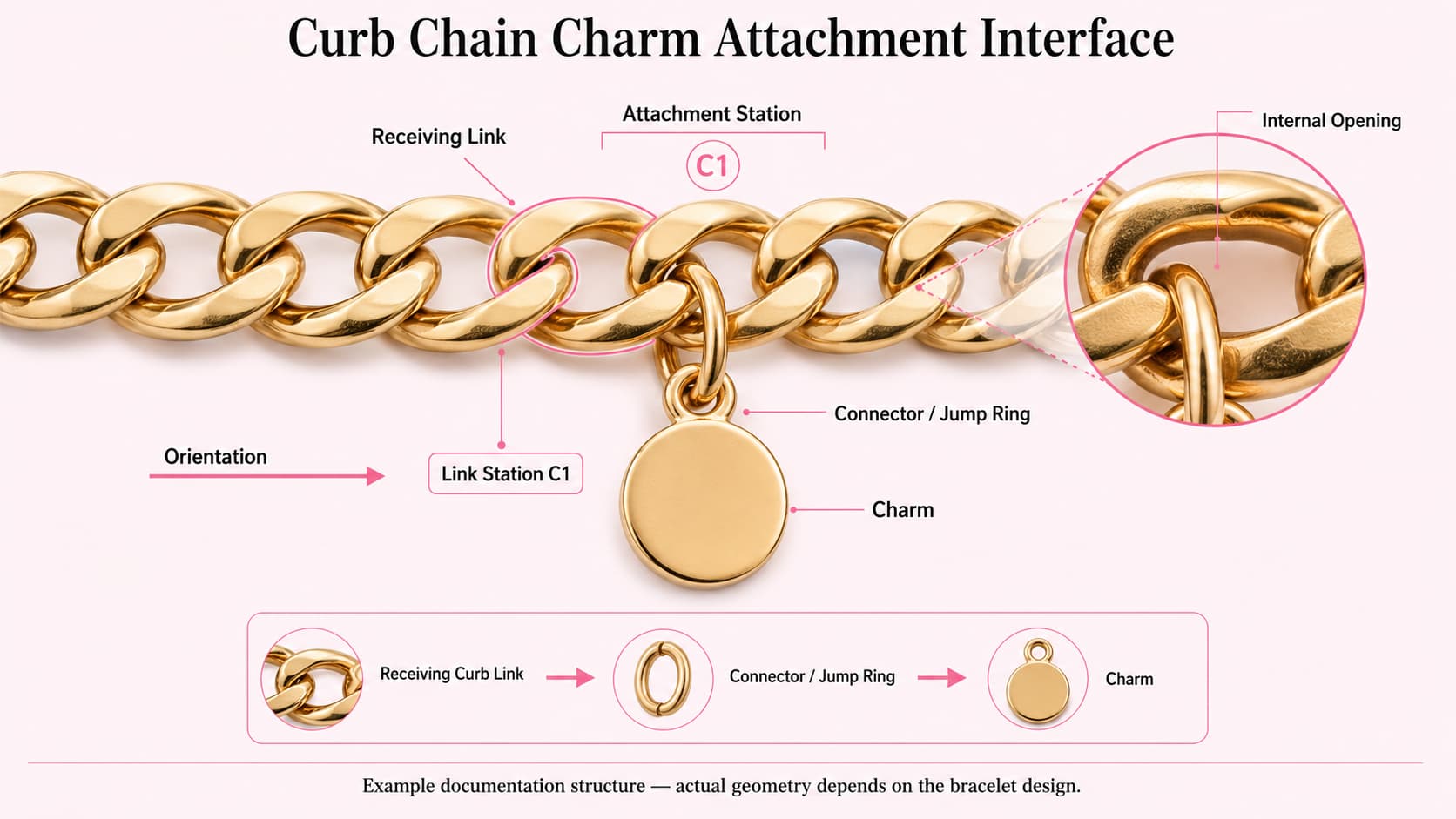
Curb Chain & Charm Attachment Map Template
| Field | Requirement |
|---|---|
| Product / SKU | |
| Chain specification version | |
| Drawing reference | |
| Link component reference | |
| Link length | |
| Link width | |
| Link thickness / profile | |
| Internal opening, if relevant | |
| Finished chain width | |
| Chain-width measurement condition | |
| Chain orientation | |
| Charm ID | |
| Attachment station | |
| Receiving link reference | |
| Connector ID | |
| Connector dimensions, if relevant | |
| Attachment method | |
| Connector orientation | |
| Charm orientation | |
| Additional notes |
Example Component Identification
| Component ID | Function |
|---|---|
| CL1 | Curb-chain link reference |
| C1 | Center attachment station |
| L1 | Left attachment station |
| R1 | Right attachment station |
| JR1 | Connector / jump ring reference |
| CH1 | Charm component |
The naming convention itself can vary. Consistency is more important than the exact letters or numbers used.
Common Curb Chain Specification Mistakes
Treating Link Size and Chain Width as the Same Measurement
An individual link and the assembled chain are different measurement objects. Record them separately when both are relevant.
Using Only a Chain Reference Photo
A photo can show the visual style of a curb chain, but it may not define:
- link length;
- link width;
- profile;
- internal opening;
- finished chain width.
Use visual references together with measurable specifications.
Recording Outer Link Size but Ignoring the Usable Opening
A large external link does not automatically guarantee enough usable internal space for a selected connector. If the opening affects attachment compatibility, document it.
Specifying the Charm Connector Without Checking the Receiving Link
A connector should be reviewed with the link it must engage. Check the actual chain-side interface rather than approving the connector only as an isolated component.
Writing “Attach Charm to Chain” Without a Defined Station
This instruction does not identify the receiving location. Use a controlled link or station reference when exact attachment position matters.
Leaving Chain Orientation Undefined
If the link position affects connector movement or charm-facing direction, define the orientation.
Repeating Placement Information Instead of Attachment Information
Charm placement and charm attachment should support each other without duplicating the same content.
Placement document:
Where?
Where?
Attachment specification:
Through which chain link and connector structure?
Through which chain link and connector structure?
Mixing Chain or Attachment Versions Across Drawings
If the chain dimensions, connector geometry or attachment station changes, update the relevant specification version. Do not rely on an old chain drawing together with a new charm attachment document.
Gold Vermeil Curb Chain Bracelet Specification Template
The following template can be used as a starting point for a custom curb-chain bracelet specification.
| Specification Field | Requirement |
|---|---|
| Product / Style | |
| SKU | |
| Chain specification version | |
| Drawing reference | |
| Curb-chain component reference | |
| Link length | |
| Link width | |
| Link thickness / profile | |
| Internal opening, if relevant | |
| Finished chain width | |
| Chain-width measurement condition | |
| Chain orientation | |
| Bracelet length reference | |
| Charm ID | |
| Charm attachment station | |
| Receiving link reference | |
| Connector component ID | |
| Connector dimensions, if relevant | |
| Connector orientation | |
| Attachment method, if applicable | |
| Charm orientation | |
| Charm placement reference | |
| Related hardware reference | |
| Additional notes |
Not every field will be necessary for every bracelet.
The goal is to turn a visual curb-chain bracelet concept into a specification that allows the chain and charm interface to be understood consistently across design, sourcing and production teams.
Final Gold Vermeil Curb Chain Bracelet Specification Checklist
Before finalizing the curb-chain portion of a custom bracelet specification, confirm the following items where applicable:
- Link component identified
- Link length defined
- Link width defined
- Link thickness or profile defined where relevant
- Internal opening defined where relevant
- Link measurement references defined
- Finished chain width defined
- Chain-width measurement condition defined
- Chain orientation documented where relevant
- Bracelet length kept separate from chain width
- Charm ID defined
- Charm attachment station identified
- Receiving chain link identified
- Connector component identified
- Connector dimensions defined where relevant
- Link-to-connector compatibility reviewed
- Attachment method defined where applicable
- Connector orientation defined
- Charm orientation defined where relevant
- Charm placement reference coordinated with the layout
- Drawing reference identified
- Specification version controlled
A good curb-chain bracelet specification does not need to make the product unnecessarily complicated. It needs to define the link geometry, assembled chain width and charm attachment interface clearly enough that the design does not depend on assumptions.
Frequently Asked Questions
What dimensions should be specified for a curb chain link?
For gold vermeil curb chain bracelet specifications, relevant link fields can include link length, link width, thickness or profile and the usable internal opening where attachment compatibility matters. The measurement reference should also be defined so different teams measure the same geometry consistently.
Is curb-chain link width the same as finished chain width?
Not necessarily. Link width describes an individual component, while finished chain width describes the assembled curb chain in a defined condition. They should be documented separately when both measurements are relevant.
Why does the internal link opening matter for charm attachment?
The usable internal opening can affect whether a jump ring or other connector can engage with the receiving curb-chain link. External link size alone may not describe the available attachment space.
How should a charm be attached to a curb chain bracelet?
The attachment structure should identify the receiving chain link or station, the connector component, the charm ID, orientation and the attachment method where relevant. The exact structure should be defined for the specific bracelet rather than assumed from a generic charm attachment method.
Can a jump ring be specified without checking the curb-chain link size?
The jump ring can have its own component specification, but its compatibility should be reviewed against the actual receiving chain link. Usable link opening, connector dimensions and orientation may all affect the interface.
How should a charm attachment station be documented?
Use a controlled link or station ID and match it to the charm and connector references. A drawing or attachment map can show which receiving chain position belongs to each charm.
Does a wider curb chain always require a larger charm?
No. There is no universal charm-to-chain width ratio. Chain width, charm size, connector geometry, movement and visual proportion should be reviewed together for the specific bracelet design.
Define Your Custom Gold Vermeil Curb Chain Bracelet Requirements
Link size, finished chain width and charm attachment should work together as one controlled technical system.
Brands developing custom pieces can review Zhefan Jewelry's gold vermeil bracelets and use the gold vermeil bracelet specification guide to organize the broader product requirements.
For bracelet length, fit and extender definitions, refer to the gold vermeil bracelet sizing guide. For clasp, jump ring and closure hardware details, use the gold vermeil bracelet clasp and jump ring specification guide. For charm dimensions, spacing and layout positions, use the gold vermeil charm bracelet design guide.
If your team has already defined the curb-link geometry, finished chain width, charm positions and connector concept, share your requirements with Zhefan Jewelry to discuss the custom production requirements for your project.
Share Your Curb Chain Bracelet Requirements
Recommended for you

What Is Gold Vermeil Jewelry? A Complete Guide for Brands and Retailers

Thick Gold Plated Jewelry Manufacturer for 925 Silver & Brass Jewelry

How to Choose a Gold Vermeil Jewelry Manufacturer

Gold Vermeil vs. Gold-Plated Jewelry: Which Fits Your Luxury Jewelry Brand?

Can Silver or Brass Be PVD Coated? A Professional Guide for Jewelry Brands

How to Make Bulk Jewelry Match the Approved Sample: A Production Control System for Jewelry Brands
Product Categories
Discuss Your Ideas with a Professional Custom Jewelry Manufacturer
We provide personalized jewelry customization services for clients worldwide.
Rest assured that your privacy is important to us, and all information provided will be handled with the utmost confidentiality.
By clicking 'Send Inquiry Now' I agree to ZHEFAN JEWELRY processing my personal data.
To see how to withdraw your consent, how to control your personal data and how we process it, please see our Privacy Policy and Terms of use.
From design to production, ZHEFAN JEWELRY offers a one-stop solution to help you enhance your brand value and market competitiveness.
Get A Quote
Contact
Tel: (+86) 188 1927 7817
© 2026 Zhefan Jewelry. All Rights Reserved.
Facebook
Instagram
YouTube
Whatsapp: +8618819277817